

278
Chemical Oceanography, 4th Edition
F 2 ′ = (V 0 + V){[H + ] SWS + [HSO 4
– ] + [HF] – [HCO 3
– ]}
(7.101)
F 1 ′ = (V 2 – V){([H + ]2 – K 1
* K 2
* )/(K 1
* [H + ] + 2 K 1
* K 2
* )} + (V 0 + V){[H + ] + [HSO 4
– ] + [HF]
– [B(OH) 4
– ] – [OH – ] × [H + ] 2 + K 1
* [H + ] + K 1
* K 2
* /N HCl (K 1
* [H + ] + 2 K 1
* K 2
* )}
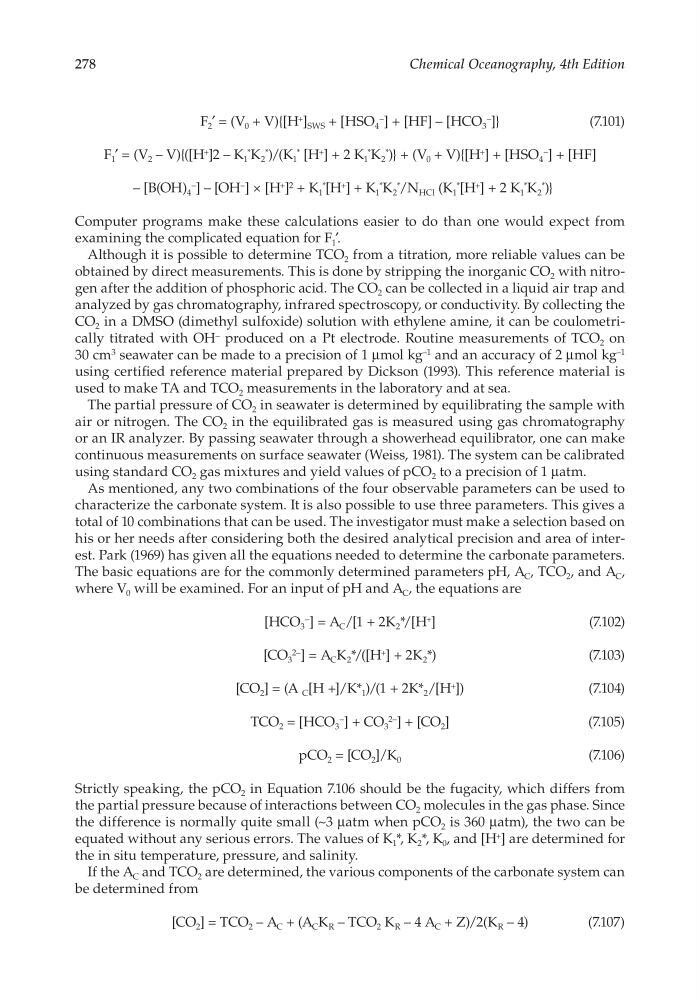
Computer programs make these calculations easier to do than one would expect from
examining the complicated equation for F 1 ′.
Although it is possible to determine TCO 2 from a titration, more reliable values can be
obtained by direct measurements. This is done by stripping the inorganic CO 2 with nitrogen after the addition of phosphoric acid. The CO 2 can be collected in a liquid air trap and
analyzed by gas chromatography, infrared spectroscopy, or conductivity. By collecting the
CO 2 in a DMSO (dimethyl sulfoxide) solution with ethylene amine, it can be coulometrically titrated with OH – produced on a Pt electrode. Routine measurements of TCO 2 on
30 cm 3 seawater can be made to a precision of 1 μmol kg –1 and an accuracy of 2 μmol kg –1
using certified reference material prepared by Dickson (1993). This reference material is
used to make TA and TCO 2 measurements in the laboratory and at sea.
The partial pressure of CO 2 in seawater is determined by equilibrating the sample with
air or nitrogen. The CO 2 in the equilibrated gas is measured using gas chromatography
or an IR analyzer. By passing seawater through a showerhead equilibrator, one can make
continuous measurements on surface seawater (Weiss, 1981). The system can be calibrated
using standard CO 2 gas mixtures and yield values of pCO 2 to a precision of 1 μatm.
As mentioned, any two combinations of the four observable parameters can be used to
characterize the carbonate system. It is also possible to use three parameters. This gives a
total of 10 combinations that can be used. The investigator must make a selection based on
his or her needs after considering both the desired analytical precision and area of interest. Park (1969) has given all the equations needed to determine the carbonate parameters.
The basic equations are for the commonly determined parameters pH, A C , TCO 2 , and A C ,
where V 0 will be examined. For an input of pH and A C , the equations are
[HCO 3
– ] = A C /[1 + 2K 2 */[H + ]
(7.102)
[CO 3
2– ] = A C K 2 */([H + ] + 2K 2 *)
(7.103)
[CO 2 ] = (A C [H +]/K* 1 )/(1 + 2K* 2 /[H + ])
(7.104)
TCO 2 = [HCO 3
– ] + CO 3
2– ] + [CO 2 ]
(7.105)
pCO 2 = [CO 2 ]/K 0
(7.106)
Strictly speaking, the pCO 2 in Equation 7.106 should be the fugacity, which differs from
the partial pressure because of interactions between CO 2 molecules in the gas phase. Since
the difference is normally quite small (~3 μatm when pCO 2 is 360 μatm), the two can be
equated without any serious errors. The values of K 1 *, K 2 *, K 0 , and [H + ] are determined for
the in situ temperature, pressure, and salinity.
If the A C and TCO 2 are determined, the various components of the carbonate system can
be determined from
[CO 2 ] = TCO 2 – A C + (A C K R – TCO 2 K R – 4 A C + Z)/2(K R – 4)
(7.107)
Chemical Oceanography, 4th Edition
F 2 ′ = (V 0 + V){[H + ] SWS + [HSO 4
– ] + [HF] – [HCO 3
– ]}
(7.101)
F 1 ′ = (V 2 – V){([H + ]2 – K 1
* K 2
* )/(K 1
* [H + ] + 2 K 1
* K 2
* )} + (V 0 + V){[H + ] + [HSO 4
– ] + [HF]
– [B(OH) 4
– ] – [OH – ] × [H + ] 2 + K 1
* [H + ] + K 1
* K 2
* /N HCl (K 1
* [H + ] + 2 K 1
* K 2
* )}
Computer programs make these calculations easier to do than one would expect from
examining the complicated equation for F 1 ′.
Although it is possible to determine TCO 2 from a titration, more reliable values can be
obtained by direct measurements. This is done by stripping the inorganic CO 2 with nitrogen after the addition of phosphoric acid. The CO 2 can be collected in a liquid air trap and
analyzed by gas chromatography, infrared spectroscopy, or conductivity. By collecting the
CO 2 in a DMSO (dimethyl sulfoxide) solution with ethylene amine, it can be coulometrically titrated with OH – produced on a Pt electrode. Routine measurements of TCO 2 on
30 cm 3 seawater can be made to a precision of 1 μmol kg –1 and an accuracy of 2 μmol kg –1
using certified reference material prepared by Dickson (1993). This reference material is
used to make TA and TCO 2 measurements in the laboratory and at sea.
The partial pressure of CO 2 in seawater is determined by equilibrating the sample with
air or nitrogen. The CO 2 in the equilibrated gas is measured using gas chromatography
or an IR analyzer. By passing seawater through a showerhead equilibrator, one can make
continuous measurements on surface seawater (Weiss, 1981). The system can be calibrated
using standard CO 2 gas mixtures and yield values of pCO 2 to a precision of 1 μatm.
As mentioned, any two combinations of the four observable parameters can be used to
characterize the carbonate system. It is also possible to use three parameters. This gives a
total of 10 combinations that can be used. The investigator must make a selection based on
his or her needs after considering both the desired analytical precision and area of interest. Park (1969) has given all the equations needed to determine the carbonate parameters.
The basic equations are for the commonly determined parameters pH, A C , TCO 2 , and A C ,
where V 0 will be examined. For an input of pH and A C , the equations are
[HCO 3
– ] = A C /[1 + 2K 2 */[H + ]
(7.102)
[CO 3
2– ] = A C K 2 */([H + ] + 2K 2 *)
(7.103)
[CO 2 ] = (A C [H +]/K* 1 )/(1 + 2K* 2 /[H + ])
(7.104)
TCO 2 = [HCO 3
– ] + CO 3
2– ] + [CO 2 ]
(7.105)
pCO 2 = [CO 2 ]/K 0
(7.106)
Strictly speaking, the pCO 2 in Equation 7.106 should be the fugacity, which differs from
the partial pressure because of interactions between CO 2 molecules in the gas phase. Since
the difference is normally quite small (~3 μatm when pCO 2 is 360 μatm), the two can be
equated without any serious errors. The values of K 1 *, K 2 *, K 0 , and [H + ] are determined for
the in situ temperature, pressure, and salinity.
If the A C and TCO 2 are determined, the various components of the carbonate system can
be determined from
[CO 2 ] = TCO 2 – A C + (A C K R – TCO 2 K R – 4 A C + Z)/2(K R – 4)
(7.107)