

9
Descriptive Oceanography
by higher rates of evaporation. The annual variation of salinity in the open oceans is 0.5,
while the values range from S = 33 to 37. Higher values occur in regions of high evaporation such as the Mediterranean (S = 39) and Red Seas (S = 41). Values as high as S = 300 can
be attained in closed lagoons during the summer in arid areas. The salinity of the North
Atlantic surface waters is higher (S = 37.3) than North Pacific waters (S = 35.5).
The higher salinity of the North Atlantic surface waters is important because it leads to
a higher density when the waters are colder. This in turn leads to the formation of deep
waters in the North Atlantic, but not in the North Pacific. The late Bruce Warren (Woods
Hole Oceanographic Institution) gave a clever answer to why the North Atlantic waters
have a higher salinity than the North Pacific. The higher salinity exists because evaporation rates are about twice as high in the North Atlantic. This overcomes the higher river
input into the Atlantic. The precipitation in both oceans is about the same. The lower evaporation rates in the North Pacific are due to the lower surface temperature. Cold waters
have a lower specific humidity, which reduces the evaporation. This thermal effect is due
to differences in the winds in the two oceans. In the Pacific, the maximum westerlies of the
40°S
4000
Depth [m]
3000
P16
2000
1000
0
20°S
EQ
Tpot-0[°C]
Pacific Ocean P16
20°N
40°N
20
25
30
15
10
5
0
Ocean Data View
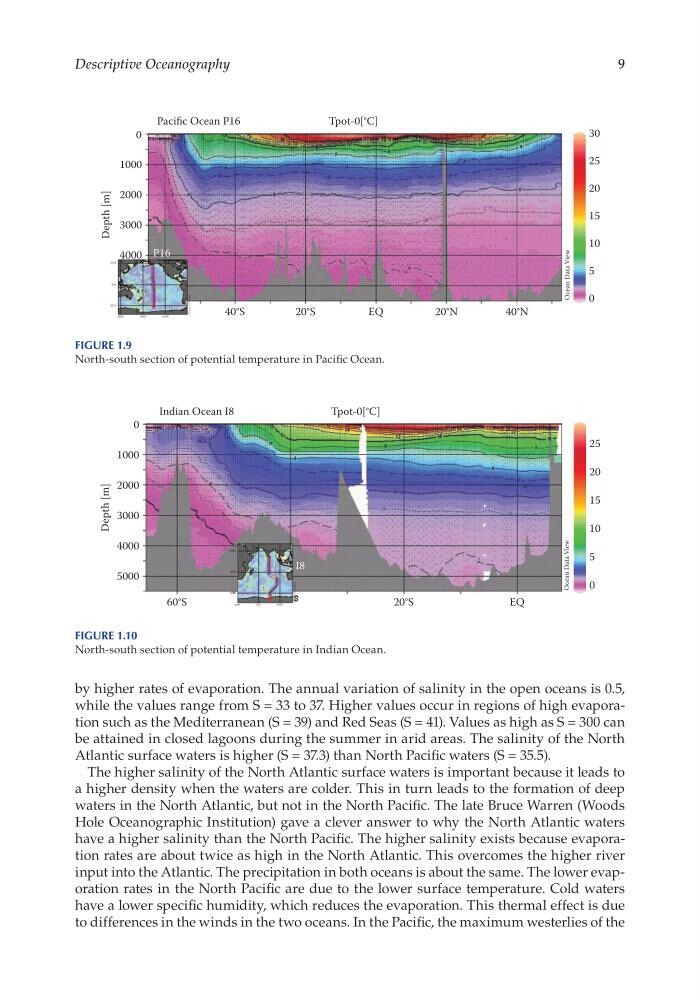
Figure 1.9
North- south section of potential temperature in Pacific Ocean.
60°S
4000
5000
Depth [m]
3000
I8
2000
1000
0
Tpot-0[°C]
Indian Ocean I8
20°S
EQ
20
25
15
10
5
0
Ocean Data View
Figure 1.10
North- south section of potential temperature in Indian Ocean.
Descriptive Oceanography
by higher rates of evaporation. The annual variation of salinity in the open oceans is 0.5,
while the values range from S = 33 to 37. Higher values occur in regions of high evaporation such as the Mediterranean (S = 39) and Red Seas (S = 41). Values as high as S = 300 can
be attained in closed lagoons during the summer in arid areas. The salinity of the North
Atlantic surface waters is higher (S = 37.3) than North Pacific waters (S = 35.5).
The higher salinity of the North Atlantic surface waters is important because it leads to
a higher density when the waters are colder. This in turn leads to the formation of deep
waters in the North Atlantic, but not in the North Pacific. The late Bruce Warren (Woods
Hole Oceanographic Institution) gave a clever answer to why the North Atlantic waters
have a higher salinity than the North Pacific. The higher salinity exists because evaporation rates are about twice as high in the North Atlantic. This overcomes the higher river
input into the Atlantic. The precipitation in both oceans is about the same. The lower evaporation rates in the North Pacific are due to the lower surface temperature. Cold waters
have a lower specific humidity, which reduces the evaporation. This thermal effect is due
to differences in the winds in the two oceans. In the Pacific, the maximum westerlies of the
40°S
4000
Depth [m]
3000
P16
2000
1000
0
20°S
EQ
Tpot-0[°C]
Pacific Ocean P16
20°N
40°N
20
25
30
15
10
5
0
Ocean Data View
Figure 1.9
North- south section of potential temperature in Pacific Ocean.
60°S
4000
5000
Depth [m]
3000
I8
2000
1000
0
Tpot-0[°C]
Indian Ocean I8
20°S
EQ
20
25
15
10
5
0
Ocean Data View
Figure 1.10
North- south section of potential temperature in Indian Ocean.