

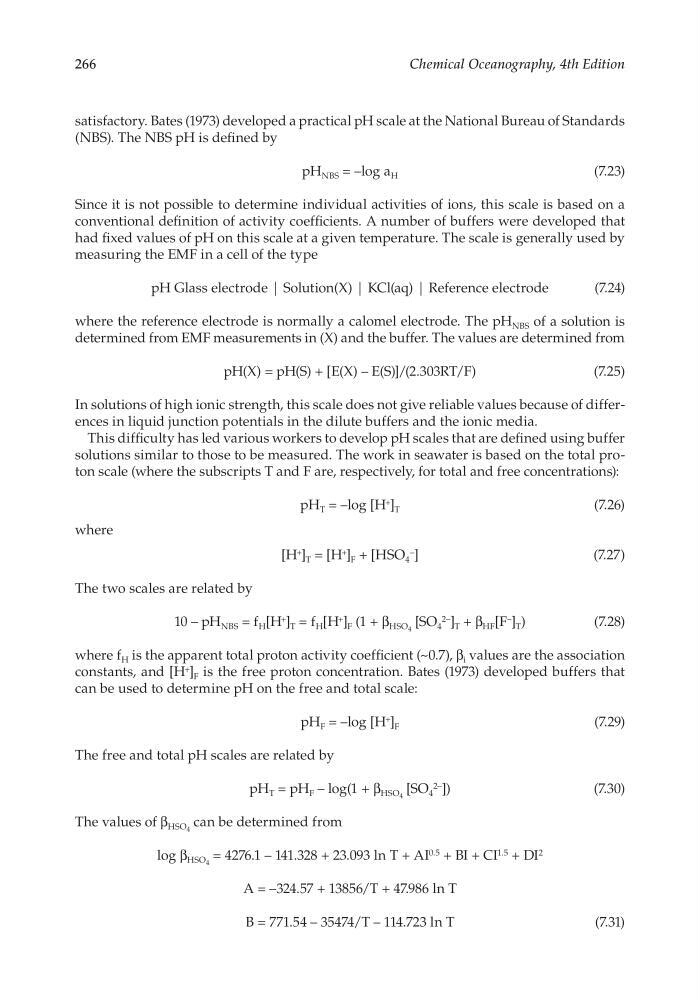
266
Chemical Oceanography, 4th Edition
satisfactory. Bates (1973) developed a practical pH scale at the National Bureau of Standards
(NBS). The NBS pH is defined by
pH NBS = –log a H
(7.23)
Since it is not possible to determine individual activities of ions, this scale is based on a
conventional definition of activity coefficients. A number of buffers were developed that
had fixed values of pH on this scale at a given temperature. The scale is generally used by
measuring the EMF in a cell of the type
pH Glass electrode | Solution(X) | KCl(aq) | Reference electrode
(7.24)
where the reference electrode is normally a calomel electrode. The pH NBS of a solution is
determined from EMF measurements in (X) and the buffer. The values are determined from
pH(X) = pH(S) + [E(X) – E(S)]/(2.303RT/ F)
(7.25)
In solutions of high ionic strength, this scale does not give reliable values because of differences in liquid junction potentials in the dilute buffers and the ionic media.
This difficulty has led various workers to develop pH scales that are defined using buffer
solutions similar to those to be measured. The work in seawater is based on the total proton scale (where the subscripts T and F are, respectively, for total and free concentrations):
pH T = –log [H + ] T
(7.26)
where
[H + ] T = [H + ] F + [HSO 4
– ]
(7.27)
The two scales are related by
10 – pH NBS = f H [H + ] T = f H [H + ] F (1 + β HSO 4 [SO 4
2– ] T + β HF [F – ] T )
(7.28)
where f H is the apparent total proton activity coefficient (~0.7), β i values are the association
constants, and [H + ] F is the free proton concentration. Bates (1973) developed buffers that
can be used to determine pH on the free and total scale:
pH F = –log [H + ] F
(7.29)
The free and total pH scales are related by
pH T = pH F – log(1 + β HSO 4 [SO 4
2– ])
(7.30)
The values of β HSO 4 can be determined from
log β HSO 4 = 4276.1 – 141.328 + 23.093 ln T + AI 0.5 + BI + CI 1.5 + DI 2
A = –324.57 + 13856/T + 47.986 ln T
B = 771.54 – 35474/T – 114.723 ln T
(7.31)
Chemical Oceanography, 4th Edition
satisfactory. Bates (1973) developed a practical pH scale at the National Bureau of Standards
(NBS). The NBS pH is defined by
pH NBS = –log a H
(7.23)
Since it is not possible to determine individual activities of ions, this scale is based on a
conventional definition of activity coefficients. A number of buffers were developed that
had fixed values of pH on this scale at a given temperature. The scale is generally used by
measuring the EMF in a cell of the type
pH Glass electrode | Solution(X) | KCl(aq) | Reference electrode
(7.24)
where the reference electrode is normally a calomel electrode. The pH NBS of a solution is
determined from EMF measurements in (X) and the buffer. The values are determined from
pH(X) = pH(S) + [E(X) – E(S)]/(2.303RT/ F)
(7.25)
In solutions of high ionic strength, this scale does not give reliable values because of differences in liquid junction potentials in the dilute buffers and the ionic media.
This difficulty has led various workers to develop pH scales that are defined using buffer
solutions similar to those to be measured. The work in seawater is based on the total proton scale (where the subscripts T and F are, respectively, for total and free concentrations):
pH T = –log [H + ] T
(7.26)
where
[H + ] T = [H + ] F + [HSO 4
– ]
(7.27)
The two scales are related by
10 – pH NBS = f H [H + ] T = f H [H + ] F (1 + β HSO 4 [SO 4
2– ] T + β HF [F – ] T )
(7.28)
where f H is the apparent total proton activity coefficient (~0.7), β i values are the association
constants, and [H + ] F is the free proton concentration. Bates (1973) developed buffers that
can be used to determine pH on the free and total scale:
pH F = –log [H + ] F
(7.29)
The free and total pH scales are related by
pH T = pH F – log(1 + β HSO 4 [SO 4
2– ])
(7.30)
The values of β HSO 4 can be determined from
log β HSO 4 = 4276.1 – 141.328 + 23.093 ln T + AI 0.5 + BI + CI 1.5 + DI 2
A = –324.57 + 13856/T + 47.986 ln T
B = 771.54 – 35474/T – 114.723 ln T
(7.31)