

265
The Carbonate System
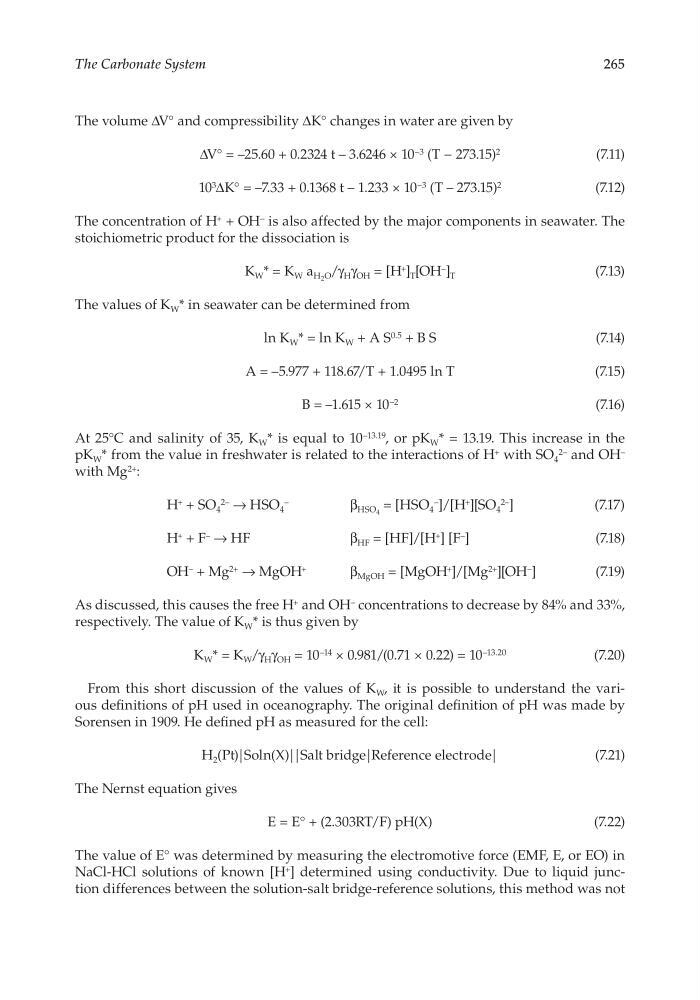
The volume ΔV° and compressibility ΔK° changes in water are given by
ΔV° = –25.60 + 0.2324 t – 3.6246 × 10 –3 (T − 273.15) 2
(7.11)
10 3 ΔK° = –7.33 + 0.1368 t – 1.233 × 10 –3 (T – 273.15) 2
(7.12)
The concentration of H + + OH – is also affected by the major components in seawater. The
stoichiometric product for the dissociation is
K W * = K W a H 2 O / γ H γ OH = [H + ] T [OH – ] T
(7.13)
The values of K W * in seawater can be determined from
ln K W * = ln K W + A S 0.5 + B S
(7.14)
A = –5.977 + 118.67/T + 1.0495 ln T
(7.15)
B = –1.615 × 10 –2
(7.16)
At 25°C and salinity of 35, K W * is equal to 10 –13.19 , or pK W * = 13.19. This increase in the
pK W * from the value in freshwater is related to the interactions of H + with SO 4
2– and OH –
with Mg 2+ :
H + + SO 4
2– → HSO 4
–
β HSO 4 = [HSO 4
– ]/[H + ][SO 4
2– ]
(7.17)
H + + F – → HF
β HF = [HF]/[H + ] [F – ]
(7.18)
OH – + Mg 2+ → MgOH +
β MgOH = [MgOH + ]/[Mg 2+ ][OH – ]
(7.19)
As discussed, this causes the free H + and OH – concentrations to decrease by 84% and 33%,
respectively. The value of K W * is thus given by
K W * = K W / γ H γ OH = 10 –14 × 0.981/(0.71 × 0.22) = 10 –13.20
(7.20)
From this short discussion of the values of K W , it is possible to understand the various definitions of pH used in oceanography. The original definition of pH was made by
Sorensen in 1909. He defined pH as measured for the cell:
H 2 (Pt)|Soln(X)||Salt bridge|Reference electrode|
(7.21)
The Nernst equation gives
E = E° + (2.303RT/ F) pH(X)
(7.22)
The value of E° was determined by measuring the electromotive force (EMF, E, or EO) in
NaCl- HCl solutions of known [H + ] determined using conductivity. Due to liquid junction differences between the solution- salt bridge- reference solutions, this method was not
The Carbonate System
The volume ΔV° and compressibility ΔK° changes in water are given by
ΔV° = –25.60 + 0.2324 t – 3.6246 × 10 –3 (T − 273.15) 2
(7.11)
10 3 ΔK° = –7.33 + 0.1368 t – 1.233 × 10 –3 (T – 273.15) 2
(7.12)
The concentration of H + + OH – is also affected by the major components in seawater. The
stoichiometric product for the dissociation is
K W * = K W a H 2 O / γ H γ OH = [H + ] T [OH – ] T
(7.13)
The values of K W * in seawater can be determined from
ln K W * = ln K W + A S 0.5 + B S
(7.14)
A = –5.977 + 118.67/T + 1.0495 ln T
(7.15)
B = –1.615 × 10 –2
(7.16)
At 25°C and salinity of 35, K W * is equal to 10 –13.19 , or pK W * = 13.19. This increase in the
pK W * from the value in freshwater is related to the interactions of H + with SO 4
2– and OH –
with Mg 2+ :
H + + SO 4
2– → HSO 4
–
β HSO 4 = [HSO 4
– ]/[H + ][SO 4
2– ]
(7.17)
H + + F – → HF
β HF = [HF]/[H + ] [F – ]
(7.18)
OH – + Mg 2+ → MgOH +
β MgOH = [MgOH + ]/[Mg 2+ ][OH – ]
(7.19)
As discussed, this causes the free H + and OH – concentrations to decrease by 84% and 33%,
respectively. The value of K W * is thus given by
K W * = K W / γ H γ OH = 10 –14 × 0.981/(0.71 × 0.22) = 10 –13.20
(7.20)
From this short discussion of the values of K W , it is possible to understand the various definitions of pH used in oceanography. The original definition of pH was made by
Sorensen in 1909. He defined pH as measured for the cell:
H 2 (Pt)|Soln(X)||Salt bridge|Reference electrode|
(7.21)
The Nernst equation gives
E = E° + (2.303RT/ F) pH(X)
(7.22)
The value of E° was determined by measuring the electromotive force (EMF, E, or EO) in
NaCl- HCl solutions of known [H + ] determined using conductivity. Due to liquid junction differences between the solution- salt bridge- reference solutions, this method was not