

6
Chemical Oceanography, 4th Edition
waters vary from –2°C (close to the freezing point) in polar regions to 28°C near the equator, although the temperature in confined areas can be as high as 40°C. The annual variations of temperature are about 2°C at the equator and poles, 8°C at 40° N or S, and as high
as 15°C in coastal surface waters. The diurnal temperature variations are about 0.3°C in the
open oceans and 2 to 3°C in shallow waters.
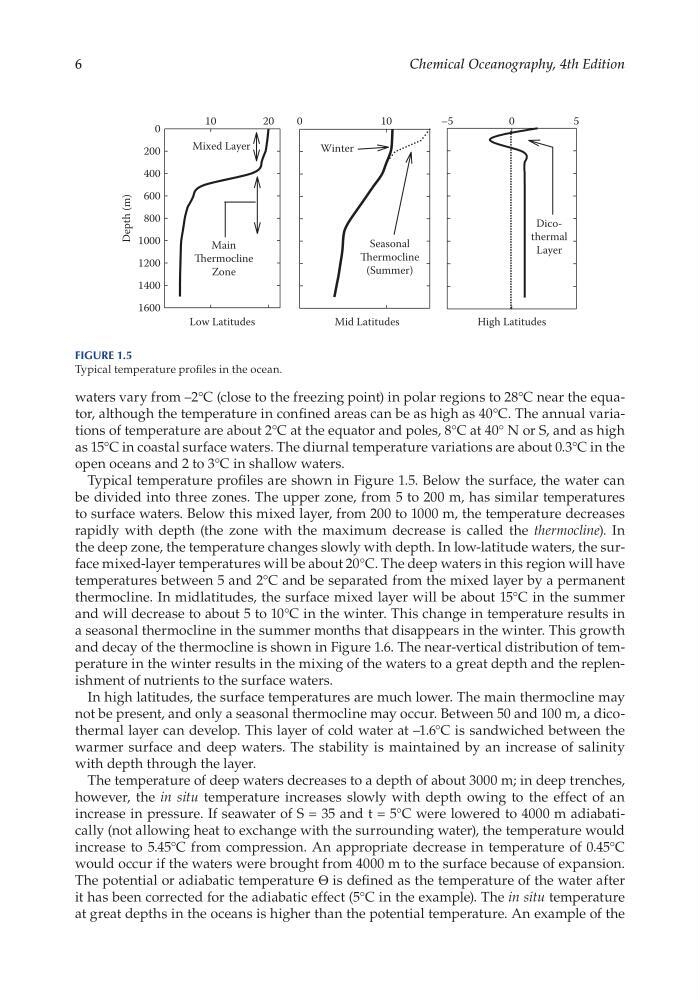
Typical temperature profiles are shown in Figure 1.5. Below the surface, the water can
be divided into three zones. The upper zone, from 5 to 200 m, has similar temperatures
to surface waters. Below this mixed layer, from 200 to 1000 m, the temperature decreases
rapidly with depth (the zone with the maximum decrease is called the thermocline). In
the deep zone, the temperature changes slowly with depth. In low- latitude waters, the surface mixed- layer temperatures will be about 20°C. The deep waters in this region will have
temperatures between 5 and 2°C and be separated from the mixed layer by a permanent
thermocline. In midlatitudes, the surface mixed layer will be about 15°C in the summer
and will decrease to about 5 to 10°C in the winter. This change in temperature results in
a seasonal thermocline in the summer months that disappears in the winter. This growth
and decay of the thermocline is shown in Figure 1.6. The near- vertical distribution of temperature in the winter results in the mixing of the waters to a great depth and the replenishment of nutrients to the surface waters.
In high latitudes, the surface temperatures are much lower. The main thermocline may
not be present, and only a seasonal thermocline may occur. Between 50 and 100 m, a dicothermal layer can develop. This layer of cold water at –1.6°C is sandwiched between the
warmer surface and deep waters. The stability is maintained by an increase of salinity
with depth through the layer.
The temperature of deep waters decreases to a depth of about 3000 m; in deep trenches,
however, the in situ temperature increases slowly with depth owing to the effect of an
increase in pressure. If seawater of S = 35 and t = 5°C were lowered to 4000 m adiabatically (not allowing heat to exchange with the surrounding water), the temperature would
increase to 5.45°C from compression. An appropriate decrease in temperature of 0.45°C
would occur if the waters were brought from 4000 m to the surface because of expansion.
The potential or adiabatic temperature Θ is defined as the temperature of the water after
it has been corrected for the adiabatic effect (5°C in the example). The in situ temperature
at great depths in the oceans is higher than the potential temperature. An example of the
Low Latitudes
10
20
Depth (m)
0
200
400
600
800
1000
1200
1400
1600
Mid Latitudes
0
10
High Latitudes
–5
0
5
Mixed Layer
Main
ermocline
Zone
Winter
Seasonal
ermocline
(Summer)
Dicothermal
Layer
Figure 1.5
Typical temperature profiles in the ocean.
Chemical Oceanography, 4th Edition
waters vary from –2°C (close to the freezing point) in polar regions to 28°C near the equator, although the temperature in confined areas can be as high as 40°C. The annual variations of temperature are about 2°C at the equator and poles, 8°C at 40° N or S, and as high
as 15°C in coastal surface waters. The diurnal temperature variations are about 0.3°C in the
open oceans and 2 to 3°C in shallow waters.
Typical temperature profiles are shown in Figure 1.5. Below the surface, the water can
be divided into three zones. The upper zone, from 5 to 200 m, has similar temperatures
to surface waters. Below this mixed layer, from 200 to 1000 m, the temperature decreases
rapidly with depth (the zone with the maximum decrease is called the thermocline). In
the deep zone, the temperature changes slowly with depth. In low- latitude waters, the surface mixed- layer temperatures will be about 20°C. The deep waters in this region will have
temperatures between 5 and 2°C and be separated from the mixed layer by a permanent
thermocline. In midlatitudes, the surface mixed layer will be about 15°C in the summer
and will decrease to about 5 to 10°C in the winter. This change in temperature results in
a seasonal thermocline in the summer months that disappears in the winter. This growth
and decay of the thermocline is shown in Figure 1.6. The near- vertical distribution of temperature in the winter results in the mixing of the waters to a great depth and the replenishment of nutrients to the surface waters.
In high latitudes, the surface temperatures are much lower. The main thermocline may
not be present, and only a seasonal thermocline may occur. Between 50 and 100 m, a dicothermal layer can develop. This layer of cold water at –1.6°C is sandwiched between the
warmer surface and deep waters. The stability is maintained by an increase of salinity
with depth through the layer.
The temperature of deep waters decreases to a depth of about 3000 m; in deep trenches,
however, the in situ temperature increases slowly with depth owing to the effect of an
increase in pressure. If seawater of S = 35 and t = 5°C were lowered to 4000 m adiabatically (not allowing heat to exchange with the surrounding water), the temperature would
increase to 5.45°C from compression. An appropriate decrease in temperature of 0.45°C
would occur if the waters were brought from 4000 m to the surface because of expansion.
The potential or adiabatic temperature Θ is defined as the temperature of the water after
it has been corrected for the adiabatic effect (5°C in the example). The in situ temperature
at great depths in the oceans is higher than the potential temperature. An example of the
Low Latitudes
10
20
Depth (m)
0
200
400
600
800
1000
1200
1400
1600
Mid Latitudes
0
10
High Latitudes
–5
0
5
Mixed Layer
Main
ermocline
Zone
Winter
Seasonal
ermocline
(Summer)
Dicothermal
Layer
Figure 1.5
Typical temperature profiles in the ocean.