

233
Dissolved Gases Other than CO 2
where A is the interfacial area, C i is the concentration of species i, t is the time, D i is the
diffusion coefficient or diffusivity of species i, and dC/ dz is the gradient (z is the vertical
distance). If this equation is combined with Henry’s law (P i = k i C i ), we have
dC i / dt = (A D i / τ k i )[P i (gas) – P i (soln)]
(6.21)
where k i is the Henry’s law constant. This model assumes that the flux of the gas across
the air–sea interface is directly proportional to the diffusion coefficient and inversely
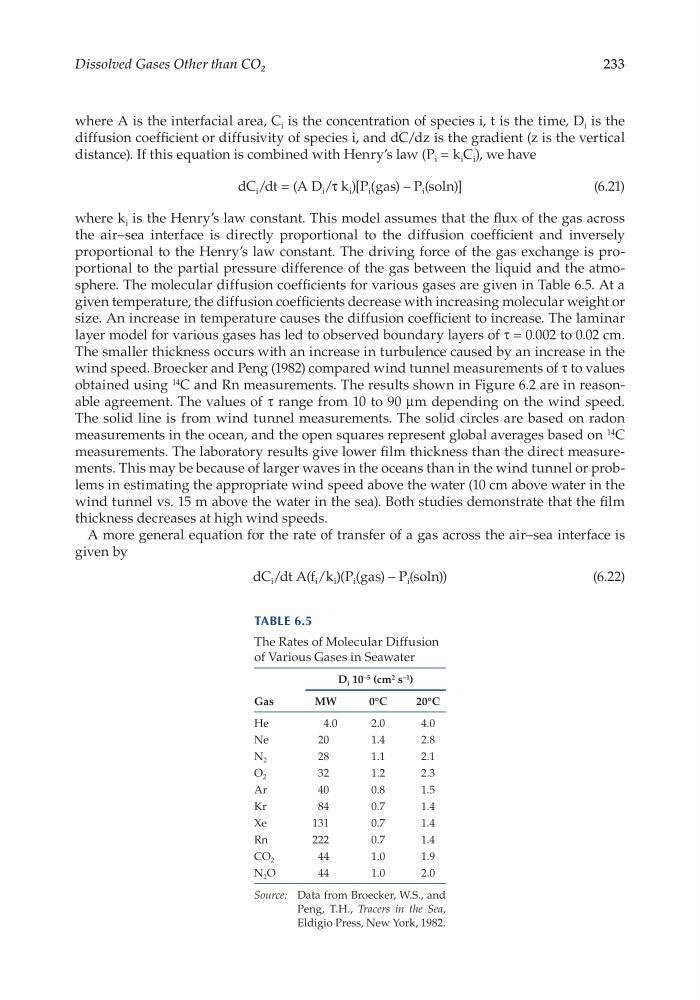
proportional to the Henry’s law constant. The driving force of the gas exchange is proportional to the partial pressure difference of the gas between the liquid and the atmosphere. The molecular diffusion coefficients for various gases are given in Table 6.5. At a
given temperature, the diffusion coefficients decrease with increasing molecular weight or
size. An increase in temperature causes the diffusion coefficient to increase. The laminar
layer model for various gases has led to observed boundary layers of τ = 0.002 to 0.02 cm.
The smaller thickness occurs with an increase in turbulence caused by an increase in the
wind speed. Broecker and Peng (1982) compared wind tunnel measurements of τ to values
obtained using 14 C and Rn measurements. The results shown in Figure 6.2 are in reasonable agreement. The values of τ range from 10 to 90 μm depending on the wind speed.
The solid line is from wind tunnel measurements. The solid circles are based on radon
measurements in the ocean, and the open squares represent global averages based on 14 C
measurements. The laboratory results give lower film thickness than the direct measurements. This may be because of larger waves in the oceans than in the wind tunnel or problems in estimating the appropriate wind speed above the water (10 cm above water in the
wind tunnel vs. 15 m above the water in the sea). Both studies demonstrate that the film
thickness decreases at high wind speeds.
A more general equation for the rate of transfer of a gas across the air–sea interface is
given by
dC i / dt A(f i / k i )(P i (gas) – P i (soln))
(6.22)
Table 6.5
The Rates of Molecular Diffusion
of Various Gases in Seawater
Gas
D i 10 –5 (cm 2 s –1 )
MW
0°C
20°C
He
4.0
2.0
4.0
Ne
20
1.4
2.8
N 2
28
1.1
2.1
O 2
32
1.2
2.3
Ar
40
0.8
1.5
Kr
84
0.7
1.4
Xe
131
0.7
1.4
Rn
222
0.7
1.4
CO 2
44
1.0
1.9
N 2 O
44
1.0
2.0
Source: Data from Broecker, W.S., and
Peng, T.H., Tracers in the Sea,
Eldigio Press, New York, 1982.
Dissolved Gases Other than CO 2
where A is the interfacial area, C i is the concentration of species i, t is the time, D i is the
diffusion coefficient or diffusivity of species i, and dC/ dz is the gradient (z is the vertical
distance). If this equation is combined with Henry’s law (P i = k i C i ), we have
dC i / dt = (A D i / τ k i )[P i (gas) – P i (soln)]
(6.21)
where k i is the Henry’s law constant. This model assumes that the flux of the gas across
the air–sea interface is directly proportional to the diffusion coefficient and inversely
proportional to the Henry’s law constant. The driving force of the gas exchange is proportional to the partial pressure difference of the gas between the liquid and the atmosphere. The molecular diffusion coefficients for various gases are given in Table 6.5. At a
given temperature, the diffusion coefficients decrease with increasing molecular weight or
size. An increase in temperature causes the diffusion coefficient to increase. The laminar
layer model for various gases has led to observed boundary layers of τ = 0.002 to 0.02 cm.
The smaller thickness occurs with an increase in turbulence caused by an increase in the
wind speed. Broecker and Peng (1982) compared wind tunnel measurements of τ to values
obtained using 14 C and Rn measurements. The results shown in Figure 6.2 are in reasonable agreement. The values of τ range from 10 to 90 μm depending on the wind speed.
The solid line is from wind tunnel measurements. The solid circles are based on radon
measurements in the ocean, and the open squares represent global averages based on 14 C
measurements. The laboratory results give lower film thickness than the direct measurements. This may be because of larger waves in the oceans than in the wind tunnel or problems in estimating the appropriate wind speed above the water (10 cm above water in the
wind tunnel vs. 15 m above the water in the sea). Both studies demonstrate that the film
thickness decreases at high wind speeds.
A more general equation for the rate of transfer of a gas across the air–sea interface is
given by
dC i / dt A(f i / k i )(P i (gas) – P i (soln))
(6.22)
Table 6.5
The Rates of Molecular Diffusion
of Various Gases in Seawater
Gas
D i 10 –5 (cm 2 s –1 )
MW
0°C
20°C
He
4.0
2.0
4.0
Ne
20
1.4
2.8
N 2
28
1.1
2.1
O 2
32
1.2
2.3
Ar
40
0.8
1.5
Kr
84
0.7
1.4
Xe
131
0.7
1.4
Rn
222
0.7
1.4
CO 2
44
1.0
1.9
N 2 O
44
1.0
2.0
Source: Data from Broecker, W.S., and
Peng, T.H., Tracers in the Sea,
Eldigio Press, New York, 1982.