

232
Chemical Oceanography, 4th Edition
solubility with respect to temperature and salinity (Kester, 1975). The solubility for O 2 has
been replaced by the measurements of Benson and Krause (1984):
ln C = –135.29996 + 1.572288 × 10 5 /T – 6.637149 × 10 7 /T 2 + 1.243678 × 10 10 /T 3
– 8.621061 × 10 11 /T 4 – S(0.020573 – 12.142/T + 2,363.1/T 2 )
(6.19)
6.4 Air–Sea Exchange
Most of the gases in seawater originate from three sources: (a) the earth’s atmosphere,
(b) volcanic activity beneath the sea, and (c) chemical processes occurring in the sea
(biological- photosynthesis and decomposition of organic matter, physical- radioactive
decay). One of the most useful assumptions concerning the solubility of gases is that at
one time, every parcel water was at the sea surface and at that time became equilibrated
(or nearly so) with the atmospheric gases. In the course of oceanic circulation, the unreactive gases are distributed throughout the water column by advection and diffusion.
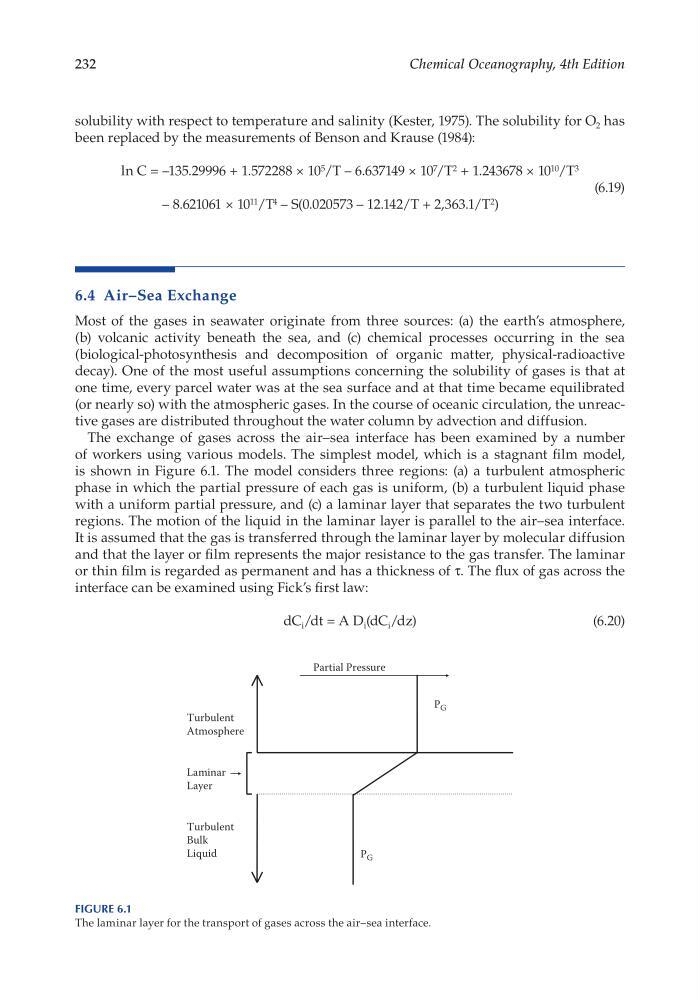
The exchange of gases across the air–sea interface has been examined by a number
of workers using various models. The simplest model, which is a stagnant film model,
is shown in Figure 6.1. The model considers three regions: (a) a turbulent atmospheric
phase in which the partial pressure of each gas is uniform, (b) a turbulent liquid phase
with a uniform partial pressure, and (c) a laminar layer that separates the two turbulent
regions. The motion of the liquid in the laminar layer is parallel to the air–sea interface.
It is assumed that the gas is transferred through the laminar layer by molecular diffusion
and that the layer or film represents the major resistance to the gas transfer. The laminar
or thin film is regarded as permanent and has a thickness of τ. The flux of gas across the
interface can be examined using Fick’s first law:
dC i / dt = A D i (dC i / dz)
(6.20)
Partial Pressure
P G
Turbulent
Atmosphere
Laminar
Layer
Turbulent
Bulk
Liquid
P G
Figure 6.1
The laminar layer for the transport of gases across the air–sea interface.
Chemical Oceanography, 4th Edition
solubility with respect to temperature and salinity (Kester, 1975). The solubility for O 2 has
been replaced by the measurements of Benson and Krause (1984):
ln C = –135.29996 + 1.572288 × 10 5 /T – 6.637149 × 10 7 /T 2 + 1.243678 × 10 10 /T 3
– 8.621061 × 10 11 /T 4 – S(0.020573 – 12.142/T + 2,363.1/T 2 )
(6.19)
6.4 Air–Sea Exchange
Most of the gases in seawater originate from three sources: (a) the earth’s atmosphere,
(b) volcanic activity beneath the sea, and (c) chemical processes occurring in the sea
(biological- photosynthesis and decomposition of organic matter, physical- radioactive
decay). One of the most useful assumptions concerning the solubility of gases is that at
one time, every parcel water was at the sea surface and at that time became equilibrated
(or nearly so) with the atmospheric gases. In the course of oceanic circulation, the unreactive gases are distributed throughout the water column by advection and diffusion.
The exchange of gases across the air–sea interface has been examined by a number
of workers using various models. The simplest model, which is a stagnant film model,
is shown in Figure 6.1. The model considers three regions: (a) a turbulent atmospheric
phase in which the partial pressure of each gas is uniform, (b) a turbulent liquid phase
with a uniform partial pressure, and (c) a laminar layer that separates the two turbulent
regions. The motion of the liquid in the laminar layer is parallel to the air–sea interface.
It is assumed that the gas is transferred through the laminar layer by molecular diffusion
and that the layer or film represents the major resistance to the gas transfer. The laminar
or thin film is regarded as permanent and has a thickness of τ. The flux of gas across the
interface can be examined using Fick’s first law:
dC i / dt = A D i (dC i / dz)
(6.20)
Partial Pressure
P G
Turbulent
Atmosphere
Laminar
Layer
Turbulent
Bulk
Liquid
P G
Figure 6.1
The laminar layer for the transport of gases across the air–sea interface.