

4
Chemical Oceanography, 4th Edition
and has a depth between 3 and 6 km. This area is not completely flat but is characterized
by welts, furrows, swells, and basins.
The bottom sediments contain material both formed in the sea (pelagic) and brought
from the land by rivers and the atmosphere (nonpelagic). The components of sediments
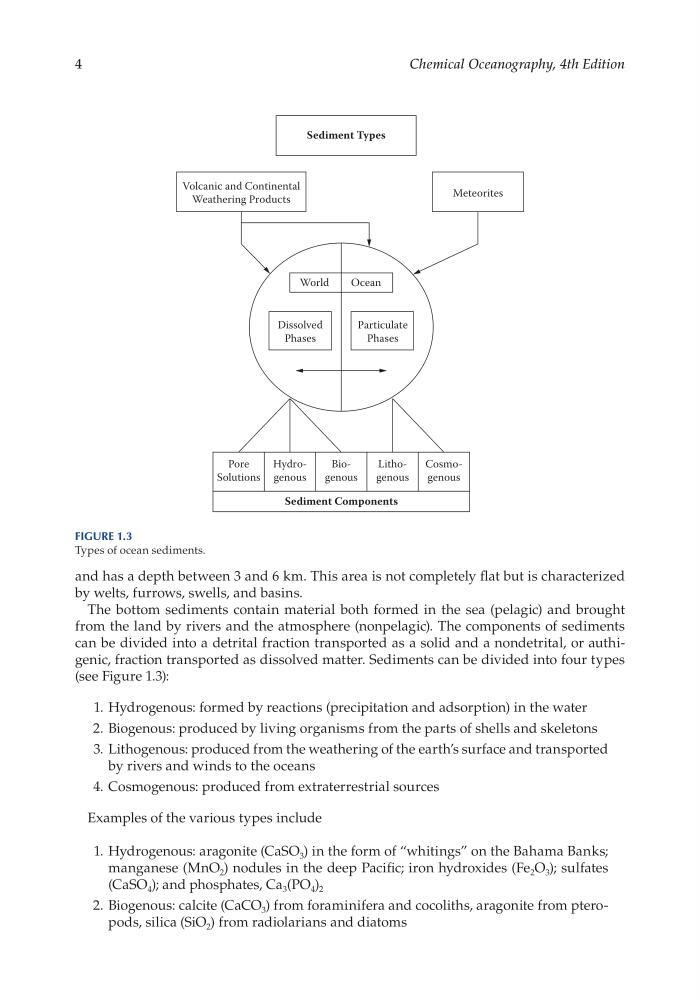
can be divided into a detrital fraction transported as a solid and a nondetrital, or authigenic, fraction transported as dissolved matter. Sediments can be divided into four types
(see Figure 1.3):
1. Hydrogenous: formed by reactions (precipitation and adsorption) in the water
2. Biogenous: produced by living organisms from the parts of shells and skeletons
3. Lithogenous: produced from the weathering of the earth’s surface and transported
by rivers and winds to the oceans
4. Cosmogenous: produced from extraterrestrial sources
Examples of the various types include
1. Hydrogenous: aragonite (CaSO 3 ) in the form of “whitings” on the Bahama Banks;
manganese (MnO 2 ) nodules in the deep Pacific; iron hydroxides (Fe 2 O 3 ); sulfates
(CaSO 4 ); and phosphates, Ca 3 (PO 4 ) 2
2. Biogenous: calcite (CaCO 3 ) from foraminifera and cocoliths, aragonite from pteropods, silica (SiO 2 ) from radiolarians and diatoms
Volcanic and Continental
Weathering Products
World
Dissolved
Phases
Pore
Solutions
Biogenous
Hydrogenous
Lithogenous
Cosmogenous
Particulate
Phases
Ocean
Meteorites
Sediment Types
Sediment Components
Figure 1.3
Types of ocean sediments.
Chemical Oceanography, 4th Edition
and has a depth between 3 and 6 km. This area is not completely flat but is characterized
by welts, furrows, swells, and basins.
The bottom sediments contain material both formed in the sea (pelagic) and brought
from the land by rivers and the atmosphere (nonpelagic). The components of sediments
can be divided into a detrital fraction transported as a solid and a nondetrital, or authigenic, fraction transported as dissolved matter. Sediments can be divided into four types
(see Figure 1.3):
1. Hydrogenous: formed by reactions (precipitation and adsorption) in the water
2. Biogenous: produced by living organisms from the parts of shells and skeletons
3. Lithogenous: produced from the weathering of the earth’s surface and transported
by rivers and winds to the oceans
4. Cosmogenous: produced from extraterrestrial sources
Examples of the various types include
1. Hydrogenous: aragonite (CaSO 3 ) in the form of “whitings” on the Bahama Banks;
manganese (MnO 2 ) nodules in the deep Pacific; iron hydroxides (Fe 2 O 3 ); sulfates
(CaSO 4 ); and phosphates, Ca 3 (PO 4 ) 2
2. Biogenous: calcite (CaCO 3 ) from foraminifera and cocoliths, aragonite from pteropods, silica (SiO 2 ) from radiolarians and diatoms
Volcanic and Continental
Weathering Products
World
Dissolved
Phases
Pore
Solutions
Biogenous
Hydrogenous
Lithogenous
Cosmogenous
Particulate
Phases
Ocean
Meteorites
Sediment Types
Sediment Components
Figure 1.3
Types of ocean sediments.