

211
Atmospheric Chemistry
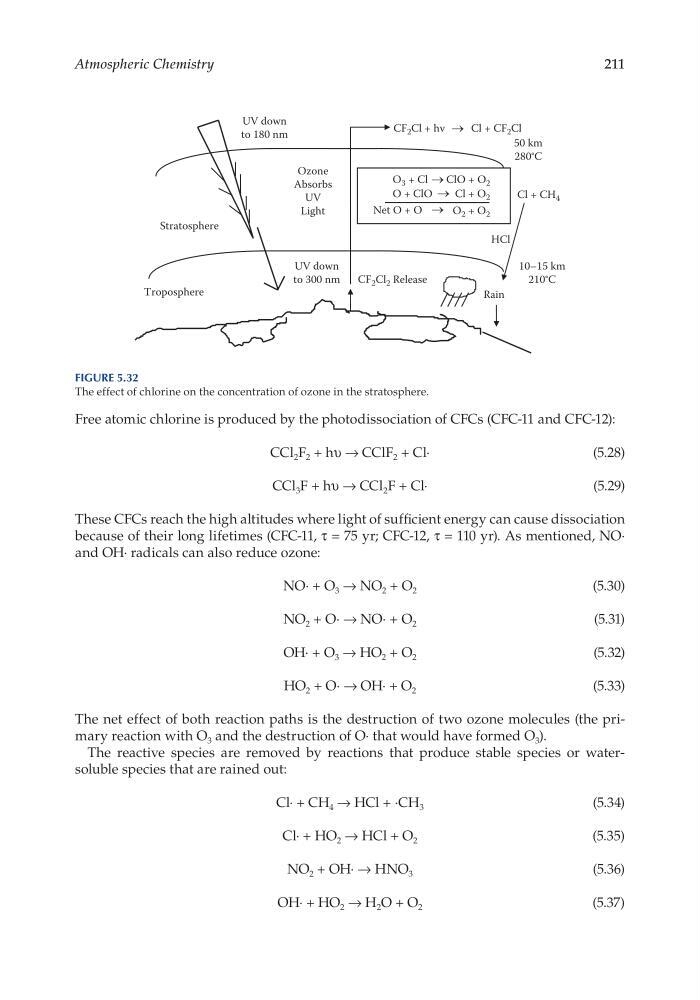
Free atomic chlorine is produced by the photodissociation of CFCs (CFC-11 and CFC-12):
CCl 2 F 2 + hυ → CClF 2 + Cl·
(5.28)
CCl 3 F + hυ → CCl 2 F + Cl·
(5.29)
These CFCs reach the high altitudes where light of sufficient energy can cause dissociation
because of their long lifetimes (CFC-11, τ = 75 yr; CFC-12, τ = 110 yr). As mentioned, NO·
and OH· radicals can also reduce ozone:
NO· + O 3 → NO 2 + O 2
(5.30)
NO 2 + O· → NO· + O 2
(5.31)
OH· + O 3 → HO 2 + O 2
(5.32)
HO 2 + O· → OH· + O 2
(5.33)
The net effect of both reaction paths is the destruction of two ozone molecules (the primary reaction with O 3 and the destruction of O· that would have formed O 3 ).
The reactive species are removed by reactions that produce stable species or watersoluble species that are rained out:
Cl· + CH 4 → HCl + ·CH 3
(5.34)
Cl· + HO 2 → HCl + O 2
(5.35)
NO 2 + OH· → HNO 3
(5.36)
OH· + HO 2 → H 2 O + O 2
(5.37)
UV down
to 180 nm
CF 2 Cl + hν
Cl + CF 2 Cl
50 km
280°C
Ozone
Absorbs
UV
Light
O 3 + Cl
ClO + O 2
O + ClO
Cl + O 2
Cl + CH 4
O 2 + O 2
Stratosphere
HCl
UV down
to 300 nm
10–15 km
210°C
CF 2 Cl 2 Release
Troposphere
Rain
Net O + O
Figure 5.32
The effect of chlorine on the concentration of ozone in the stratosphere.
Atmospheric Chemistry
Free atomic chlorine is produced by the photodissociation of CFCs (CFC-11 and CFC-12):
CCl 2 F 2 + hυ → CClF 2 + Cl·
(5.28)
CCl 3 F + hυ → CCl 2 F + Cl·
(5.29)
These CFCs reach the high altitudes where light of sufficient energy can cause dissociation
because of their long lifetimes (CFC-11, τ = 75 yr; CFC-12, τ = 110 yr). As mentioned, NO·
and OH· radicals can also reduce ozone:
NO· + O 3 → NO 2 + O 2
(5.30)
NO 2 + O· → NO· + O 2
(5.31)
OH· + O 3 → HO 2 + O 2
(5.32)
HO 2 + O· → OH· + O 2
(5.33)
The net effect of both reaction paths is the destruction of two ozone molecules (the primary reaction with O 3 and the destruction of O· that would have formed O 3 ).
The reactive species are removed by reactions that produce stable species or watersoluble species that are rained out:
Cl· + CH 4 → HCl + ·CH 3
(5.34)
Cl· + HO 2 → HCl + O 2
(5.35)
NO 2 + OH· → HNO 3
(5.36)
OH· + HO 2 → H 2 O + O 2
(5.37)
UV down
to 180 nm
CF 2 Cl + hν
Cl + CF 2 Cl
50 km
280°C
Ozone
Absorbs
UV
Light
O 3 + Cl
ClO + O 2
O + ClO
Cl + O 2
Cl + CH 4
O 2 + O 2
Stratosphere
HCl
UV down
to 300 nm
10–15 km
210°C
CF 2 Cl 2 Release
Troposphere
Rain
Net O + O
Figure 5.32
The effect of chlorine on the concentration of ozone in the stratosphere.