

210
Chemical Oceanography, 4th Edition
1. Warming of surface waters
2. Deoxygenation of surface waters
3. Ocean acidification of surface waters
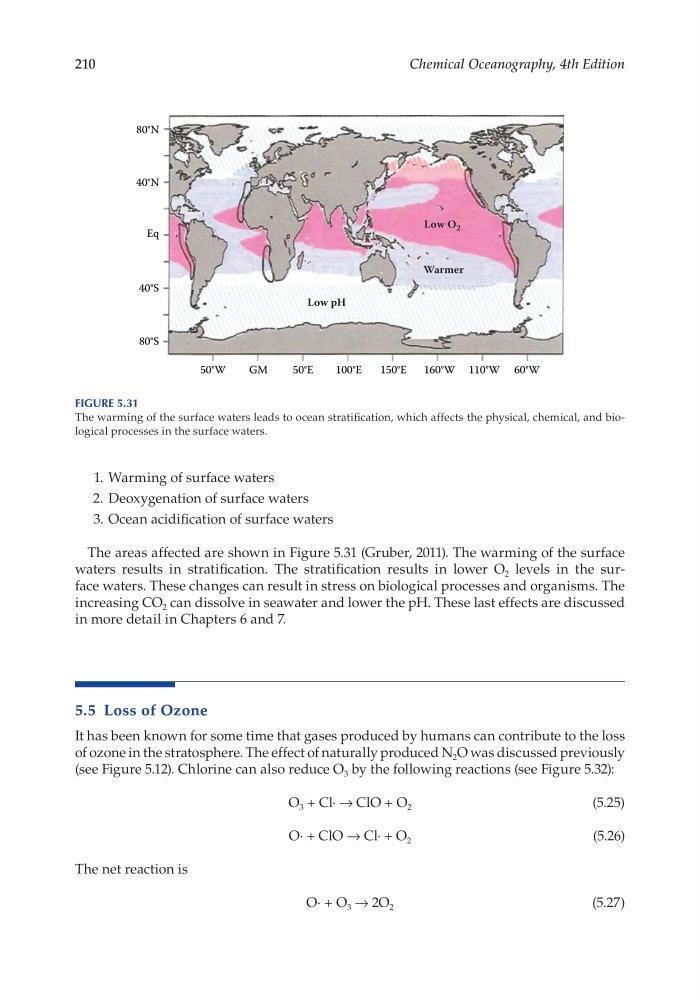
The areas affected are shown in Figure 5.31 (Gruber, 2011). The warming of the surface
waters results in stratification. The stratification results in lower O 2 levels in the surface waters. These changes can result in stress on biological processes and organisms. The
increasing CO 2 can dissolve in seawater and lower the pH. These last effects are discussed
in more detail in Chapters 6 and 7.
5.5 Loss of Ozone
It has been known for some time that gases produced by humans can contribute to the loss
of ozone in the stratosphere. The effect of naturally produced N 2 O was discussed previously
(see Figure 5.12). Chlorine can also reduce O 3 by the following reactions (see Figure 5.32):
O 3 + Cl· → ClO + O 2
(5.25)
O· + ClO → Cl· + O 2
(5.26)
The net reaction is
O· + O 3 → 2O 2
(5.27)
60°W
160°W
150°E
Low pH
Low O 2
Warmer
100°E
50°E
50°W
80°S
40°S
40°N
80°N
Eq
GM
110°W
Figure 5.31
The warming of the surface waters leads to ocean stratification, which affects the physical, chemical, and biological processes in the surface waters.
Chemical Oceanography, 4th Edition
1. Warming of surface waters
2. Deoxygenation of surface waters
3. Ocean acidification of surface waters
The areas affected are shown in Figure 5.31 (Gruber, 2011). The warming of the surface
waters results in stratification. The stratification results in lower O 2 levels in the surface waters. These changes can result in stress on biological processes and organisms. The
increasing CO 2 can dissolve in seawater and lower the pH. These last effects are discussed
in more detail in Chapters 6 and 7.
5.5 Loss of Ozone
It has been known for some time that gases produced by humans can contribute to the loss
of ozone in the stratosphere. The effect of naturally produced N 2 O was discussed previously
(see Figure 5.12). Chlorine can also reduce O 3 by the following reactions (see Figure 5.32):
O 3 + Cl· → ClO + O 2
(5.25)
O· + ClO → Cl· + O 2
(5.26)
The net reaction is
O· + O 3 → 2O 2
(5.27)
60°W
160°W
150°E
Low pH
Low O 2
Warmer
100°E
50°E
50°W
80°S
40°S
40°N
80°N
Eq
GM
110°W
Figure 5.31
The warming of the surface waters leads to ocean stratification, which affects the physical, chemical, and biological processes in the surface waters.