

207
Atmospheric Chemistry
increase of trace gases will have on the temperature in the next century. The models used
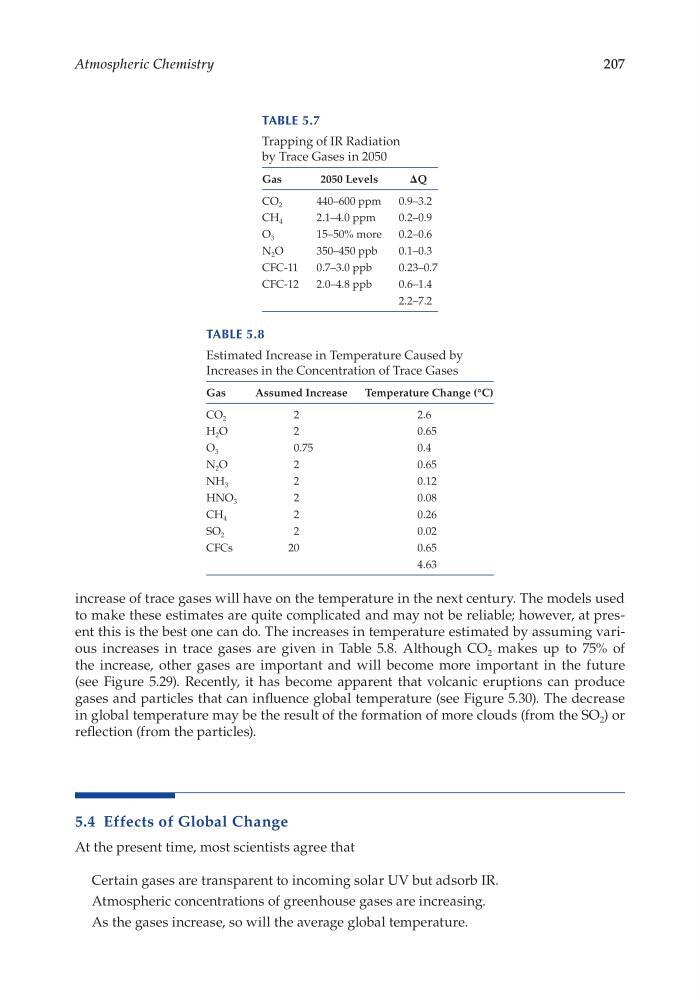
to make these estimates are quite complicated and may not be reliable; however, at present this is the best one can do. The increases in temperature estimated by assuming various increases in trace gases are given in Table 5.8. Although CO 2 makes up to 75% of
the increase, other gases are important and will become more important in the future
(see Figure 5.29). Recently, it has become apparent that volcanic eruptions can produce
gases and particles that can influence global temperature (see Figure 5.30). The decrease
in global temperature may be the result of the formation of more clouds (from the SO 2 ) or
reflection (from the particles).
5.4 Effects of Global Change
At the present time, most scientists agree that
Certain gases are transparent to incoming solar UV but adsorb IR.
Atmospheric concentrations of greenhouse gases are increasing.
As the gases increase, so will the average global temperature.
Table 5.7
Trapping of IR Radiation
by Trace Gases in 2050
Gas
2050 Levels
ΔQ
CO 2
440–600 ppm
0.9–3.2
CH 4
2.1–4.0 ppm
0.2–0.9
O 3
15–50% more
0.2–0.6
N 2 O
350–450 ppb
0.1–0.3
CFC-11
0.7–3.0 ppb
0.23–0.7
CFC-12
2.0–4.8 ppb
0.6–1.4
2.2–7.2
Table 5.8
Estimated Increase in Temperature Caused by
Increases in the Concentration of Trace Gases
Gas
Assumed Increase
Temperature Change (°C)
CO 2
2
2.6
H 2 O
2
0.65
O 3
0.75
0.4
N 2 O
2
0.65
NH 3
2
0.12
HNO 3
2
0.08
CH 4
2
0.26
SO 2
2
0.02
CFCs
20
0.65
4.63
Atmospheric Chemistry
increase of trace gases will have on the temperature in the next century. The models used
to make these estimates are quite complicated and may not be reliable; however, at present this is the best one can do. The increases in temperature estimated by assuming various increases in trace gases are given in Table 5.8. Although CO 2 makes up to 75% of
the increase, other gases are important and will become more important in the future
(see Figure 5.29). Recently, it has become apparent that volcanic eruptions can produce
gases and particles that can influence global temperature (see Figure 5.30). The decrease
in global temperature may be the result of the formation of more clouds (from the SO 2 ) or
reflection (from the particles).
5.4 Effects of Global Change
At the present time, most scientists agree that
Certain gases are transparent to incoming solar UV but adsorb IR.
Atmospheric concentrations of greenhouse gases are increasing.
As the gases increase, so will the average global temperature.
Table 5.7
Trapping of IR Radiation
by Trace Gases in 2050
Gas
2050 Levels
ΔQ
CO 2
440–600 ppm
0.9–3.2
CH 4
2.1–4.0 ppm
0.2–0.9
O 3
15–50% more
0.2–0.6
N 2 O
350–450 ppb
0.1–0.3
CFC-11
0.7–3.0 ppb
0.23–0.7
CFC-12
2.0–4.8 ppb
0.6–1.4
2.2–7.2
Table 5.8
Estimated Increase in Temperature Caused by
Increases in the Concentration of Trace Gases
Gas
Assumed Increase
Temperature Change (°C)
CO 2
2
2.6
H 2 O
2
0.65
O 3
0.75
0.4
N 2 O
2
0.65
NH 3
2
0.12
HNO 3
2
0.08
CH 4
2
0.26
SO 2
2
0.02
CFCs
20
0.65
4.63