

191
Atmospheric Chemistry
1. Biogenic (CH 4 , NH 3 , N 2 O, H 2 , CS 2 , OCS)
2. Photochemical (CO, O 3 , NO 2 , HNO 3 , H 2 , OH, HO 2 , H 2 O 2 , H 2 CO)
3. Lightning (NO, NO 2 )
4. Volcanic (SO 2 )
The sinks of these gases are largely photochemical, with the exception of H 2 O 2 , HNO 3 , and
H 2 SO 4 , which are lost because of rainout.
All three phases of water exist in the atmosphere. The partial pressure of water under
ordinary conditions is quite small (30 to 40 mbar, which corresponds to 25 gm 3 ). In typical
clouds, little of this is in the condensed phase (stratus clouds have 0.3 to 1 gm 3 ).
These clouds are important since they deliver water from the atmosphere to the earth’s
surface, and they scavenge a number of materials from the air and deliver them to the
surface. The formation of clouds is due to particles that act as cloud condensation nuclei
(CCN). These particles must be small enough to have small settling velocities. They are soluble in water. In the past, it was thought that NaCl from sea spray was the main CCN. More
recent studies indicate that sulfate particles (H 2 SO 4 and [NH 4 ] 2 SO 4 ) dominate. Following
the growth of droplets by condensation, further growth occurs by collisions. Large water
10
22
H 2 O
CO 2
H 2 O
N 2
O 2
O 3
O 2
N 2
N 2
O 2 H 2
O
O
O
He
He
H
H
O 3
O 2
N
O
N
10 20
10
18
10
16
10
14
10
12
10
10
10
22
10
20
10
18
10
16
10
14
10
12
10
10
300
200
0
20
40
60
Altitude (km)
80
100
120
200
300
400
500
600
Troposphere
Tropopause
Stratosphere
Stratopause
Mesopause
Mesosphere
Temperature
Profile (°K)
Approximate Gas Concentrations (molecules/m
3 )
CO 2
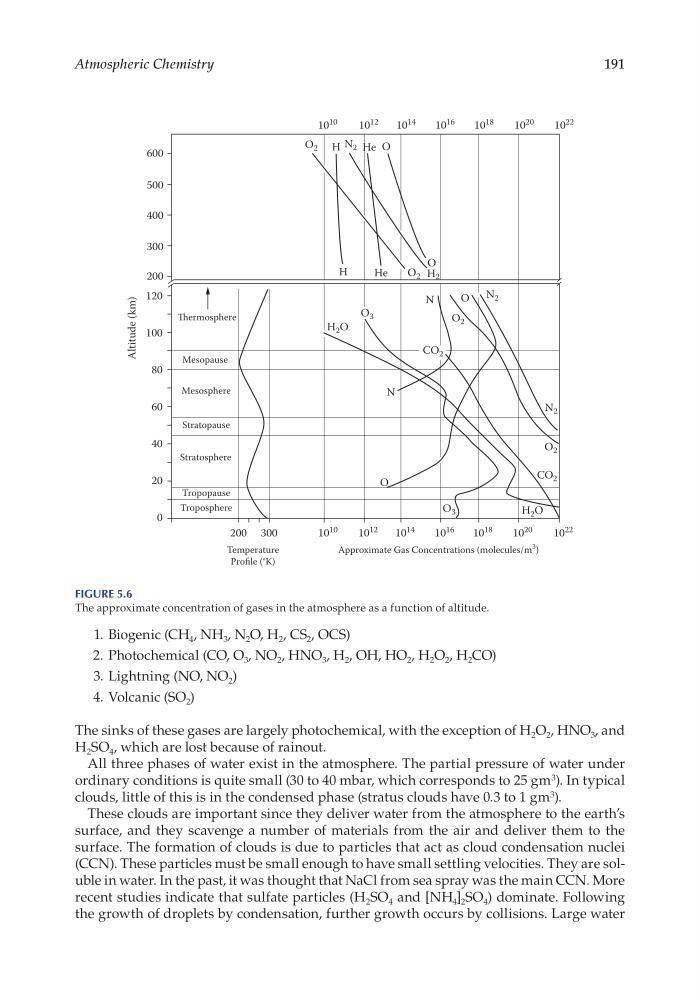
Figure 5.6
The approximate concentration of gases in the atmosphere as a function of altitude.
Atmospheric Chemistry
1. Biogenic (CH 4 , NH 3 , N 2 O, H 2 , CS 2 , OCS)
2. Photochemical (CO, O 3 , NO 2 , HNO 3 , H 2 , OH, HO 2 , H 2 O 2 , H 2 CO)
3. Lightning (NO, NO 2 )
4. Volcanic (SO 2 )
The sinks of these gases are largely photochemical, with the exception of H 2 O 2 , HNO 3 , and
H 2 SO 4 , which are lost because of rainout.
All three phases of water exist in the atmosphere. The partial pressure of water under
ordinary conditions is quite small (30 to 40 mbar, which corresponds to 25 gm 3 ). In typical
clouds, little of this is in the condensed phase (stratus clouds have 0.3 to 1 gm 3 ).
These clouds are important since they deliver water from the atmosphere to the earth’s
surface, and they scavenge a number of materials from the air and deliver them to the
surface. The formation of clouds is due to particles that act as cloud condensation nuclei
(CCN). These particles must be small enough to have small settling velocities. They are soluble in water. In the past, it was thought that NaCl from sea spray was the main CCN. More
recent studies indicate that sulfate particles (H 2 SO 4 and [NH 4 ] 2 SO 4 ) dominate. Following
the growth of droplets by condensation, further growth occurs by collisions. Large water
10
22
H 2 O
CO 2
H 2 O
N 2
O 2
O 3
O 2
N 2
N 2
O 2 H 2
O
O
O
He
He
H
H
O 3
O 2
N
O
N
10 20
10
18
10
16
10
14
10
12
10
10
10
22
10
20
10
18
10
16
10
14
10
12
10
10
300
200
0
20
40
60
Altitude (km)
80
100
120
200
300
400
500
600
Troposphere
Tropopause
Stratosphere
Stratopause
Mesopause
Mesosphere
Temperature
Profile (°K)
Approximate Gas Concentrations (molecules/m
3 )
CO 2
Figure 5.6
The approximate concentration of gases in the atmosphere as a function of altitude.