

178
Chemical Oceanography, 4th Edition
1. The values of ΔP EX in dilute solutions are not very large and can be assumed to be
zero. This leads to the additivity of ϕ, or Young’s (1951) first rule.
2. The values of ΔP EX for mixtures with a common anion or cation are not strongly
affected by the common ion. For example, the ΔP EX for mixing NaCl and KCl is
nearly the same as that for mixing NaBr and KBr.
ΔP EX (NaCl- KCl) = ΔP EX (NaBr- KBr)
(4.96)
Since this mixing process is largely related to cation–cation and anion–anion
interactions, as a first approximation, plus–plus and minus–minus interactions
are independent of the other ions in the solutions.
3. The third rule is called the cross- square rule and is given by
Σ = Σ X
(4.97)
which states the sum of the excess mixing properties around the sides of the diagram given is equal to the sum of the excess properties of the cross mixtures. For
the major sea salts, this gives
ΔP EX (NaCl + Na 2 SO 4 ) + ΔP EX (MgCl 2 + MgSO 4 ) + ΔP EX (NaCl + MgCl 2 )
+ ΔP EX (MgSO 4 + Na 2 SO 4 ) = ΔP EX (NaCl + MgSO 4 ) + ΔP EX (Na 2 SO 4 + MgCl 2 )
(4.98)
This simplifies the estimation of the ΔP EX for a complicated mixture like seawater. The
addition to Young’s simple rule gives
ϕ = Σ M Σ X E M E X φ(MX) + ΔP M / e T
(4.99)
where ΔP M / e T is given by
ΔP M / e T = ( e T /4)[Σ E X E N E X (Z M + Z X )(Z N + Z X ) ΔP(M, N) X
+ E X E N E M (Z M + Z X )(Z M + Z Y ) ΔP(X, Y) M ]
(4.100)
where Z i is the absolute charge on ion i, ΔP(M,N) X is the excess mixing properties for MX +
NX, and ΔP(X,Y) is the excess mixing properties for NX + NY. This equation attempts to
account for cation–cation and anion–anion interactions in the mixture by neglecting triplicate interaction (Young’s third rule). Since the values of ΔP EX are symmetrical around the
ionic strength fraction (see Figure 4.37), the values of ΔP needed to estimate ΔP M for
the mixture can be the value near y = 0.5.
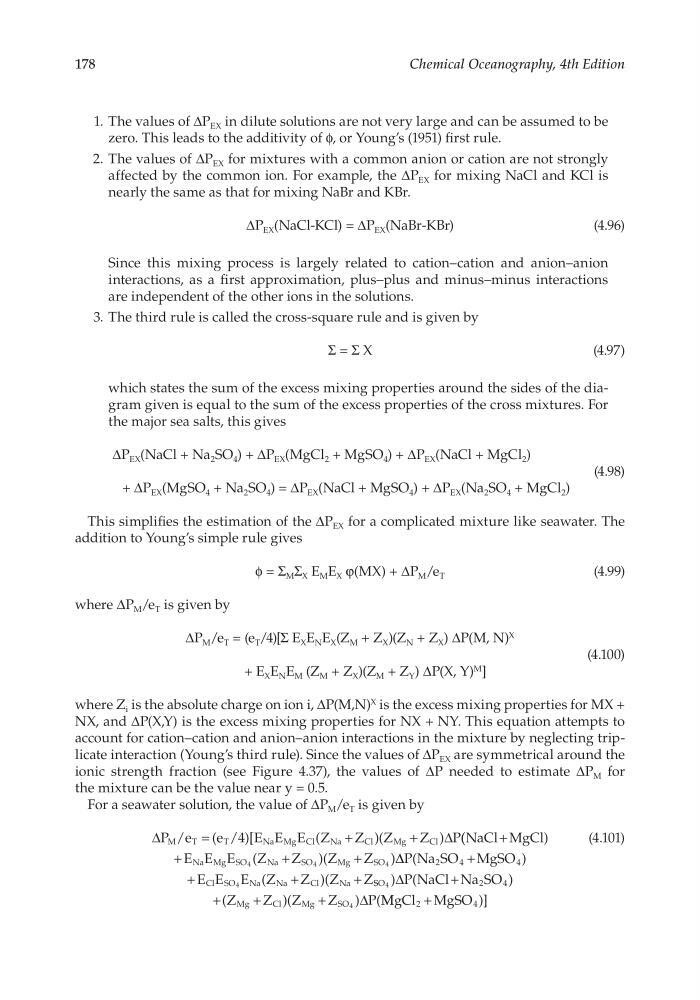
For a seawater solution, the value of ΔP M / e T is given by
∆
∆
P e
e
E E E Z
Z Z
Z
P
M
T
T
Na Mg Cl
Na
Cl
Mg
Cl
/
/
=
+
+
(
)[
(
)(
)
4
( (
)
(
)(
)
NaCl MgCl
E E E
Z
Z
Z
Z
Na Mg SO
Na
SO
Mg
SO
+
+
+
+
4
4
4 ∆ ∆P Na SO MgSO
E E E Z
Z Z
Z
Cl SO
Na
Na
Cl
Na
(
)
(
)(
2
4
4
4
+
+
+
+ S SO
Mg
Cl
Mg
SO
P NaCl Na SO
Z
Z Z
Z
P
4
4
2
4
) (
)
(
)(
) (
∆
∆
+
+
+
+
M MgCl MgSO
2
4
+
)]
(4.101)
Chemical Oceanography, 4th Edition
1. The values of ΔP EX in dilute solutions are not very large and can be assumed to be
zero. This leads to the additivity of ϕ, or Young’s (1951) first rule.
2. The values of ΔP EX for mixtures with a common anion or cation are not strongly
affected by the common ion. For example, the ΔP EX for mixing NaCl and KCl is
nearly the same as that for mixing NaBr and KBr.
ΔP EX (NaCl- KCl) = ΔP EX (NaBr- KBr)
(4.96)
Since this mixing process is largely related to cation–cation and anion–anion
interactions, as a first approximation, plus–plus and minus–minus interactions
are independent of the other ions in the solutions.
3. The third rule is called the cross- square rule and is given by
Σ = Σ X
(4.97)
which states the sum of the excess mixing properties around the sides of the diagram given is equal to the sum of the excess properties of the cross mixtures. For
the major sea salts, this gives
ΔP EX (NaCl + Na 2 SO 4 ) + ΔP EX (MgCl 2 + MgSO 4 ) + ΔP EX (NaCl + MgCl 2 )
+ ΔP EX (MgSO 4 + Na 2 SO 4 ) = ΔP EX (NaCl + MgSO 4 ) + ΔP EX (Na 2 SO 4 + MgCl 2 )
(4.98)
This simplifies the estimation of the ΔP EX for a complicated mixture like seawater. The
addition to Young’s simple rule gives
ϕ = Σ M Σ X E M E X φ(MX) + ΔP M / e T
(4.99)
where ΔP M / e T is given by
ΔP M / e T = ( e T /4)[Σ E X E N E X (Z M + Z X )(Z N + Z X ) ΔP(M, N) X
+ E X E N E M (Z M + Z X )(Z M + Z Y ) ΔP(X, Y) M ]
(4.100)
where Z i is the absolute charge on ion i, ΔP(M,N) X is the excess mixing properties for MX +
NX, and ΔP(X,Y) is the excess mixing properties for NX + NY. This equation attempts to
account for cation–cation and anion–anion interactions in the mixture by neglecting triplicate interaction (Young’s third rule). Since the values of ΔP EX are symmetrical around the
ionic strength fraction (see Figure 4.37), the values of ΔP needed to estimate ΔP M for
the mixture can be the value near y = 0.5.
For a seawater solution, the value of ΔP M / e T is given by
∆
∆
P e
e
E E E Z
Z Z
Z
P
M
T
T
Na Mg Cl
Na
Cl
Mg
Cl
/
/
=
+
+
(
)[
(
)(
)
4
( (
)
(
)(
)
NaCl MgCl
E E E
Z
Z
Z
Z
Na Mg SO
Na
SO
Mg
SO
+
+
+
+
4
4
4 ∆ ∆P Na SO MgSO
E E E Z
Z Z
Z
Cl SO
Na
Na
Cl
Na
(
)
(
)(
2
4
4
4
+
+
+
+ S SO
Mg
Cl
Mg
SO
P NaCl Na SO
Z
Z Z
Z
P
4
4
2
4
) (
)
(
)(
) (
∆
∆
+
+
+
+
M MgCl MgSO
2
4
+
)]
(4.101)