

157
Ionic Interactions
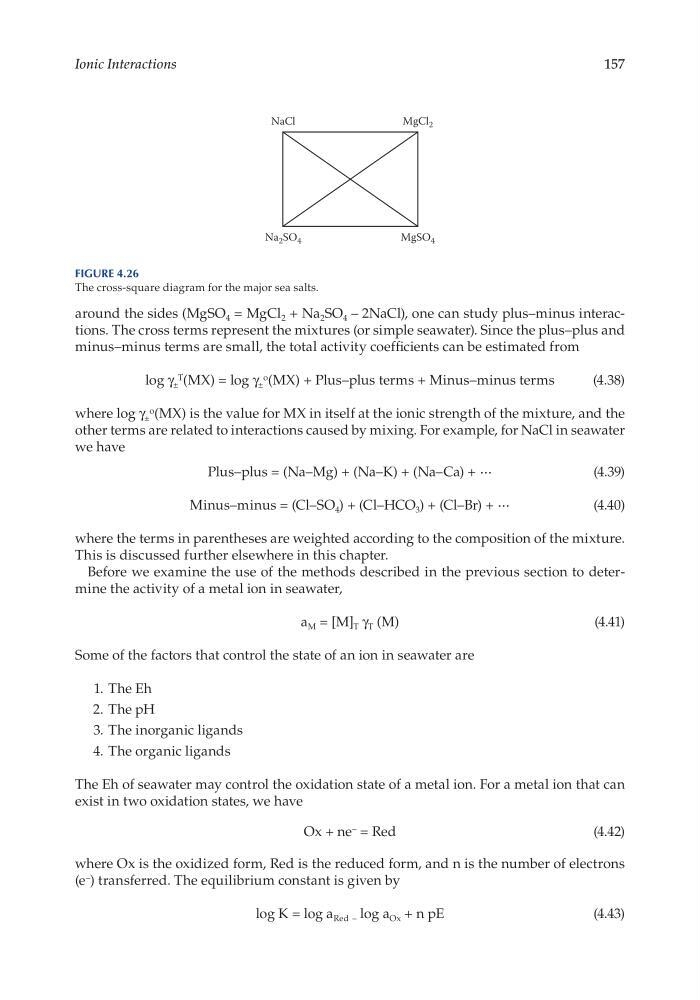
around the sides (MgSO 4 = MgCl 2 + Na 2 SO 4 – 2NaCl), one can study plus–minus interactions. The cross terms represent the mixtures (or simple seawater). Since the plus–plus and
minus–minus terms are small, the total activity coefficients can be estimated from
log γ ±
T (MX) = log γ ±
o (MX) + Plus–plus terms + Minus–minus terms
(4.38)
where log γ ±
o (MX) is the value for MX in itself at the ionic strength of the mixture, and the
other terms are related to interactions caused by mixing. For example, for NaCl in seawater
we have
Plus–plus = (Na–Mg) + (Na–K) + (Na–Ca) + ⋯
(4.39)
Minus–minus = (Cl–SO 4 ) + (Cl–HCO 3 ) + (Cl–Br) + ⋯
(4.40)
where the terms in parentheses are weighted according to the composition of the mixture.
This is discussed further elsewhere in this chapter.
Before we examine the use of the methods described in the previous section to determine the activity of a metal ion in seawater,
a M = [M] T γ T (M)
(4.41)
Some of the factors that control the state of an ion in seawater are
1. The Eh
2. The pH
3. The inorganic ligands
4. The organic ligands
The Eh of seawater may control the oxidation state of a metal ion. For a metal ion that can
exist in two oxidation states, we have
Ox + ne – = Red
(4.42)
where Ox is the oxidized form, Red is the reduced form, and n is the number of electrons
(e – ) transferred. The equilibrium constant is given by
log K = log a Red – log a Ox + n pE
(4.43)
NaCl
MgCl 2
Na 2 SO 4
MgSO 4
Figure 4.26
The cross- square diagram for the major sea salts.
Ionic Interactions
around the sides (MgSO 4 = MgCl 2 + Na 2 SO 4 – 2NaCl), one can study plus–minus interactions. The cross terms represent the mixtures (or simple seawater). Since the plus–plus and
minus–minus terms are small, the total activity coefficients can be estimated from
log γ ±
T (MX) = log γ ±
o (MX) + Plus–plus terms + Minus–minus terms
(4.38)
where log γ ±
o (MX) is the value for MX in itself at the ionic strength of the mixture, and the
other terms are related to interactions caused by mixing. For example, for NaCl in seawater
we have
Plus–plus = (Na–Mg) + (Na–K) + (Na–Ca) + ⋯
(4.39)
Minus–minus = (Cl–SO 4 ) + (Cl–HCO 3 ) + (Cl–Br) + ⋯
(4.40)
where the terms in parentheses are weighted according to the composition of the mixture.
This is discussed further elsewhere in this chapter.
Before we examine the use of the methods described in the previous section to determine the activity of a metal ion in seawater,
a M = [M] T γ T (M)
(4.41)
Some of the factors that control the state of an ion in seawater are
1. The Eh
2. The pH
3. The inorganic ligands
4. The organic ligands
The Eh of seawater may control the oxidation state of a metal ion. For a metal ion that can
exist in two oxidation states, we have
Ox + ne – = Red
(4.42)
where Ox is the oxidized form, Red is the reduced form, and n is the number of electrons
(e – ) transferred. The equilibrium constant is given by
log K = log a Red – log a Ox + n pE
(4.43)
NaCl
MgCl 2
Na 2 SO 4
MgSO 4
Figure 4.26
The cross- square diagram for the major sea salts.