

156
Chemical Oceanography, 4th Edition
Many workers have criticized the Bjerrum theory because of the arbitrary cutoff distance.
It has now been superseded by other theories. For example, the model of Fuoss (1958) considers only anions on the surface of a cation in volume, V = 2.52 a 3 , to be ion pairs. Fuoss
obtained
K A = (4πNa 3 /3000) exp(Z + Z – e 2 /DakT)
(4.37)
where the first term is the excluded volume around the cation. Others have further
expanded these methods and discussed the shortcomings of the model. Studies of electrolyte solutions have been made by using the cluster expansion method of Friedman (1960).
This method in simple terms considers all the interactions in a solution and makes no
attempt to separate coulombic and noncoulombic terms. For example, for the major sea
salts (NaCl + MgSO 4 ) there are a number of possible interactions to consider:
Interactions
Possible Types
Plus–plus
Na–Na, Mg–Mg, Na–Mg
Minus–minus Cl–Cl, SO 4 –SO 4 , Cl–SO 4
Plus–minus
Na–Cl, MgSO 4 , Mg–Cl, NaSO 4
These interactions can be represented by the cross- square diagram shown in Figure 4.26.
By studying the mixtures along the side of this diagram, one can obtain information
about plus–plus and minus–minus interactions; by studying individual salts and the sum
+
–
Covalent
Bonding
+
–
Contact
Pair
+
–
–
+
Solvent
Shared
Solvent
Separated
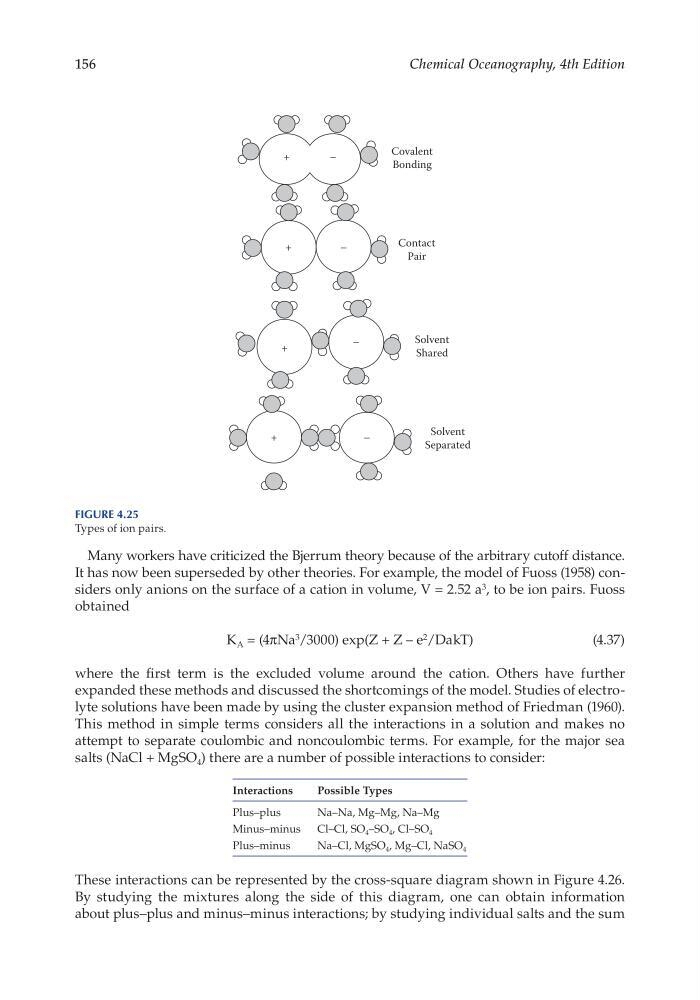
Figure 4.25
Types of ion pairs.
Chemical Oceanography, 4th Edition
Many workers have criticized the Bjerrum theory because of the arbitrary cutoff distance.
It has now been superseded by other theories. For example, the model of Fuoss (1958) considers only anions on the surface of a cation in volume, V = 2.52 a 3 , to be ion pairs. Fuoss
obtained
K A = (4πNa 3 /3000) exp(Z + Z – e 2 /DakT)
(4.37)
where the first term is the excluded volume around the cation. Others have further
expanded these methods and discussed the shortcomings of the model. Studies of electrolyte solutions have been made by using the cluster expansion method of Friedman (1960).
This method in simple terms considers all the interactions in a solution and makes no
attempt to separate coulombic and noncoulombic terms. For example, for the major sea
salts (NaCl + MgSO 4 ) there are a number of possible interactions to consider:
Interactions
Possible Types
Plus–plus
Na–Na, Mg–Mg, Na–Mg
Minus–minus Cl–Cl, SO 4 –SO 4 , Cl–SO 4
Plus–minus
Na–Cl, MgSO 4 , Mg–Cl, NaSO 4
These interactions can be represented by the cross- square diagram shown in Figure 4.26.
By studying the mixtures along the side of this diagram, one can obtain information
about plus–plus and minus–minus interactions; by studying individual salts and the sum
+
–
Covalent
Bonding
+
–
Contact
Pair
+
–
–
+
Solvent
Shared
Solvent
Separated
Figure 4.25
Types of ion pairs.