

154
Chemical Oceanography, 4th Edition
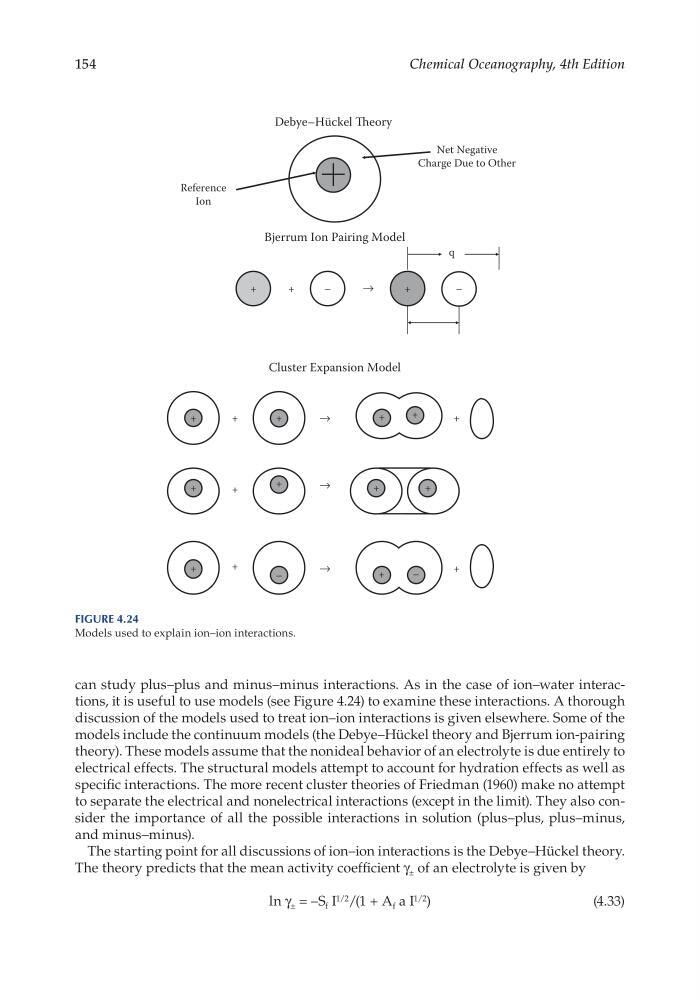
can study plus–plus and minus–minus interactions. As in the case of ion–water interactions, it is useful to use models (see Figure 4.24) to examine these interactions. A thorough
discussion of the models used to treat ion–ion interactions is given elsewhere. Some of the
models include the continuum models (the Debye–Hückel theory and Bjerrum ion- pairing
theory). These models assume that the nonideal behavior of an electrolyte is due entirely to
electrical effects. The structural models attempt to account for hydration effects as well as
specific interactions. The more recent cluster theories of Friedman (1960) make no attempt
to separate the electrical and nonelectrical interactions (except in the limit). They also consider the importance of all the possible interactions in solution (plus–plus, plus–minus,
and minus–minus).
The starting point for all discussions of ion–ion interactions is the Debye–Hückel theory.
The theory predicts that the mean activity coefficient γ ± of an electrolyte is given by
ln γ ± = –S f I 1/2 /(1 + A f a I 1/2 )
(4.33)
Debye–Hückel eory
Net Negative
Charge Due to Other
Reference
Ion
Bjerrum Ion Pairing Model
q
+
+
–
+
–
Cluster Expansion Model
+
+
+
+
+
–
+
+
+
+
+
+
+
+
+
–
+
Figure 4.24
Models used to explain ion–ion interactions.
Chemical Oceanography, 4th Edition
can study plus–plus and minus–minus interactions. As in the case of ion–water interactions, it is useful to use models (see Figure 4.24) to examine these interactions. A thorough
discussion of the models used to treat ion–ion interactions is given elsewhere. Some of the
models include the continuum models (the Debye–Hückel theory and Bjerrum ion- pairing
theory). These models assume that the nonideal behavior of an electrolyte is due entirely to
electrical effects. The structural models attempt to account for hydration effects as well as
specific interactions. The more recent cluster theories of Friedman (1960) make no attempt
to separate the electrical and nonelectrical interactions (except in the limit). They also consider the importance of all the possible interactions in solution (plus–plus, plus–minus,
and minus–minus).
The starting point for all discussions of ion–ion interactions is the Debye–Hückel theory.
The theory predicts that the mean activity coefficient γ ± of an electrolyte is given by
ln γ ± = –S f I 1/2 /(1 + A f a I 1/2 )
(4.33)
Debye–Hückel eory
Net Negative
Charge Due to Other
Reference
Ion
Bjerrum Ion Pairing Model
q
+
+
–
+
–
Cluster Expansion Model
+
+
+
+
+
–
+
+
+
+
+
+
+
+
+
–
+
Figure 4.24
Models used to explain ion–ion interactions.