

152
Chemical Oceanography, 4th Edition
is a lot larger than the crystal molal volume of water V o (cryst) = 2.52 × (1.38) 3 = 6.6 cm 3 mol –1
or the value corrected for packing effects V o (int) = 4.48 × (1.38) 3 = 11.8 cm 3 mol –1 . Thus, the
water molecules in the electrostricted region are not as tightly packed as one might expect.
Part of this difference may, however, be caused by the water molecules in the so- called
broken- down region. The solution properties of the other partial molal properties can also
be treated by using the hydration model.
4.4.2 Proton Structure in aqueous Solutions
The structure of the proton in the gas phase and in solution has been characterized by
the formula H + (H 2 O) n . Most of the earlier studies have been related to small clusters with
n > 10. Eigen (1964) suggested that n = 1, H 3 O + , while Zundel (1974) suggested that n = 2,
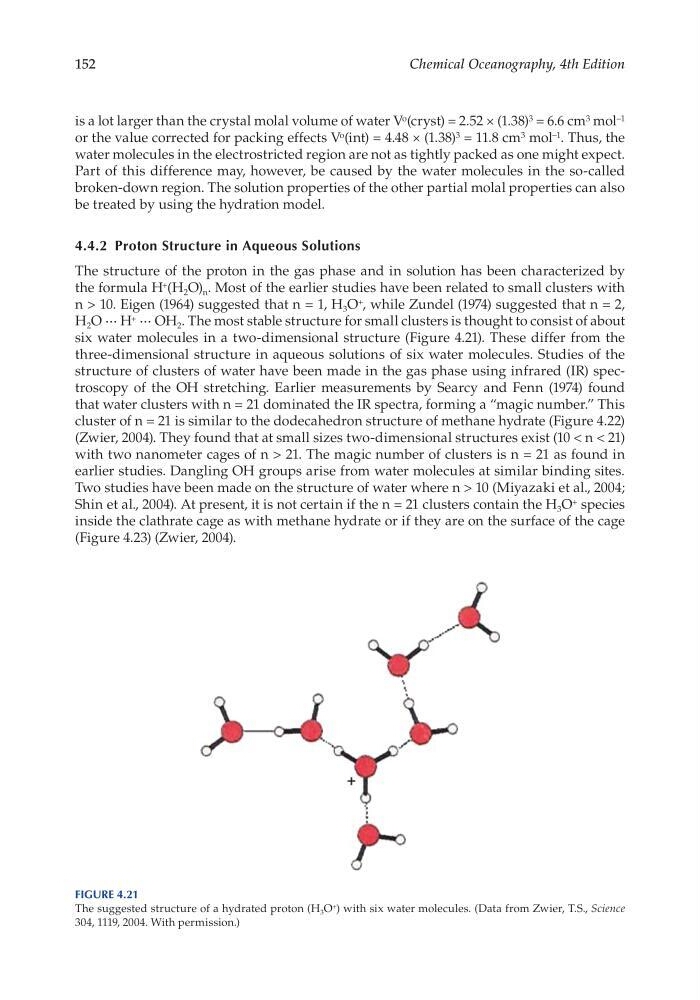
H 2 O ⋯ H + ⋯ OH 2 . The most stable structure for small clusters is thought to consist of about
six water molecules in a two- dimensional structure (Figure 4.21). These differ from the
three- dimensional structure in aqueous solutions of six water molecules. Studies of the
structure of clusters of water have been made in the gas phase using infrared (IR) spectroscopy of the OH stretching. Earlier measurements by Searcy and Fenn (1974) found
that water clusters with n = 21 dominated the IR spectra, forming a “magic number.” This
cluster of n = 21 is similar to the dodecahedron structure of methane hydrate (Figure 4.22)
(Zwier, 2004). They found that at small sizes two- dimensional structures exist (10 < n < 21)
with two nanometer cages of n > 21. The magic number of clusters is n = 21 as found in
earlier studies. Dangling OH groups arise from water molecules at similar binding sites.
Two studies have been made on the structure of water where n > 10 (Miyazaki et al., 2004;
Shin et al., 2004). At present, it is not certain if the n = 21 clusters contain the H 3 O + species
inside the clathrate cage as with methane hydrate or if they are on the surface of the cage
(Figure 4.23) (Zwier, 2004).
Figure 4.21
The suggested structure of a hydrated proton (H 3 O + ) with six water molecules. (Data from Zwier, T.S., Science
304, 1119, 2004. With permission.)
Chemical Oceanography, 4th Edition
is a lot larger than the crystal molal volume of water V o (cryst) = 2.52 × (1.38) 3 = 6.6 cm 3 mol –1
or the value corrected for packing effects V o (int) = 4.48 × (1.38) 3 = 11.8 cm 3 mol –1 . Thus, the
water molecules in the electrostricted region are not as tightly packed as one might expect.
Part of this difference may, however, be caused by the water molecules in the so- called
broken- down region. The solution properties of the other partial molal properties can also
be treated by using the hydration model.
4.4.2 Proton Structure in aqueous Solutions
The structure of the proton in the gas phase and in solution has been characterized by
the formula H + (H 2 O) n . Most of the earlier studies have been related to small clusters with
n > 10. Eigen (1964) suggested that n = 1, H 3 O + , while Zundel (1974) suggested that n = 2,
H 2 O ⋯ H + ⋯ OH 2 . The most stable structure for small clusters is thought to consist of about
six water molecules in a two- dimensional structure (Figure 4.21). These differ from the
three- dimensional structure in aqueous solutions of six water molecules. Studies of the
structure of clusters of water have been made in the gas phase using infrared (IR) spectroscopy of the OH stretching. Earlier measurements by Searcy and Fenn (1974) found
that water clusters with n = 21 dominated the IR spectra, forming a “magic number.” This
cluster of n = 21 is similar to the dodecahedron structure of methane hydrate (Figure 4.22)
(Zwier, 2004). They found that at small sizes two- dimensional structures exist (10 < n < 21)
with two nanometer cages of n > 21. The magic number of clusters is n = 21 as found in
earlier studies. Dangling OH groups arise from water molecules at similar binding sites.
Two studies have been made on the structure of water where n > 10 (Miyazaki et al., 2004;
Shin et al., 2004). At present, it is not certain if the n = 21 clusters contain the H 3 O + species
inside the clathrate cage as with methane hydrate or if they are on the surface of the cage
(Figure 4.23) (Zwier, 2004).
Figure 4.21
The suggested structure of a hydrated proton (H 3 O + ) with six water molecules. (Data from Zwier, T.S., Science
304, 1119, 2004. With permission.)