

125
Minor Elements in Seawater
Q YO = (X Y – Y O ) 2
(3.16)
where the value of Q YO is a measure of the electrostatic contribution to the Y- O bond energy
or a measure of the attraction of an element (Y) for the oxide- based mineral. The values for
X are values of the electronegativity of various elements.
Meybeck (1987) has examined chemical weathering by considering the ions formed from
various rock types. The abundance of the major rock types is given in Table 3.13. His
estimates for the origins of the major components of the rock types released to the rivers
are given in Table 3.14. Ca and Mg come mostly from shale and carbonate rocks, Na and
Cl from rock salt, SO 4 from shale and gypsum, HCO 3 from shale and carbonate, and K
from sandstone and carbonate rocks. The sources of the dissolved river salts carried to the
oceans by the weathering of the various rock types are given in Table 3.15. These results
point out the importance of the weathering process in controlling the input of the major
components to the oceans.
log K Y (sw)
–6
–4
–2
0
2
4
log τ
Y
2
3
4
5
6
7
8
9
Ce
Al
Mn
Fe
Pb Cu
Zn
Ba
Ni
Si
Co
Ga
Pr
Sc
Ho
Ti
Gd
La, Nd, Sm
Eu, Tb
Er, Yb Lu, Tm Cr
Ag
Sb
P Au
As
Cs
Li Mo
Ca
Rb, U
Sr
K
Mg
B
Na
Br
V
Sn
Zr
W
C
I
N
Se
F
S
Cl
Hg
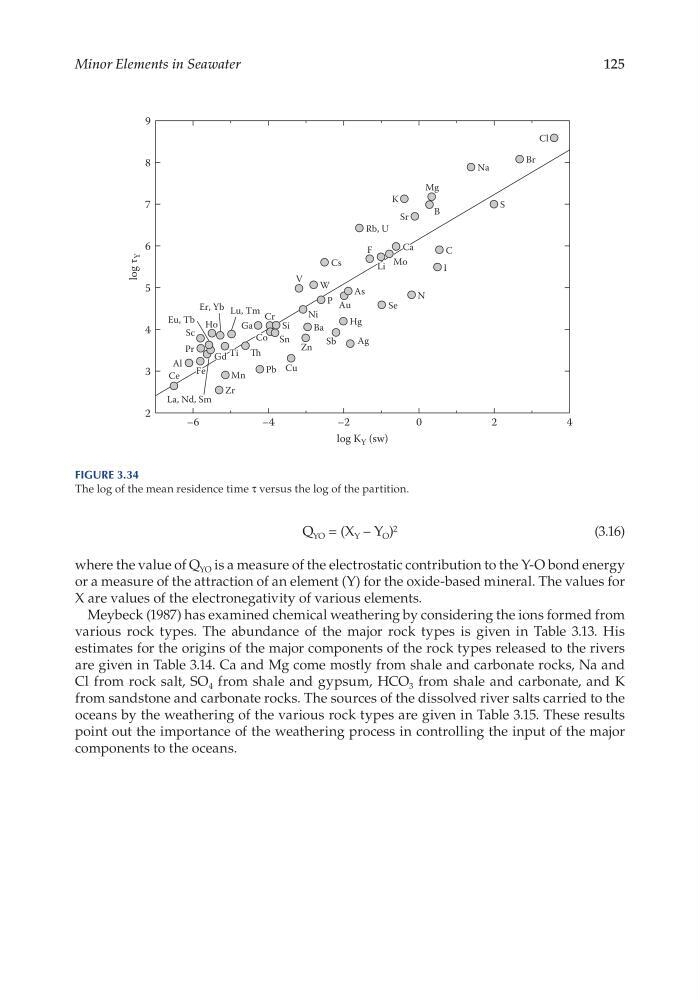
Figure 3.34
The log of the mean residence time τ versus the log of the partition.
Minor Elements in Seawater
Q YO = (X Y – Y O ) 2
(3.16)
where the value of Q YO is a measure of the electrostatic contribution to the Y- O bond energy
or a measure of the attraction of an element (Y) for the oxide- based mineral. The values for
X are values of the electronegativity of various elements.
Meybeck (1987) has examined chemical weathering by considering the ions formed from
various rock types. The abundance of the major rock types is given in Table 3.13. His
estimates for the origins of the major components of the rock types released to the rivers
are given in Table 3.14. Ca and Mg come mostly from shale and carbonate rocks, Na and
Cl from rock salt, SO 4 from shale and gypsum, HCO 3 from shale and carbonate, and K
from sandstone and carbonate rocks. The sources of the dissolved river salts carried to the
oceans by the weathering of the various rock types are given in Table 3.15. These results
point out the importance of the weathering process in controlling the input of the major
components to the oceans.
log K Y (sw)
–6
–4
–2
0
2
4
log τ
Y
2
3
4
5
6
7
8
9
Ce
Al
Mn
Fe
Pb Cu
Zn
Ba
Ni
Si
Co
Ga
Pr
Sc
Ho
Ti
Gd
La, Nd, Sm
Eu, Tb
Er, Yb Lu, Tm Cr
Ag
Sb
P Au
As
Cs
Li Mo
Ca
Rb, U
Sr
K
Mg
B
Na
Br
V
Sn
Zr
W
C
I
N
Se
F
S
Cl
Hg
Figure 3.34
The log of the mean residence time τ versus the log of the partition.