

106
Chemical Oceanography, 4th Edition
The metal Mn 2+ is a good example of an element that enters surface waters via
rivers or release from shelf sediments off California (see Figure 3.20). Elements
that can occupy different oxidation states can also exhibit this type of profile. The
reduction of metal in surface waters can be caused by biological and photochemical processes. The subsequent oxidation can lead to an oxidized form that is insoluble in seawater. The elements Cr 3+ , As 3+ , and I – fall into this classification.
4. Middepth minima: A middepth minimum can result from a surface input and
regeneration at or near the bottom or scavenging throughout the water column.
The metals Cu 2+ , Sn 4– , and Al 3+ show this type of profile. Profiles for the distribution of Al in the Atlantic and Pacific are shown in Figure 3.21. The input into the
surface oceans comes from the fallout of atmospheric dust that originates on the
continents. The input of dust from Africa (Sahara Desert) into the Atlantic is much
higher than the values from China (Gobi Desert) to the Pacific. The Al is quickly
scavenged from surface water by adsorption on plant material or the uptake of
plants. The particles settle into the deep oceans and are deposited in the sediment.
Ge (pM)
0
30
60
90
120
Depth (m)
0
1000
2000
3000
4000
5000
6000
Si (µmol kg
–1 )
0
40
80
120
160
0
1000
2000
3000
4000
5000
6000
Si (µmol kg
–1 )
0
40
80
120
160
Ge (pM)
0
30
60
90
120
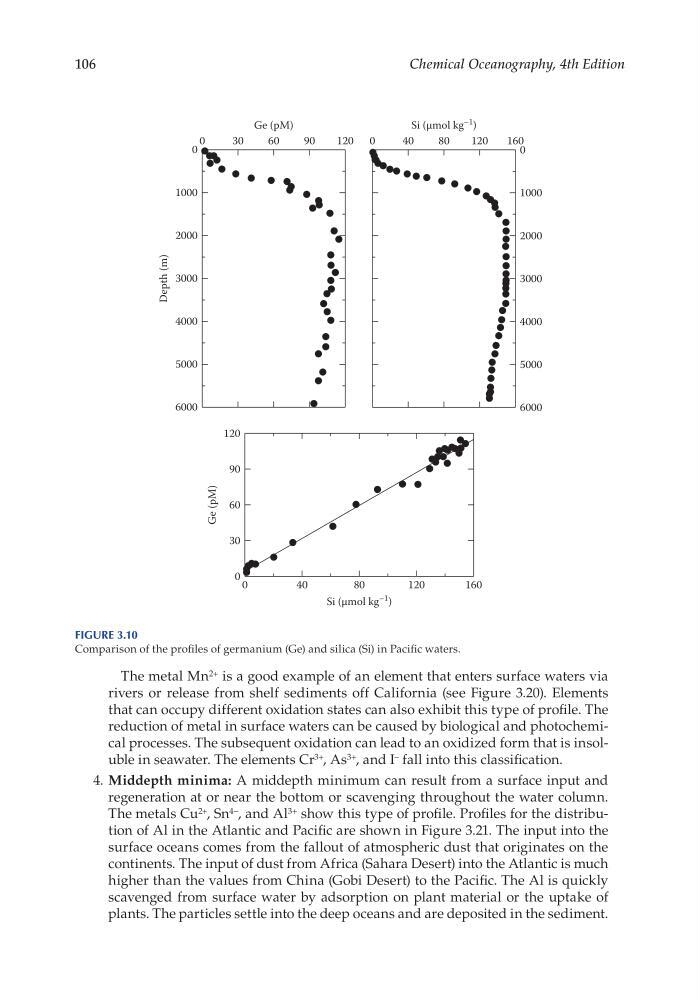
Figure 3.10
Comparison of the profiles of germanium (Ge) and silica (Si) in Pacific waters.
Chemical Oceanography, 4th Edition
The metal Mn 2+ is a good example of an element that enters surface waters via
rivers or release from shelf sediments off California (see Figure 3.20). Elements
that can occupy different oxidation states can also exhibit this type of profile. The
reduction of metal in surface waters can be caused by biological and photochemical processes. The subsequent oxidation can lead to an oxidized form that is insoluble in seawater. The elements Cr 3+ , As 3+ , and I – fall into this classification.
4. Middepth minima: A middepth minimum can result from a surface input and
regeneration at or near the bottom or scavenging throughout the water column.
The metals Cu 2+ , Sn 4– , and Al 3+ show this type of profile. Profiles for the distribution of Al in the Atlantic and Pacific are shown in Figure 3.21. The input into the
surface oceans comes from the fallout of atmospheric dust that originates on the
continents. The input of dust from Africa (Sahara Desert) into the Atlantic is much
higher than the values from China (Gobi Desert) to the Pacific. The Al is quickly
scavenged from surface water by adsorption on plant material or the uptake of
plants. The particles settle into the deep oceans and are deposited in the sediment.
Ge (pM)
0
30
60
90
120
Depth (m)
0
1000
2000
3000
4000
5000
6000
Si (µmol kg
–1 )
0
40
80
120
160
0
1000
2000
3000
4000
5000
6000
Si (µmol kg
–1 )
0
40
80
120
160
Ge (pM)
0
30
60
90
120
Figure 3.10
Comparison of the profiles of germanium (Ge) and silica (Si) in Pacific waters.