

82
Chemical Oceanography, 4th Edition
2.6.6 exchange between atmosphere and Sea
Sea and atmospheric bubbles give off 10 × 10 9 tons of ions into the atmosphere each year.
Most return directly or indirectly to the oceans. Considerable fractionation occurs. The
bubbles gather dissolved species and particles to their surfaces that may take up certain
ions selectively. White gap aerosols of ions and organics have a size of 0.1 to 20 μm and
may cause nucleation of rain. Mainly Ca 2+ , K + , Mg 2+ , and SO 4
2– are enriched relative to Na +
in the atmosphere, whereas Cl – and Br – are impoverished. Many bubbles concentrate transition metals from strong complexing with organics. The ratio of Br – /Cl – is only slightly
higher in air as both are neglected via bubble breaking (Duce, 1989). The gaseous form of
Cl – may be HCl, formed from salt and sulfur trioxide or NO 2 . Photochemical oxidation
of Br – in the salt yields Br 2 . The (I – /Cl – ) ratio in the atmosphere is 777 times higher than
in sea water as I 2 is formed by photochemical oxidation of I – . The rate of I lost from the
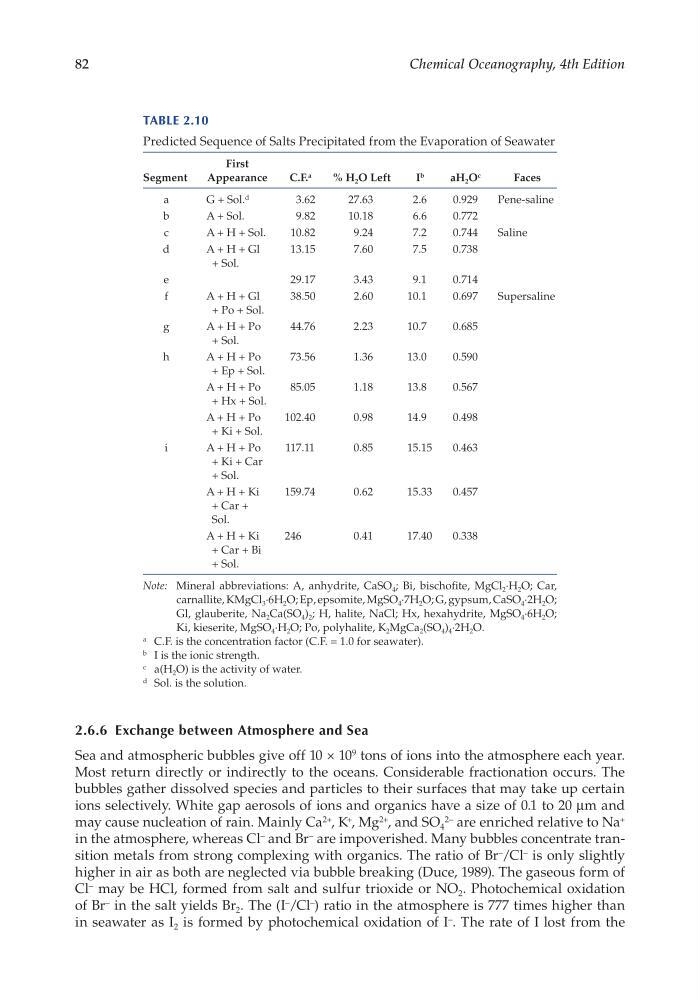
Table 2.10
Predicted Sequence of Salts Precipitated from the Evaporation of Seawater
Segment
First
Appearance
C.F. a
% H 2 O Left
I b
aH 2 O c
Faces
a
G + Sol. d
3.62
27.63
2.6
0.929
Pene- saline
b
A + Sol.
9.82
10.18
6.6
0.772
c
A + H + Sol.
10.82
9.24
7.2
0.744
Saline
d
A + H + Gl
+ Sol.
13.15
7.60
7.5
0.738
e
29.17
3.43
9.1
0.714
f
A + H + Gl
+ Po + Sol.
38.50
2.60
10.1
0.697
Supersaline
g
A + H + Po
+ Sol.
44.76
2.23
10.7
0.685
h
A + H + Po
+ Ep + Sol.
73.56
1.36
13.0
0.590
A + H + Po
+ Hx + Sol.
85.05
1.18
13.8
0.567
A + H + Po
+ Ki + Sol.
102.40
0.98
14.9
0.498
i
A + H + Po
+ Ki + Car
+ Sol.
117.11
0.85
15.15
0.463
A + H + Ki
+ Car +
Sol.
159.74
0.62
15.33
0.457
A + H + Ki
+ Car + Bi
+ Sol.
246
0.41
17.40
0.338
Note: Mineral abbreviations: A, anhydrite, CaSO 4 ; Bi, bischofite, MgCl 2 ∙H 2 O; Car,
carnallite, KMgCl 3 ∙6H 2 O; Ep, epsomite, MgSO 4 ∙7H 2 O; G, gypsum, CaSO 4 ∙2H 2 O;
Gl, glauberite, Na 2 Ca(SO 4 ) 2 ; H, halite, NaCl; Hx, hexahydrite, MgSO 4 ∙6H 2 O;
Ki, kieserite, MgSO 4 ∙H 2 O; Po, polyhalite, K 2 MgCa 2 (SO 4 ) 4 ∙2H 2 O.
a C.F. is the concentration factor (C.F. = 1.0 for seawater).
b I is the ionic strength.
c a(H 2 O) is the activity of water.
d Sol. is the solution.
Chemical Oceanography, 4th Edition
2.6.6 exchange between atmosphere and Sea
Sea and atmospheric bubbles give off 10 × 10 9 tons of ions into the atmosphere each year.
Most return directly or indirectly to the oceans. Considerable fractionation occurs. The
bubbles gather dissolved species and particles to their surfaces that may take up certain
ions selectively. White gap aerosols of ions and organics have a size of 0.1 to 20 μm and
may cause nucleation of rain. Mainly Ca 2+ , K + , Mg 2+ , and SO 4
2– are enriched relative to Na +
in the atmosphere, whereas Cl – and Br – are impoverished. Many bubbles concentrate transition metals from strong complexing with organics. The ratio of Br – /Cl – is only slightly
higher in air as both are neglected via bubble breaking (Duce, 1989). The gaseous form of
Cl – may be HCl, formed from salt and sulfur trioxide or NO 2 . Photochemical oxidation
of Br – in the salt yields Br 2 . The (I – /Cl – ) ratio in the atmosphere is 777 times higher than
in sea water as I 2 is formed by photochemical oxidation of I – . The rate of I lost from the
Table 2.10
Predicted Sequence of Salts Precipitated from the Evaporation of Seawater
Segment
First
Appearance
C.F. a
% H 2 O Left
I b
aH 2 O c
Faces
a
G + Sol. d
3.62
27.63
2.6
0.929
Pene- saline
b
A + Sol.
9.82
10.18
6.6
0.772
c
A + H + Sol.
10.82
9.24
7.2
0.744
Saline
d
A + H + Gl
+ Sol.
13.15
7.60
7.5
0.738
e
29.17
3.43
9.1
0.714
f
A + H + Gl
+ Po + Sol.
38.50
2.60
10.1
0.697
Supersaline
g
A + H + Po
+ Sol.
44.76
2.23
10.7
0.685
h
A + H + Po
+ Ep + Sol.
73.56
1.36
13.0
0.590
A + H + Po
+ Hx + Sol.
85.05
1.18
13.8
0.567
A + H + Po
+ Ki + Sol.
102.40
0.98
14.9
0.498
i
A + H + Po
+ Ki + Car
+ Sol.
117.11
0.85
15.15
0.463
A + H + Ki
+ Car +
Sol.
159.74
0.62
15.33
0.457
A + H + Ki
+ Car + Bi
+ Sol.
246
0.41
17.40
0.338
Note: Mineral abbreviations: A, anhydrite, CaSO 4 ; Bi, bischofite, MgCl 2 ∙H 2 O; Car,
carnallite, KMgCl 3 ∙6H 2 O; Ep, epsomite, MgSO 4 ∙7H 2 O; G, gypsum, CaSO 4 ∙2H 2 O;
Gl, glauberite, Na 2 Ca(SO 4 ) 2 ; H, halite, NaCl; Hx, hexahydrite, MgSO 4 ∙6H 2 O;
Ki, kieserite, MgSO 4 ∙H 2 O; Po, polyhalite, K 2 MgCa 2 (SO 4 ) 4 ∙2H 2 O.
a C.F. is the concentration factor (C.F. = 1.0 for seawater).
b I is the ionic strength.
c a(H 2 O) is the activity of water.
d Sol. is the solution.