

81
Composition of the Major Components of Seawater
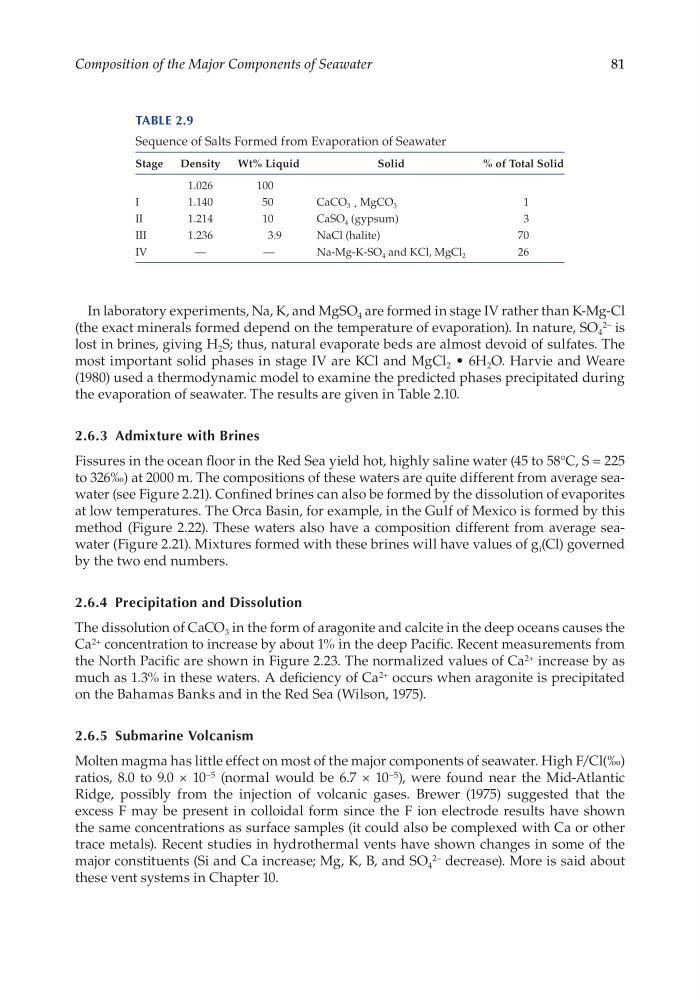
In laboratory experiments, Na, K, and MgSO 4 are formed in stage IV rather than K- Mg- Cl
(the exact minerals formed depend on the temperature of evaporation). In nature, SO 4
2– is
lost in brines, giving H 2 S; thus, natural evaporate beds are almost devoid of sulfates. The
most important solid phases in stage IV are KCl and MgCl 2 • 6H 2 O. Harvie and Weare
(1980) used a thermodynamic model to examine the predicted phases precipitated during
the evaporation of sea water. The results are given in Table 2.10.
2.6.3 admixture with brines
Fissures in the ocean floor in the Red Sea yield hot, highly saline water (45 to 58°C, S = 225
to 326‰) at 2000 m. The compositions of these waters are quite different from average seawater (see Figure 2.21). Confined brines can also be formed by the dissolution of evaporites
at low temperatures. The Orca Basin, for example, in the Gulf of Mexico is formed by this
method (Figure 2.22). These waters also have a composition different from average seawater (Figure 2.21). Mixtures formed with these brines will have values of g i (Cl) governed
by the two end numbers.
2.6.4 Precipitation and Dissolution
The dissolution of CaCO 3 in the form of aragonite and calcite in the deep oceans causes the
Ca 2+ concentration to increase by about 1% in the deep Pacific. Recent measurements from
the North Pacific are shown in Figure 2.23. The normalized values of Ca 2+ increase by as
much as 1.3% in these waters. A deficiency of Ca 2+ occurs when aragonite is precipitated
on the Bahamas Banks and in the Red Sea (Wilson, 1975).
2.6.5 Submarine Volcanism
Molten magma has little effect on most of the major components of sea water. High F/ Cl(‰)
ratios, 8.0 to 9.0 × 10 –5 (normal would be 6.7 × 10 –5 ), were found near the Mid- Atlantic
Ridge, possibly from the injection of volcanic gases. Brewer (1975) suggested that the
excess F may be present in colloidal form since the F ion electrode results have shown
the same concentrations as surface samples (it could also be complexed with Ca or other
trace metals). Recent studies in hydrothermal vents have shown changes in some of the
major constituents (Si and Ca increase; Mg, K, B, and SO 4
2– decrease). More is said about
these vent systems in Chapter 10.
Table 2.9
Sequence of Salts Formed from Evaporation of Seawater
Stage
Density
Wt% Liquid
Solid
% of Total Solid
1.026
100
I
1.140
50
CaCO 3 + MgCO 3
1
II
1.214
10
CaSO 4 (gypsum)
3
III
1.236
3.9
NaCl (halite)
70
IV
—
—
Na- Mg- K-SO 4 and KCl, MgCl 2
26
Composition of the Major Components of Seawater
In laboratory experiments, Na, K, and MgSO 4 are formed in stage IV rather than K- Mg- Cl
(the exact minerals formed depend on the temperature of evaporation). In nature, SO 4
2– is
lost in brines, giving H 2 S; thus, natural evaporate beds are almost devoid of sulfates. The
most important solid phases in stage IV are KCl and MgCl 2 • 6H 2 O. Harvie and Weare
(1980) used a thermodynamic model to examine the predicted phases precipitated during
the evaporation of sea water. The results are given in Table 2.10.
2.6.3 admixture with brines
Fissures in the ocean floor in the Red Sea yield hot, highly saline water (45 to 58°C, S = 225
to 326‰) at 2000 m. The compositions of these waters are quite different from average seawater (see Figure 2.21). Confined brines can also be formed by the dissolution of evaporites
at low temperatures. The Orca Basin, for example, in the Gulf of Mexico is formed by this
method (Figure 2.22). These waters also have a composition different from average seawater (Figure 2.21). Mixtures formed with these brines will have values of g i (Cl) governed
by the two end numbers.
2.6.4 Precipitation and Dissolution
The dissolution of CaCO 3 in the form of aragonite and calcite in the deep oceans causes the
Ca 2+ concentration to increase by about 1% in the deep Pacific. Recent measurements from
the North Pacific are shown in Figure 2.23. The normalized values of Ca 2+ increase by as
much as 1.3% in these waters. A deficiency of Ca 2+ occurs when aragonite is precipitated
on the Bahamas Banks and in the Red Sea (Wilson, 1975).
2.6.5 Submarine Volcanism
Molten magma has little effect on most of the major components of sea water. High F/ Cl(‰)
ratios, 8.0 to 9.0 × 10 –5 (normal would be 6.7 × 10 –5 ), were found near the Mid- Atlantic
Ridge, possibly from the injection of volcanic gases. Brewer (1975) suggested that the
excess F may be present in colloidal form since the F ion electrode results have shown
the same concentrations as surface samples (it could also be complexed with Ca or other
trace metals). Recent studies in hydrothermal vents have shown changes in some of the
major constituents (Si and Ca increase; Mg, K, B, and SO 4
2– decrease). More is said about
these vent systems in Chapter 10.
Table 2.9
Sequence of Salts Formed from Evaporation of Seawater
Stage
Density
Wt% Liquid
Solid
% of Total Solid
1.026
100
I
1.140
50
CaCO 3 + MgCO 3
1
II
1.214
10
CaSO 4 (gypsum)
3
III
1.236
3.9
NaCl (halite)
70
IV
—
—
Na- Mg- K-SO 4 and KCl, MgCl 2
26