

including the representations of the subtle processes governing water mass transformation in
the Norwegian and Greenland seas, and of the
sill overflows across the narrow passages of the
Greenland–Scotland ridge system. Some insight
was provided by careful assessments of the
behaviour of different model formulations, beginning with geopotential and isopycnic models in
non-eddy-resolving North Atlantic configurations
(Chassignet et al., 1996; Marsh et al., 1996;
Roberts et al., 1996), followed by the systematic
evaluation of three comprehensive eddy-permitting
models in the framework of the DYNAMO project (DYNAMO Group, 1997; Willebrand et al.,
2001). In addition to the difficulty in accurately
depicting the passage geometries in models of
moderate resolution, leading to a strong impact of
minor changes in the chosen model topography
(Roberts and Wood, 1997), the simulation of the
dynamics of the narrow downslope flow of the
dense overflow plumes (see Saunders, Chapter 5.6)
has been identified as particularly critical. While in
the real ocean, the density of the outflow product
is governed by localized mixing with ambient
waters caused by entrainment (Price and Baringer,
1994) and eddies (Krauss and Käse, 1998), the
mixing rate in models has typically been affected
primarily by numerical choices. In the case of
DYNAMO, either too little or too strong diapycnic mixing in the outflow regime were identified as
main causes for differences in the strength and vertical structure of the NADW cell akin to the CME
cases discussed in Fig. 2.2.10.
In order to limit spurious numerical mixing
effects and account for the impact of near-bottom
dynamics in outflow regimes, the development of
improved parameterization schemes has received
increasing attention recently (Beckmann and
Döscher, 1997; Killworth and Edwards, 1999).
Inclusion of such schemes, particularly in the case
of level coordinate models, has contributed to substantial improvements in the deep water formation
and overturning circulation. These improvements
are manifested, for example, in the simulation of
the uptake and spreading of anthropogenic tracers
such as CFCs (Redler and Dengg, 1999).
The subtleties in the behaviour of deep water
formation and meridional overturning have important implications for the simulation of meridional
heat transport in the ocean. In contrast to the
primarily wind-driven variations on subseasonal to
interannual time scales (Section 2.2.4.1), model
realizations of annual mean heat transports obtained
under nearly identical forcing conditions have
often shown substantial differences.
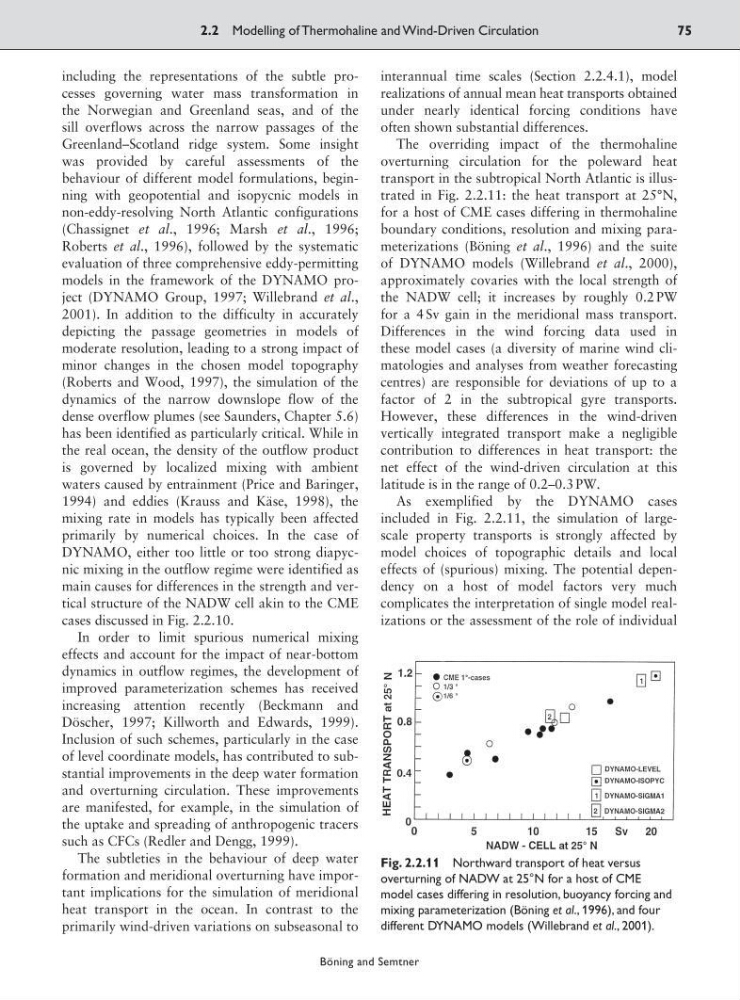
The overriding impact of the thermohaline
overturning circulation for the poleward heat
transport in the subtropical North Atlantic is illustrated in Fig. 2.2.11: the heat transport at 25°N,
for a host of CME cases differing in thermohaline
boundary conditions, resolution and mixing parameterizations (Böning et al., 1996) and the suite
of DYNAMO models (Willebrand et al., 2000),
approximately covaries with the local strength of
the NADW cell; it increases by roughly 0.2 PW
for a 4 Sv gain in the meridional mass transport.
Differences in the wind forcing data used in
these model cases (a diversity of marine wind climatologies and analyses from weather forecasting
centres) are responsible for deviations of up to a
factor of 2 in the subtropical gyre transports.
However, these differences in the wind-driven
vertically integrated transport make a negligible
contribution to differences in heat transport: the
net effect of the wind-driven circulation at this
latitude is in the range of 0.2–0.3 PW.
As exemplified by the DYNAMO cases
included in Fig. 2.2.11, the simulation of largescale property transports is strongly affected by
model choices of topographic details and local
effects of (spurious) mixing. The potential dependency on a host of model factors very much
complicates the interpretation of single model realizations or the assessment of the role of individual
2.2 Modelling of Thermohaline and Wind-Driven Circulation
75
Böning and Semtner
Fig. 2.2.11 Northward transport of heat versus
overturning of NADW at 25°N for a host of CME
model cases differing in resolution, buoyancy forcing and
mixing parameterization (Böning et al., 1996), and four
different DYNAMO models (Willebrand et al., 2001).
the Norwegian and Greenland seas, and of the
sill overflows across the narrow passages of the
Greenland–Scotland ridge system. Some insight
was provided by careful assessments of the
behaviour of different model formulations, beginning with geopotential and isopycnic models in
non-eddy-resolving North Atlantic configurations
(Chassignet et al., 1996; Marsh et al., 1996;
Roberts et al., 1996), followed by the systematic
evaluation of three comprehensive eddy-permitting
models in the framework of the DYNAMO project (DYNAMO Group, 1997; Willebrand et al.,
2001). In addition to the difficulty in accurately
depicting the passage geometries in models of
moderate resolution, leading to a strong impact of
minor changes in the chosen model topography
(Roberts and Wood, 1997), the simulation of the
dynamics of the narrow downslope flow of the
dense overflow plumes (see Saunders, Chapter 5.6)
has been identified as particularly critical. While in
the real ocean, the density of the outflow product
is governed by localized mixing with ambient
waters caused by entrainment (Price and Baringer,
1994) and eddies (Krauss and Käse, 1998), the
mixing rate in models has typically been affected
primarily by numerical choices. In the case of
DYNAMO, either too little or too strong diapycnic mixing in the outflow regime were identified as
main causes for differences in the strength and vertical structure of the NADW cell akin to the CME
cases discussed in Fig. 2.2.10.
In order to limit spurious numerical mixing
effects and account for the impact of near-bottom
dynamics in outflow regimes, the development of
improved parameterization schemes has received
increasing attention recently (Beckmann and
Döscher, 1997; Killworth and Edwards, 1999).
Inclusion of such schemes, particularly in the case
of level coordinate models, has contributed to substantial improvements in the deep water formation
and overturning circulation. These improvements
are manifested, for example, in the simulation of
the uptake and spreading of anthropogenic tracers
such as CFCs (Redler and Dengg, 1999).
The subtleties in the behaviour of deep water
formation and meridional overturning have important implications for the simulation of meridional
heat transport in the ocean. In contrast to the
primarily wind-driven variations on subseasonal to
interannual time scales (Section 2.2.4.1), model
realizations of annual mean heat transports obtained
under nearly identical forcing conditions have
often shown substantial differences.
The overriding impact of the thermohaline
overturning circulation for the poleward heat
transport in the subtropical North Atlantic is illustrated in Fig. 2.2.11: the heat transport at 25°N,
for a host of CME cases differing in thermohaline
boundary conditions, resolution and mixing parameterizations (Böning et al., 1996) and the suite
of DYNAMO models (Willebrand et al., 2000),
approximately covaries with the local strength of
the NADW cell; it increases by roughly 0.2 PW
for a 4 Sv gain in the meridional mass transport.
Differences in the wind forcing data used in
these model cases (a diversity of marine wind climatologies and analyses from weather forecasting
centres) are responsible for deviations of up to a
factor of 2 in the subtropical gyre transports.
However, these differences in the wind-driven
vertically integrated transport make a negligible
contribution to differences in heat transport: the
net effect of the wind-driven circulation at this
latitude is in the range of 0.2–0.3 PW.
As exemplified by the DYNAMO cases
included in Fig. 2.2.11, the simulation of largescale property transports is strongly affected by
model choices of topographic details and local
effects of (spurious) mixing. The potential dependency on a host of model factors very much
complicates the interpretation of single model realizations or the assessment of the role of individual
2.2 Modelling of Thermohaline and Wind-Driven Circulation
75
Böning and Semtner
Fig. 2.2.11 Northward transport of heat versus
overturning of NADW at 25°N for a host of CME
model cases differing in resolution, buoyancy forcing and
mixing parameterization (Böning et al., 1996), and four
different DYNAMO models (Willebrand et al., 2001).