

however, that the zonal grid spacing of about
60 km in this model case was not capable of
resolving the narrow outflow plume, implying
some exaggeration of the volume of dense water in
this experiment.)
While the latitudinal pattern of meridional
overturning still appears difficult to quantify
observationally, the vertical profiles of the meridional transport per unit depth, obtained for individual transoceanic sections, have provided an
important means of assessing model solutions.
Model evaluations have mainly utilized profiles
based on analyses of the repeatedly occupied sections along 24°N and 36°N (Hall and Bryden,
1982; Roemmich and Wunsch, 1985; Lavin et al.,
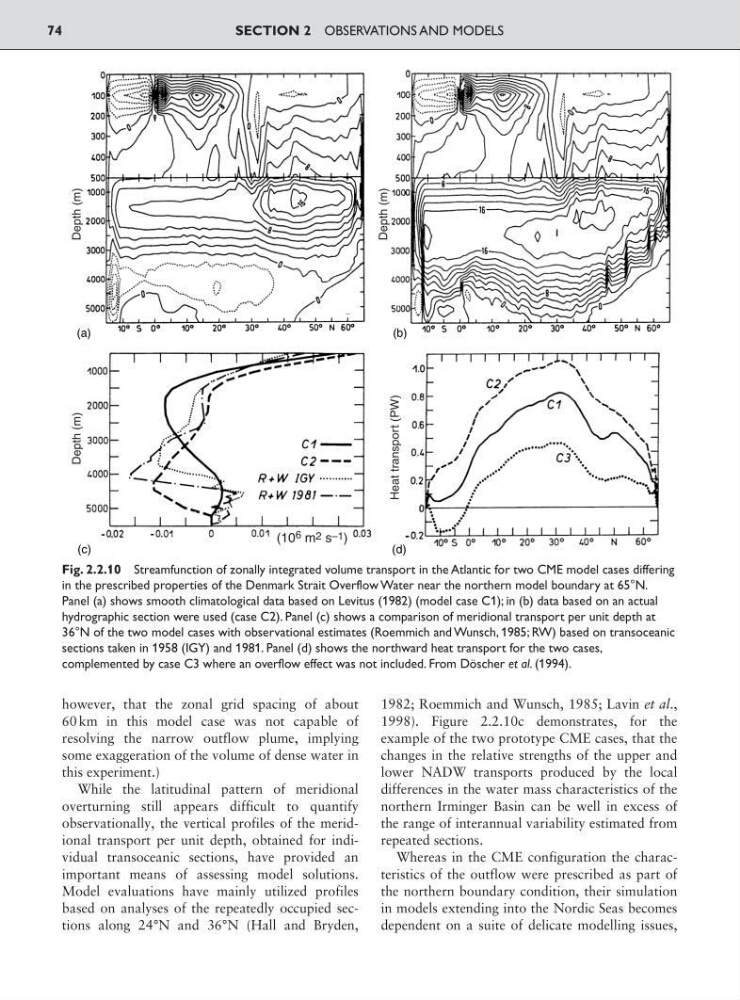
1998). Figure 2.2.10c demonstrates, for the
example of the two prototype CME cases, that the
changes in the relative strengths of the upper and
lower NADW transports produced by the local
differences in the water mass characteristics of the
northern Irminger Basin can be well in excess of
the range of interannual variability estimated from
repeated sections.
Whereas in the CME configuration the characteristics of the outflow were prescribed as part of
the northern boundary condition, their simulation
in models extending into the Nordic Seas becomes
dependent on a suite of delicate modelling issues,
SECTION 2 OBSERVATIONS AND MODELS
74
Heat transport (PW)
Depth
Depth
(b)
(a)
(c)
(d)
Depth (m)
Depth
Depth (m)
Depth
Heat transport (PW)
Heat transport (PW)
Depth (m)
(10 6 m 2 s –1 )
Fig. 2.2.10 Streamfunction of zonally integrated volume transport in the Atlantic for two CME model cases differing
in the prescribed properties of the Denmark Strait Overflow Water near the northern model boundary at 65°N.
Panel (a) shows smooth climatological data based on Levitus (1982) (model case C1); in (b) data based on an actual
hydrographic section were used (case C2). Panel (c) shows a comparison of meridional transport per unit depth at
36°N of the two model cases with observational estimates (Roemmich and Wunsch, 1985; RW) based on transoceanic
sections taken in 1958 (IGY) and 1981. Panel (d) shows the northward heat transport for the two cases,
complemented by case C3 where an overflow effect was not included. From Döscher et al. (1994).
60 km in this model case was not capable of
resolving the narrow outflow plume, implying
some exaggeration of the volume of dense water in
this experiment.)
While the latitudinal pattern of meridional
overturning still appears difficult to quantify
observationally, the vertical profiles of the meridional transport per unit depth, obtained for individual transoceanic sections, have provided an
important means of assessing model solutions.
Model evaluations have mainly utilized profiles
based on analyses of the repeatedly occupied sections along 24°N and 36°N (Hall and Bryden,
1982; Roemmich and Wunsch, 1985; Lavin et al.,
1998). Figure 2.2.10c demonstrates, for the
example of the two prototype CME cases, that the
changes in the relative strengths of the upper and
lower NADW transports produced by the local
differences in the water mass characteristics of the
northern Irminger Basin can be well in excess of
the range of interannual variability estimated from
repeated sections.
Whereas in the CME configuration the characteristics of the outflow were prescribed as part of
the northern boundary condition, their simulation
in models extending into the Nordic Seas becomes
dependent on a suite of delicate modelling issues,
SECTION 2 OBSERVATIONS AND MODELS
74
Heat transport (PW)
Depth
Depth
(b)
(a)
(c)
(d)
Depth (m)
Depth
Depth (m)
Depth
Heat transport (PW)
Heat transport (PW)
Depth (m)
(10 6 m 2 s –1 )
Fig. 2.2.10 Streamfunction of zonally integrated volume transport in the Atlantic for two CME model cases differing
in the prescribed properties of the Denmark Strait Overflow Water near the northern model boundary at 65°N.
Panel (a) shows smooth climatological data based on Levitus (1982) (model case C1); in (b) data based on an actual
hydrographic section were used (case C2). Panel (c) shows a comparison of meridional transport per unit depth at
36°N of the two model cases with observational estimates (Roemmich and Wunsch, 1985; RW) based on transoceanic
sections taken in 1958 (IGY) and 1981. Panel (d) shows the northward heat transport for the two cases,
complemented by case C3 where an overflow effect was not included. From Döscher et al. (1994).