

differences in the annual mean behaviour
(Willebrand et al., 2001; see also Section 2.2.4.3).
The similarity of model solutions with rather
different mean flow patterns is suggestive of an
essentially linear mechanism governing the atmospherically forced variability of ocean fluxes on
seasonal time scales, adding to a remarkable consistency in model results concerning the underlying
mechanism. As originally suggested by Bryan
(1982), it can be understood in terms of winddriven mass transport variations in the meridional–
vertical plane: transport variations induced in the
surface Ekman layer are compensated by nearly
depth-independent return flows, i.e. without any
significant baroclinic adjustment except for a narrow equatorial belt. In contrast to observational
studies (Molinari et al., 1990b; Fillenbaum et al.,
1997) using the seasonal hydrographic climatology
of Levitus (1982), the model results unanimously
negate the significance of seasonal baroclinic flows
in the interior, and suggest that the geostrophic
shear observed in one-time hydrographic sections should still reflect the longer-term mean
conditions.
2.2.4.2 Simulation of mesoscale variability
Investigation of the mechanisms of mesoscale
ocean variability has been a ‘classical’ application
2.2 Modelling of Thermohaline and Wind-Driven Circulation
69
Böning and Semtner
KUROSHIO EXTENSION (35˚N)
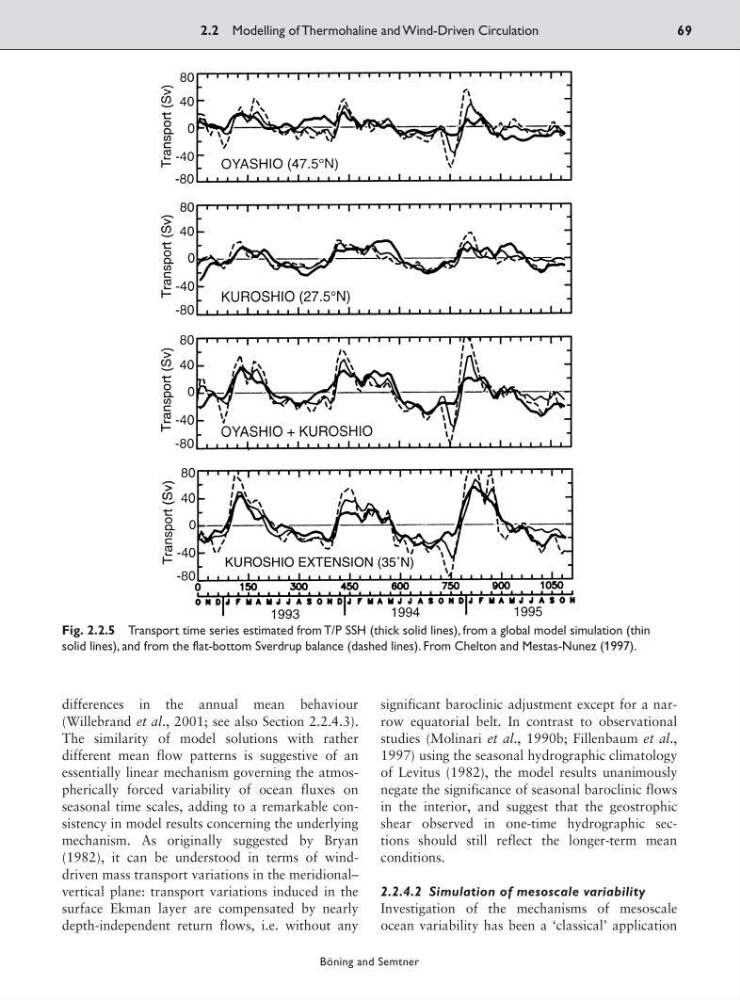
Fig. 2.2.5 Transport time series estimated from T/P SSH (thick solid lines), from a global model simulation (thin
solid lines), and from the flat-bottom Sverdrup balance (dashed lines). From Chelton and Mestas-Nunez (1997).
(Willebrand et al., 2001; see also Section 2.2.4.3).
The similarity of model solutions with rather
different mean flow patterns is suggestive of an
essentially linear mechanism governing the atmospherically forced variability of ocean fluxes on
seasonal time scales, adding to a remarkable consistency in model results concerning the underlying
mechanism. As originally suggested by Bryan
(1982), it can be understood in terms of winddriven mass transport variations in the meridional–
vertical plane: transport variations induced in the
surface Ekman layer are compensated by nearly
depth-independent return flows, i.e. without any
significant baroclinic adjustment except for a narrow equatorial belt. In contrast to observational
studies (Molinari et al., 1990b; Fillenbaum et al.,
1997) using the seasonal hydrographic climatology
of Levitus (1982), the model results unanimously
negate the significance of seasonal baroclinic flows
in the interior, and suggest that the geostrophic
shear observed in one-time hydrographic sections should still reflect the longer-term mean
conditions.
2.2.4.2 Simulation of mesoscale variability
Investigation of the mechanisms of mesoscale
ocean variability has been a ‘classical’ application
2.2 Modelling of Thermohaline and Wind-Driven Circulation
69
Böning and Semtner
KUROSHIO EXTENSION (35˚N)
Fig. 2.2.5 Transport time series estimated from T/P SSH (thick solid lines), from a global model simulation (thin
solid lines), and from the flat-bottom Sverdrup balance (dashed lines). From Chelton and Mestas-Nunez (1997).