

extrapolation and interpretation must take place
(the process of data assimilation) in order to provide
the appropriate constraint (guidance) for the model
evolution. The accuracy of the initial condition is
governed by the density of information relative the
most energetic space and time scales, and by the
errors introduced by the model and assimilation.
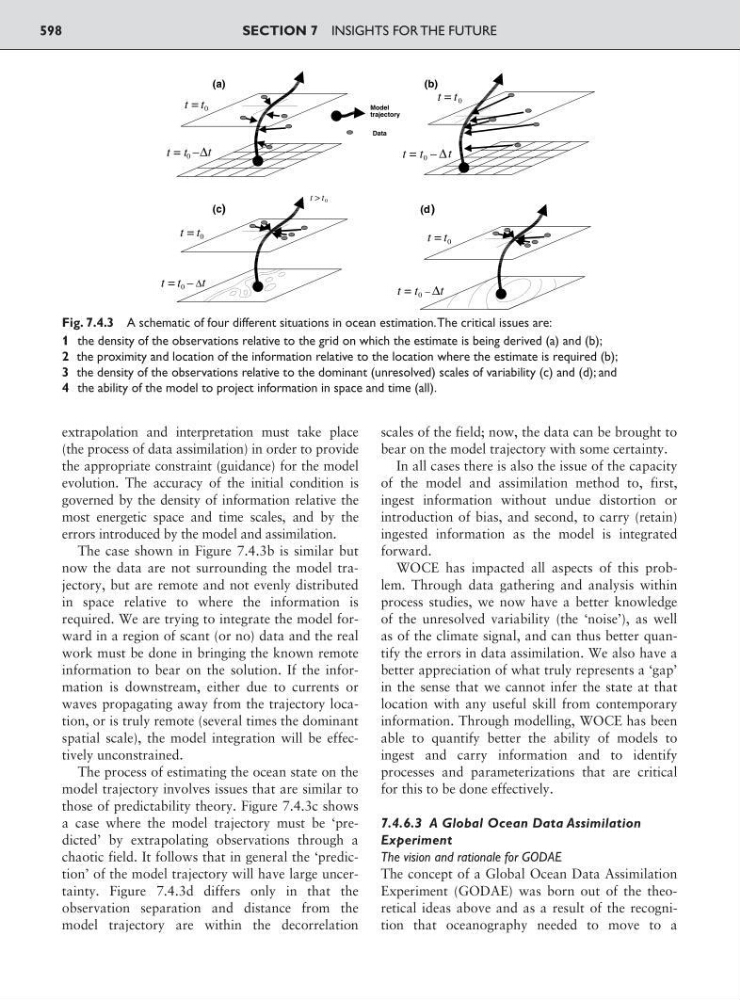
The case shown in Figure 7.4.3b is similar but
now the data are not surrounding the model trajectory, but are remote and not evenly distributed
in space relative to where the information is
required. We are trying to integrate the model forward in a region of scant (or no) data and the real
work must be done in bringing the known remote
information to bear on the solution. If the information is downstream, either due to currents or
waves propagating away from the trajectory location, or is truly remote (several times the dominant
spatial scale), the model integration will be effectively unconstrained.
The process of estimating the ocean state on the
model trajectory involves issues that are similar to
those of predictability theory. Figure 7.4.3c shows
a case where the model trajectory must be ‘predicted’ by extrapolating observations through a
chaotic field. It follows that in general the ‘prediction’ of the model trajectory will have large uncertainty. Figure 7.4.3d differs only in that the
observation separation and distance from the
model trajectory are within the decorrelation
scales of the field; now, the data can be brought to
bear on the model trajectory with some certainty.
In all cases there is also the issue of the capacity
of the model and assimilation method to, first,
ingest information without undue distortion or
introduction of bias, and second, to carry (retain)
ingested information as the model is integrated
forward.
WOCE has impacted all aspects of this problem. Through data gathering and analysis within
process studies, we now have a better knowledge
of the unresolved variability (the ‘noise’), as well
as of the climate signal, and can thus better quantify the errors in data assimilation. We also have a
better appreciation of what truly represents a ‘gap’
in the sense that we cannot infer the state at that
location with any useful skill from contemporary
information. Through modelling, WOCE has been
able to quantify better the ability of models to
ingest and carry information and to identify
processes and parameterizations that are critical
for this to be done effectively.
7.4.6.3 A Global Ocean Data Assimilation
Experiment
The vision and rationale for GODAE
The concept of a Global Ocean Data Assimilation
Experiment (GODAE) was born out of the theoretical ideas above and as a result of the recognition that oceanography needed to move to a
SECTION 7 INSIGHTS FOR THE FUTURE
598
t = t 0 – Δt
t = t 0
t > t 0
t = t 0 – Δt
t = t 0
t = t 0 – Δt
t = t 0
Data
t = t 0 –Δt
t = t 0
Model
trajectory
(a)
(b)
(c)
(d)
Fig. 7.4.3 A schematic of four different situations in ocean estimation.The critical issues are:
1 the density of the observations relative to the grid on which the estimate is being derived (a) and (b);
2 the proximity and location of the information relative to the location where the estimate is required (b);
3 the density of the observations relative to the dominant (unresolved) scales of variability (c) and (d); and
4 the ability of the model to project information in space and time (all).