

Climate Variability and Predictability Programme
(CLIVAR, of the World Climate Research
Programme; WCRP 1995a, 1998). Indeed, knowledge of representativeness is tantamount to understanding ocean climate variability, and determining
the significance of change is equivalent to determining predictability. One important distinction,
however, is that for WOCE oceanic variability is
interesting not only for its direct role in the coupled
climate system, but also for its semi-independent
role in the ocean circulation as manifested through
mesoscale eddies and vertical mixing, among other
things.
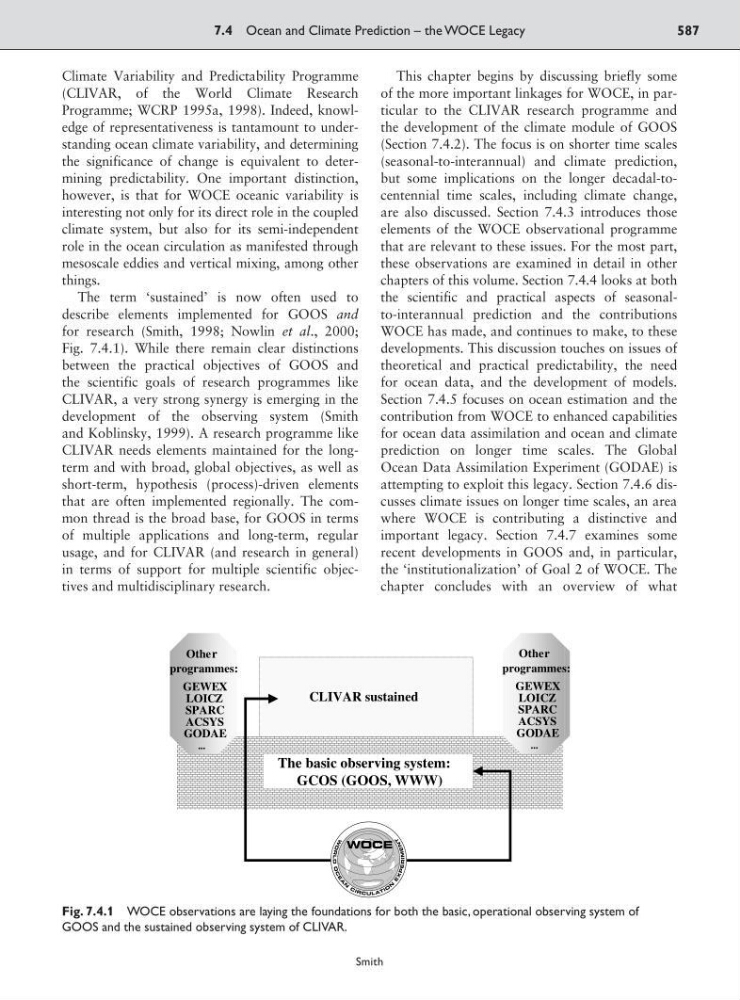
The term ‘sustained’ is now often used to
describe elements implemented for GOOS and
for research (Smith, 1998; Nowlin et al., 2000;
Fig. 7.4.1). While there remain clear distinctions
between the practical objectives of GOOS and
the scientific goals of research programmes like
CLIVAR, a very strong synergy is emerging in the
development of the observing system (Smith
and Koblinsky, 1999). A research programme like
CLIVAR needs elements maintained for the longterm and with broad, global objectives, as well as
short-term, hypothesis (process)-driven elements
that are often implemented regionally. The common thread is the broad base, for GOOS in terms
of multiple applications and long-term, regular
usage, and for CLIVAR (and research in general)
in terms of support for multiple scientific objectives and multidisciplinary research.
This chapter begins by discussing briefly some
of the more important linkages for WOCE, in particular to the CLIVAR research programme and
the development of the climate module of GOOS
(Section 7.4.2). The focus is on shorter time scales
(seasonal-to-interannual) and climate prediction,
but some implications on the longer decadal-tocentennial time scales, including climate change,
are also discussed. Section 7.4.3 introduces those
elements of the WOCE observational programme
that are relevant to these issues. For the most part,
these observations are examined in detail in other
chapters of this volume. Section 7.4.4 looks at both
the scientific and practical aspects of seasonalto-interannual prediction and the contributions
WOCE has made, and continues to make, to these
developments. This discussion touches on issues of
theoretical and practical predictability, the need
for ocean data, and the development of models.
Section 7.4.5 focuses on ocean estimation and the
contribution from WOCE to enhanced capabilities
for ocean data assimilation and ocean and climate
prediction on longer time scales. The Global
Ocean Data Assimilation Experiment (GODAE) is
attempting to exploit this legacy. Section 7.4.6 discusses climate issues on longer time scales, an area
where WOCE is contributing a distinctive and
important legacy. Section 7.4.7 examines some
recent developments in GOOS and, in particular,
the ‘institutionalization’ of Goal 2 of WOCE. The
chapter concludes with an overview of what
7.4 Ocean and Climate Prediction – the WOCE Legacy
587
Smith
Other
programmes:
GEWEX
LOICZ
SPARC
ACSYS
GODAE
...
CLIVAR sustained
Other
GEWEX
LOICZ
SPARC
ACSYS
GODAE
...
The basic observing system:
GCOS (GOOS, WWW)
programmes:
Fig. 7.4.1 WOCE observations are laying the foundations for both the basic, operational observing system of
GOOS and the sustained observing system of CLIVAR.