

Oceanographic and Atmospheric Administration’s
(NOAA) Ocean–Atmosphere Carbon Exchange
Study (OACES) programme, as well as by the US
and International JGOFS Scientific Steering Committees. The NOAA-OACES programme, in particular, played a major role in collecting extensive
data sets for a wide range of ocean carbon-related
parameters along a large number of sections,
including several WOCE sections.
The measurement problem
There are four measurable quantities that can be
used to define the speciation and concentration of
inorganic carbon in seawater (Park, 1969; DOE,
1994). These are the total dissolved inorganic carbon or TCO 2 , the pH, the partial pressure of dissolved CO 2 (pCO 2 ) and the total alkalinity of
seawater. Measurement of any two of these four
allows the concentration of the dissolved CO 2 ,
bicarbonate ion (HCO 3
9
) and carbonate ion
(CO 3
29 ) species to be separately estimated. Of
these, only the first three are changing directly as a
result of the uptake of Excess CO 2 by the oceans.
First and foremost, the pCO 2 is increasing as a
result of the tendency of the surface ocean to
maintain equilibrium with the increasing pCO 2 of
the atmosphere. This implies (for constant alkalinity): increasing TCO 2 and decreasing pH. Table
6.3.1 summarizes the expected annual changes of
the four measurable quantities for surface seawater which maintains equilibrium with the current rate of increase of atmospheric pCO 2 . Also
shown are the typical ranges of these parameters
in the ocean, together with the currently bestattainable measurement accuracy for each parameter. The expected annual increase in surface water
concentrations provides an obvious target for the
accuracy required of CO 2 Survey data in order
that there be potential to document the interannual to decadal build up of CO 2 within the ocean.
During the initial planning stages for the CO 2 Survey such a target seemed impossible to reach, and
it is a measure of the success of the technical work
conducted for the Survey that such a target now
appears to be approachable.
Pre-WOCE data coverage and quality
Prior to the Global CO 2 Survey, the data coverage
for CO 2 parameters was patchy and limited in
scope and quality. The pre-WOCE data consisted
largely of the measurements of TCO 2 , pCO 2 and
alkalinity made during the Geochemical Ocean
Sections (GEOSECS) expeditions between 1972
and 1978, as well as similar measurements made
during the Transient Tracers in the Ocean (TTO)
North and Tropical Atlantic Surveys in 1981–83.
6.3 Storage and Transport of Excess CO 2 in the Oceans
497
Wallace
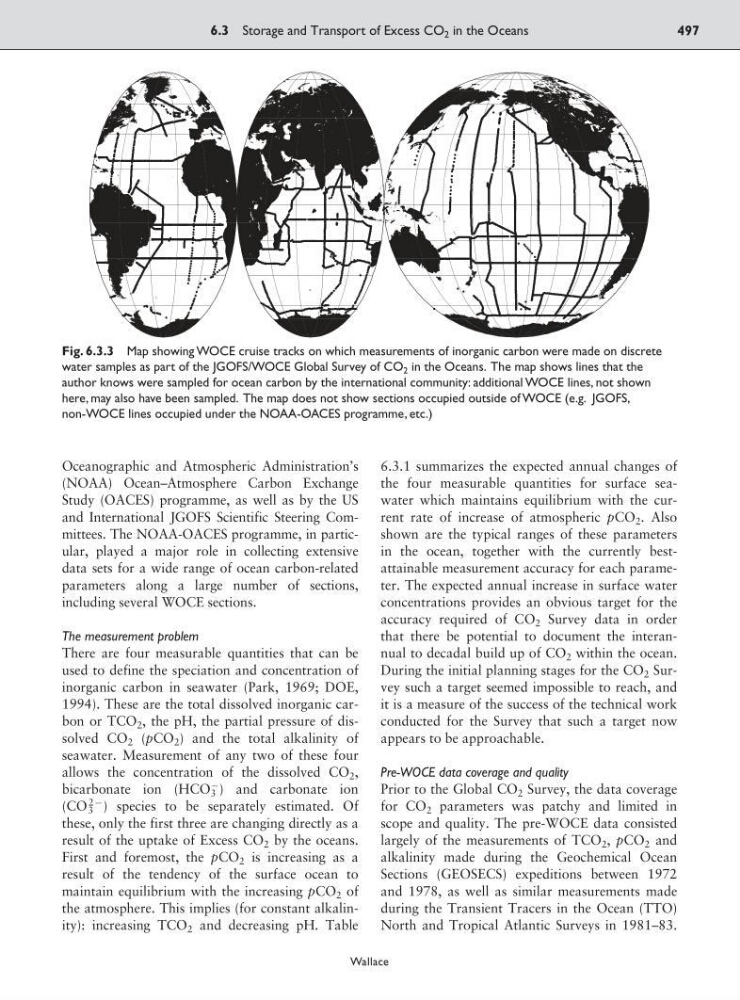
Fig. 6.3.3 Map showing WOCE cruise tracks on which measurements of inorganic carbon were made on discrete
water samples as part of the JGOFS/WOCE Global Survey of CO 2 in the Oceans. The map shows lines that the
author knows were sampled for ocean carbon by the international community: additional WOCE lines, not shown
here, may also have been sampled. The map does not show sections occupied outside of WOCE (e.g. JGOFS,
non-WOCE lines occupied under the NOAA-OACES programme, etc.)
(NOAA) Ocean–Atmosphere Carbon Exchange
Study (OACES) programme, as well as by the US
and International JGOFS Scientific Steering Committees. The NOAA-OACES programme, in particular, played a major role in collecting extensive
data sets for a wide range of ocean carbon-related
parameters along a large number of sections,
including several WOCE sections.
The measurement problem
There are four measurable quantities that can be
used to define the speciation and concentration of
inorganic carbon in seawater (Park, 1969; DOE,
1994). These are the total dissolved inorganic carbon or TCO 2 , the pH, the partial pressure of dissolved CO 2 (pCO 2 ) and the total alkalinity of
seawater. Measurement of any two of these four
allows the concentration of the dissolved CO 2 ,
bicarbonate ion (HCO 3
9
) and carbonate ion
(CO 3
29 ) species to be separately estimated. Of
these, only the first three are changing directly as a
result of the uptake of Excess CO 2 by the oceans.
First and foremost, the pCO 2 is increasing as a
result of the tendency of the surface ocean to
maintain equilibrium with the increasing pCO 2 of
the atmosphere. This implies (for constant alkalinity): increasing TCO 2 and decreasing pH. Table
6.3.1 summarizes the expected annual changes of
the four measurable quantities for surface seawater which maintains equilibrium with the current rate of increase of atmospheric pCO 2 . Also
shown are the typical ranges of these parameters
in the ocean, together with the currently bestattainable measurement accuracy for each parameter. The expected annual increase in surface water
concentrations provides an obvious target for the
accuracy required of CO 2 Survey data in order
that there be potential to document the interannual to decadal build up of CO 2 within the ocean.
During the initial planning stages for the CO 2 Survey such a target seemed impossible to reach, and
it is a measure of the success of the technical work
conducted for the Survey that such a target now
appears to be approachable.
Pre-WOCE data coverage and quality
Prior to the Global CO 2 Survey, the data coverage
for CO 2 parameters was patchy and limited in
scope and quality. The pre-WOCE data consisted
largely of the measurements of TCO 2 , pCO 2 and
alkalinity made during the Geochemical Ocean
Sections (GEOSECS) expeditions between 1972
and 1978, as well as similar measurements made
during the Transient Tracers in the Ocean (TTO)
North and Tropical Atlantic Surveys in 1981–83.
6.3 Storage and Transport of Excess CO 2 in the Oceans
497
Wallace
Fig. 6.3.3 Map showing WOCE cruise tracks on which measurements of inorganic carbon were made on discrete
water samples as part of the JGOFS/WOCE Global Survey of CO 2 in the Oceans. The map shows lines that the
author knows were sampled for ocean carbon by the international community: additional WOCE lines, not shown
here, may also have been sampled. The map does not show sections occupied outside of WOCE (e.g. JGOFS,
non-WOCE lines occupied under the NOAA-OACES programme, etc.)