

may indicate that problems in one section are locally
confined. There are vertical exchanges of decreasing
magnitude away from 11°N in the Atlantic, however, so it may be that a problem at one location
affects the final circulation far away from the initial
location. Another substantial problem with Macdonald’s global circulation is the large conversion of
cold deep waters into warm upper layer waters in
the Indian Ocean, which is now considered to be
incompatible with silica conservation. Despite these
problems, Macdonald’s global circulation solution
presents a consistent set of ocean heat transport estimates that are reasonably close (and within the
errors estimated by Macdonald) to careful estimates
of ocean heat transport throughout the Atlantic
Ocean based on analyses of individual sections.
6.1.5 Discussion
Direct estimates of ocean heat transport are valuable for establishing a baseline for the air–sea flux
climatologies, in assessing the residual estimates of
ocean heat transport, and in evaluating ocean and
coupled atmosphere–ocean general circulation
models. Furthermore, the mechanisms of ocean
heat transport must be understood if we are to
evaluate how ocean circulation and heat transport
will be modified under changing climate conditions.
6.1.5.1 Comparison of direct and indirect
estimates of ocean heat transport
Both da Silva et al. (1994) and Josey et al. (1999)
have compared the ocean heat transports implied
by their air–sea flux climatologies with direct
estimates. da Silva et al. actually constrained their
flux climatology so that its implied heat transports
at 24°N and at the equator in the Atlantic
matched direct estimates of ocean heat transport
across these latitudes. Josey et al. compared their
net air–sea heat exchange with the divergence of
meridional ocean heat transport over regions of the
SECTION 6 LARGE-SCALE OCEAN TRANSPORTS
466
–39±19
Estimated Heat Fluxes (W m )
–2
Convergence (negative values) = Net Heat
Loss to the Atmosphere.
Divergence (positive values)
1±19
–20±20
–2±11
–8±18
–33±22
–1±36
39±63
–20±18
44±21
72±33
19±15
–8±33
–77±57
14±2
141±114
–60±95
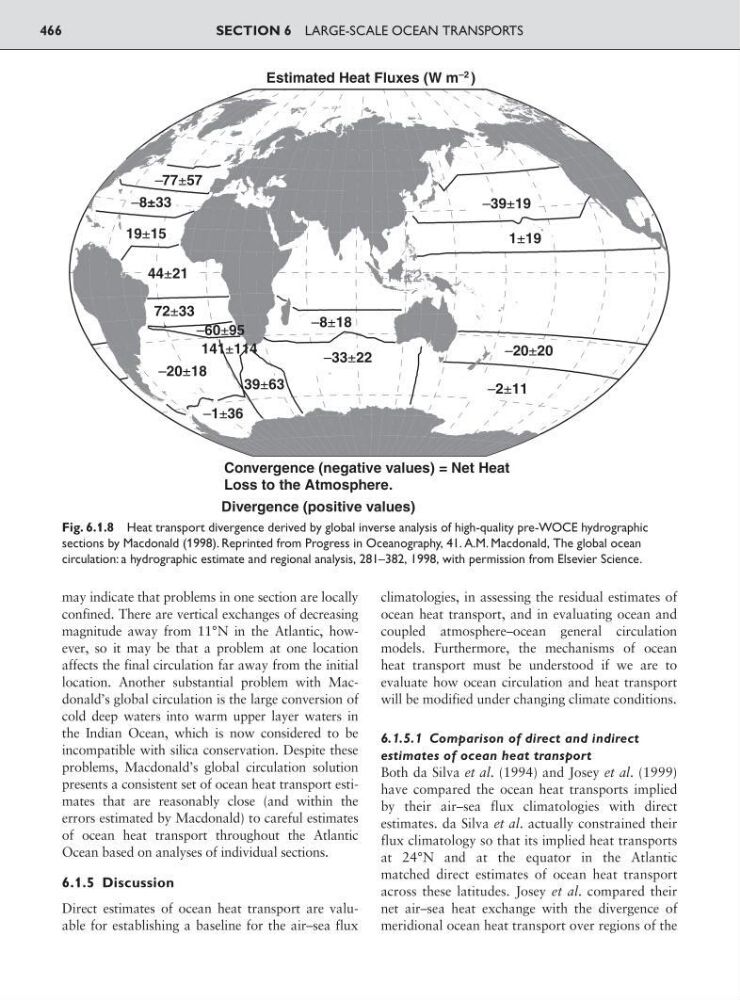
Fig. 6.1.8 Heat transport divergence derived by global inverse analysis of high-quality pre-WOCE hydrographic
sections by Macdonald (1998). Reprinted from Progress in Oceanography, 41. A.M. Macdonald, The global ocean
circulation: a hydrographic estimate and regional analysis, 281–382, 1998, with permission from Elsevier Science.
confined. There are vertical exchanges of decreasing
magnitude away from 11°N in the Atlantic, however, so it may be that a problem at one location
affects the final circulation far away from the initial
location. Another substantial problem with Macdonald’s global circulation is the large conversion of
cold deep waters into warm upper layer waters in
the Indian Ocean, which is now considered to be
incompatible with silica conservation. Despite these
problems, Macdonald’s global circulation solution
presents a consistent set of ocean heat transport estimates that are reasonably close (and within the
errors estimated by Macdonald) to careful estimates
of ocean heat transport throughout the Atlantic
Ocean based on analyses of individual sections.
6.1.5 Discussion
Direct estimates of ocean heat transport are valuable for establishing a baseline for the air–sea flux
climatologies, in assessing the residual estimates of
ocean heat transport, and in evaluating ocean and
coupled atmosphere–ocean general circulation
models. Furthermore, the mechanisms of ocean
heat transport must be understood if we are to
evaluate how ocean circulation and heat transport
will be modified under changing climate conditions.
6.1.5.1 Comparison of direct and indirect
estimates of ocean heat transport
Both da Silva et al. (1994) and Josey et al. (1999)
have compared the ocean heat transports implied
by their air–sea flux climatologies with direct
estimates. da Silva et al. actually constrained their
flux climatology so that its implied heat transports
at 24°N and at the equator in the Atlantic
matched direct estimates of ocean heat transport
across these latitudes. Josey et al. compared their
net air–sea heat exchange with the divergence of
meridional ocean heat transport over regions of the
SECTION 6 LARGE-SCALE OCEAN TRANSPORTS
466
–39±19
Estimated Heat Fluxes (W m )
–2
Convergence (negative values) = Net Heat
Loss to the Atmosphere.
Divergence (positive values)
1±19
–20±20
–2±11
–8±18
–33±22
–1±36
39±63
–20±18
44±21
72±33
19±15
–8±33
–77±57
14±2
141±114
–60±95
Fig. 6.1.8 Heat transport divergence derived by global inverse analysis of high-quality pre-WOCE hydrographic
sections by Macdonald (1998). Reprinted from Progress in Oceanography, 41. A.M. Macdonald, The global ocean
circulation: a hydrographic estimate and regional analysis, 281–382, 1998, with permission from Elsevier Science.