

on the size of the Ekman transport and/or boundary currents. For example, consider that the
seasonal Ekman transport varies by 10 Sv over a
section of width 5000 km and depth 4000 m.
Compensation for the Ekman transport can generally be done in a depth-independent manner
because changes in baroclinic structure require
much longer time scales for adjustment. With
three-quarters of the section area in deep water
(below 1000 m depth), most of the compensation
for seasonal changes is in the deep water flow; in
this example the deep water flow would vary by
7.5 Sv. For a temperature difference between the
Ekman transport and the barotropic temperature
of 20°C, the seasonal change in heat transport
would be 0.8 PW. Is this interesting or important?
We would argue that such seasonal heat transport
variation is not particularly interesting because the
barotropic compensating velocity would be only
0.05 cm s
91 and over 6 months the water would
move only 10 km before sloshing back in the other
direction. The key assumption, of course, is that
the baroclinic structure remains constant on seasonal time scales and there are few, if any, observations with which we can test such an assumption.
Theory and numerical simulations, however, tend
to confirm this assumption (Böning and Herrmann,
1994, for the Atlantic; Wacongne and Pacanowski,
1996, and Lee and Marotzke, 1998, for the Indian
Ocean) and observationally based analyses of the
24°N Atlantic section have not yet revealed significant seasonal fluctuations in the mid-ocean baroclinic structure (Fillenbaum et al., 1997; Baringer
and Molinari, 1999).
Koltermann et al. (1999) also estimated heat
transports across 24°N, 36°N and 48°N in their
study of decadal changes in the North Atlantic
thermohaline circulation from the 1950s to the
1980s to the 1990s. Their circulation and heat
transport across 24°N are reasonably time invariant and similar to those of Lavín et al. (1998), but
their estimates at 36°N and 48°N exhibit large
decadal variability, both in heat transport and in
meridional overturning circulation. Their analysis
procedure fixed the Gulf Stream transport at 24°N
to be 32 Sv, as measured in Florida Straits, and at
36°N and 48°N to equal the Sverdrup transport
based on Hellerman and Rosenstein (1983) winds –
about 17 Sv and 5 Sv, respectively. Because such
transports are far less than observed Gulf Stream
transports across 36°N and 48°N and because the
treatment of western boundary current transports
is so critical for direct estimates of ocean heat
transport, we question the heat transports at 36°N
and 48°N estimated by Koltermann et al.
6.1.4.2 Pacific Ocean heat transport
In the Pacific Ocean, Wijffels et al. (1996a) have
analysed a 1989 trans-Pacific hydrographic section
across 10°N; Tsimplis et al. (1998) examined two
WOCE sections across 17°S and 32°S; Wijffels
et al. (2000) examined the WOCE section across
32°S; and Koshlyakov and Sazhina (1995) analysed
a WOCE section at 67°S across the Ross Sea.
Ongoing work to quantify the heat tranport in the
North Pacific will be discussed in Section 6.1.6.
At 10°N Wijffels et al. (1996a) found the upper
level circulation and deep water circulation to be
SECTION 6 LARGE-SCALE OCEAN TRANSPORTS
462
80° N
60°
40°
20°
0°
20°
40°
60°
80°S
60
20° 0°
1.2
0.5 PW
0.6
1.3
0.3 PW
0.3
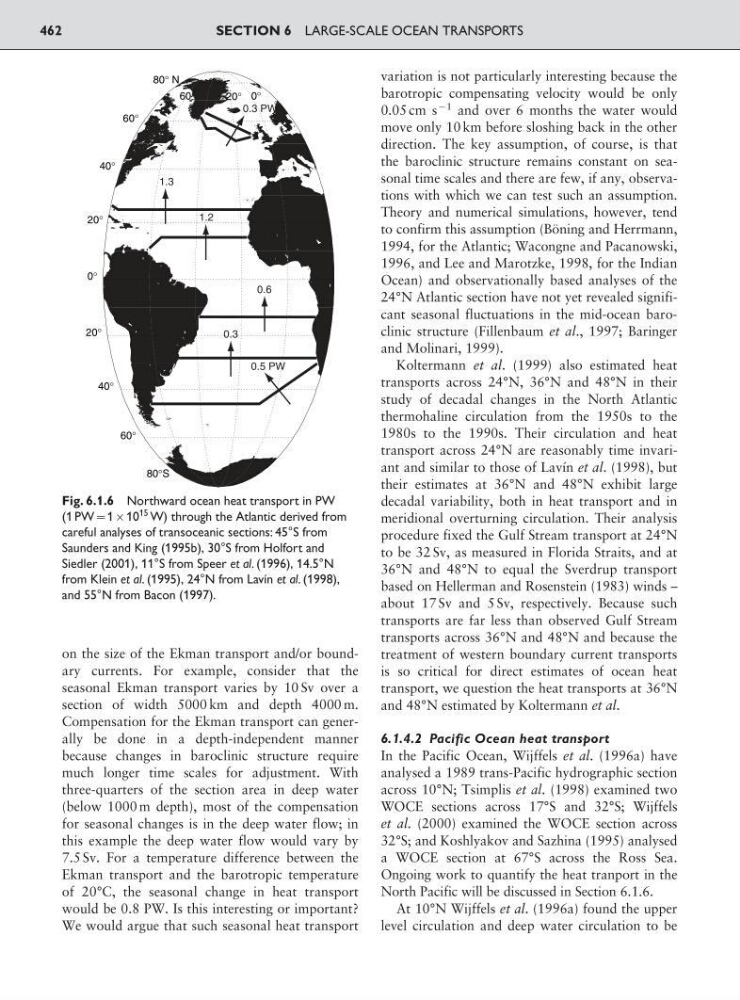
Fig. 6.1.6 Northward ocean heat transport in PW
(1 PW:110
15 W) through the Atlantic derived from
careful analyses of transoceanic sections: 45°S from
Saunders and King (1995b), 30°S from Holfort and
Siedler (2001), 11°S from Speer et al. (1996), 14.5°N
from Klein et al. (1995), 24°N from Lavín et al. (1998),
and 55°N from Bacon (1997).
seasonal Ekman transport varies by 10 Sv over a
section of width 5000 km and depth 4000 m.
Compensation for the Ekman transport can generally be done in a depth-independent manner
because changes in baroclinic structure require
much longer time scales for adjustment. With
three-quarters of the section area in deep water
(below 1000 m depth), most of the compensation
for seasonal changes is in the deep water flow; in
this example the deep water flow would vary by
7.5 Sv. For a temperature difference between the
Ekman transport and the barotropic temperature
of 20°C, the seasonal change in heat transport
would be 0.8 PW. Is this interesting or important?
We would argue that such seasonal heat transport
variation is not particularly interesting because the
barotropic compensating velocity would be only
0.05 cm s
91 and over 6 months the water would
move only 10 km before sloshing back in the other
direction. The key assumption, of course, is that
the baroclinic structure remains constant on seasonal time scales and there are few, if any, observations with which we can test such an assumption.
Theory and numerical simulations, however, tend
to confirm this assumption (Böning and Herrmann,
1994, for the Atlantic; Wacongne and Pacanowski,
1996, and Lee and Marotzke, 1998, for the Indian
Ocean) and observationally based analyses of the
24°N Atlantic section have not yet revealed significant seasonal fluctuations in the mid-ocean baroclinic structure (Fillenbaum et al., 1997; Baringer
and Molinari, 1999).
Koltermann et al. (1999) also estimated heat
transports across 24°N, 36°N and 48°N in their
study of decadal changes in the North Atlantic
thermohaline circulation from the 1950s to the
1980s to the 1990s. Their circulation and heat
transport across 24°N are reasonably time invariant and similar to those of Lavín et al. (1998), but
their estimates at 36°N and 48°N exhibit large
decadal variability, both in heat transport and in
meridional overturning circulation. Their analysis
procedure fixed the Gulf Stream transport at 24°N
to be 32 Sv, as measured in Florida Straits, and at
36°N and 48°N to equal the Sverdrup transport
based on Hellerman and Rosenstein (1983) winds –
about 17 Sv and 5 Sv, respectively. Because such
transports are far less than observed Gulf Stream
transports across 36°N and 48°N and because the
treatment of western boundary current transports
is so critical for direct estimates of ocean heat
transport, we question the heat transports at 36°N
and 48°N estimated by Koltermann et al.
6.1.4.2 Pacific Ocean heat transport
In the Pacific Ocean, Wijffels et al. (1996a) have
analysed a 1989 trans-Pacific hydrographic section
across 10°N; Tsimplis et al. (1998) examined two
WOCE sections across 17°S and 32°S; Wijffels
et al. (2000) examined the WOCE section across
32°S; and Koshlyakov and Sazhina (1995) analysed
a WOCE section at 67°S across the Ross Sea.
Ongoing work to quantify the heat tranport in the
North Pacific will be discussed in Section 6.1.6.
At 10°N Wijffels et al. (1996a) found the upper
level circulation and deep water circulation to be
SECTION 6 LARGE-SCALE OCEAN TRANSPORTS
462
80° N
60°
40°
20°
0°
20°
40°
60°
80°S
60
20° 0°
1.2
0.5 PW
0.6
1.3
0.3 PW
0.3
Fig. 6.1.6 Northward ocean heat transport in PW
(1 PW:110
15 W) through the Atlantic derived from
careful analyses of transoceanic sections: 45°S from
Saunders and King (1995b), 30°S from Holfort and
Siedler (2001), 11°S from Speer et al. (1996), 14.5°N
from Klein et al. (1995), 24°N from Lavín et al. (1998),
and 55°N from Bacon (1997).