

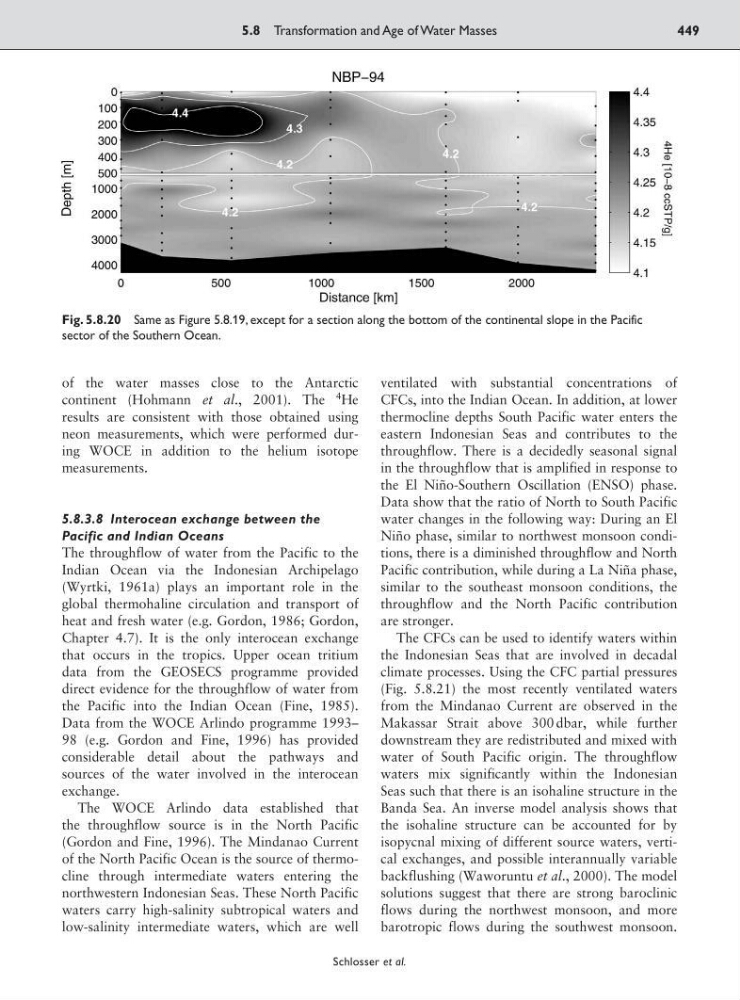
of the water masses close to the Antarctic
continent (Hohmann et al., 2001). The
4
He
results are consistent with those obtained using
neon measurements, which were performed during WOCE in addition to the helium isotope
measurements.
5.8.3.8 Interocean exchange between the
Pacific and Indian Oceans
The throughflow of water from the Pacific to the
Indian Ocean via the Indonesian Archipelago
(Wyrtki, 1961a) plays an important role in the
global thermohaline circulation and transport of
heat and fresh water (e.g. Gordon, 1986; Gordon,
Chapter 4.7). It is the only interocean exchange
that occurs in the tropics. Upper ocean tritium
data from the GEOSECS programme provided
direct evidence for the throughflow of water from
the Pacific into the Indian Ocean (Fine, 1985).
Data from the WOCE Arlindo programme 1993–
98 (e.g. Gordon and Fine, 1996) has provided
considerable detail about the pathways and
sources of the water involved in the interocean
exchange.
The WOCE Arlindo data established that
the throughflow source is in the North Pacific
(Gordon and Fine, 1996). The Mindanao Current
of the North Pacific Ocean is the source of thermocline through intermediate waters entering the
northwestern Indonesian Seas. These North Pacific
waters carry high-salinity subtropical waters and
low-salinity intermediate waters, which are well
ventilated with substantial concentrations of
CFCs, into the Indian Ocean. In addition, at lower
thermocline depths South Pacific water enters the
eastern Indonesian Seas and contributes to the
throughflow. There is a decidedly seasonal signal
in the throughflow that is amplified in response to
the El Niño-Southern Oscillation (ENSO) phase.
Data show that the ratio of North to South Pacific
water changes in the following way: During an El
Niño phase, similar to northwest monsoon conditions, there is a diminished throughflow and North
Pacific contribution, while during a La Niña phase,
similar to the southeast monsoon conditions, the
throughflow and the North Pacific contribution
are stronger.
The CFCs can be used to identify waters within
the Indonesian Seas that are involved in decadal
climate processes. Using the CFC partial pressures
(Fig. 5.8.21) the most recently ventilated waters
from the Mindanao Current are observed in the
Makassar Strait above 300 dbar, while further
downstream they are redistributed and mixed with
water of South Pacific origin. The throughflow
waters mix significantly within the Indonesian
Seas such that there is an isohaline structure in the
Banda Sea. An inverse model analysis shows that
the isohaline structure can be accounted for by
isopycnal mixing of different source waters, vertical exchanges, and possible interannually variable
backflushing (Waworuntu et al., 2000). The model
solutions suggest that there are strong baroclinic
flows during the northwest monsoon, and more
barotropic flows during the southwest monsoon.
5.8 Transformation and Age of Water Masses
449
Schlosser et al.
Fig. 5.8.20 Same as Figure 5.8.19, except for a section along the bottom of the continental slope in the Pacific
sector of the Southern Ocean.
continent (Hohmann et al., 2001). The
4
He
results are consistent with those obtained using
neon measurements, which were performed during WOCE in addition to the helium isotope
measurements.
5.8.3.8 Interocean exchange between the
Pacific and Indian Oceans
The throughflow of water from the Pacific to the
Indian Ocean via the Indonesian Archipelago
(Wyrtki, 1961a) plays an important role in the
global thermohaline circulation and transport of
heat and fresh water (e.g. Gordon, 1986; Gordon,
Chapter 4.7). It is the only interocean exchange
that occurs in the tropics. Upper ocean tritium
data from the GEOSECS programme provided
direct evidence for the throughflow of water from
the Pacific into the Indian Ocean (Fine, 1985).
Data from the WOCE Arlindo programme 1993–
98 (e.g. Gordon and Fine, 1996) has provided
considerable detail about the pathways and
sources of the water involved in the interocean
exchange.
The WOCE Arlindo data established that
the throughflow source is in the North Pacific
(Gordon and Fine, 1996). The Mindanao Current
of the North Pacific Ocean is the source of thermocline through intermediate waters entering the
northwestern Indonesian Seas. These North Pacific
waters carry high-salinity subtropical waters and
low-salinity intermediate waters, which are well
ventilated with substantial concentrations of
CFCs, into the Indian Ocean. In addition, at lower
thermocline depths South Pacific water enters the
eastern Indonesian Seas and contributes to the
throughflow. There is a decidedly seasonal signal
in the throughflow that is amplified in response to
the El Niño-Southern Oscillation (ENSO) phase.
Data show that the ratio of North to South Pacific
water changes in the following way: During an El
Niño phase, similar to northwest monsoon conditions, there is a diminished throughflow and North
Pacific contribution, while during a La Niña phase,
similar to the southeast monsoon conditions, the
throughflow and the North Pacific contribution
are stronger.
The CFCs can be used to identify waters within
the Indonesian Seas that are involved in decadal
climate processes. Using the CFC partial pressures
(Fig. 5.8.21) the most recently ventilated waters
from the Mindanao Current are observed in the
Makassar Strait above 300 dbar, while further
downstream they are redistributed and mixed with
water of South Pacific origin. The throughflow
waters mix significantly within the Indonesian
Seas such that there is an isohaline structure in the
Banda Sea. An inverse model analysis shows that
the isohaline structure can be accounted for by
isopycnal mixing of different source waters, vertical exchanges, and possible interannually variable
backflushing (Waworuntu et al., 2000). The model
solutions suggest that there are strong baroclinic
flows during the northwest monsoon, and more
barotropic flows during the southwest monsoon.
5.8 Transformation and Age of Water Masses
449
Schlosser et al.
Fig. 5.8.20 Same as Figure 5.8.19, except for a section along the bottom of the continental slope in the Pacific
sector of the Southern Ocean.