

Water (typical saturation levels :3%) along the
pathway. This mixing roughly doubles the initial
volume of the strongly ventilated shelf component, and reduces the CFC saturation level to
Ϸ35%.
5.8.3.7 Addition of glacial meltwater around
Antarctica traced by
4 He
Helium isotopes and stable isotopes of water
(mainly ␦
18 O) have been developed as a tool to
study the addition of fresh water from melting of
the glacial ice sheets around Antarctica (e.g. Weiss
et al., 1979; Jacobs et al., 1985; Schlosser, 1986;
Schlosser et al., 1990; Weppernig et al., 1996).
Most of the stable isotope data, including all published noble gas results, are from studies performed in the Weddell Sea. They allowed us to
examine the pathways of Ice Shelf Water, a fresh
shelf water type that is produced around Antarctica through interaction of near-surface water with
glacial ice shelves (e.g. Lusquinos, 1963; Jacobs
et al., 1970, 1979; Foldvik et al., 1985a–c), from
its source onto the continental slope (e.g. Schlosser
et al., 1990). Additionally, these tracers are among
the very few tools that can be used to quantify
the relative contributions of ISW and other shelf
water to Antarctic Bottom Water (AABW; e.g.
Weppernig et al., 1996).
The WOCE One-Time Survey allowed us to
collect the first helium isotope data set in areas
outside the Weddell Sea with the goal to determine
the contribution of glacial meltwater to the freshwater budget on the shelves of the Southern
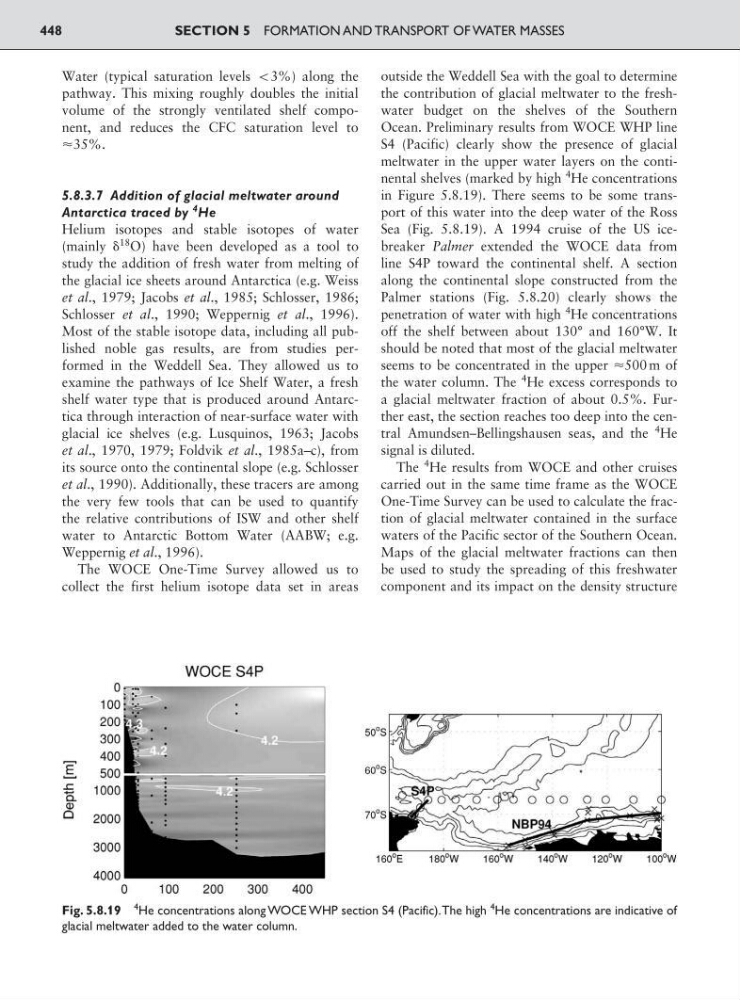
Ocean. Preliminary results from WOCE WHP line
S4 (Pacific) clearly show the presence of glacial
meltwater in the upper water layers on the continental shelves (marked by high
4
He concentrations
in Figure 5.8.19). There seems to be some transport of this water into the deep water of the Ross
Sea (Fig. 5.8.19). A 1994 cruise of the US icebreaker Palmer extended the WOCE data from
line S4P toward the continental shelf. A section
along the continental slope constructed from the
Palmer stations (Fig. 5.8.20) clearly shows the
penetration of water with high
4
He concentrations
off the shelf between about 130° and 160°W. It
should be noted that most of the glacial meltwater
seems to be concentrated in the upper Ϸ500 m of
the water column. The
4
He excess corresponds to
a glacial meltwater fraction of about 0.5%. Further east, the section reaches too deep into the central Amundsen–Bellingshausen seas, and the
4
He
signal is diluted.
The
4
He results from WOCE and other cruises
carried out in the same time frame as the WOCE
One-Time Survey can be used to calculate the fraction of glacial meltwater contained in the surface
waters of the Pacific sector of the Southern Ocean.
Maps of the glacial meltwater fractions can then
be used to study the spreading of this freshwater
component and its impact on the density structure
SECTION 5 FORMATION AND TRANSPORT OF WATER MASSES
448
Fig. 5.8.19
4 He concentrations along WOCE WHP section S4 (Pacific).The high
4 He concentrations are indicative of
glacial meltwater added to the water column.
pathway. This mixing roughly doubles the initial
volume of the strongly ventilated shelf component, and reduces the CFC saturation level to
Ϸ35%.
5.8.3.7 Addition of glacial meltwater around
Antarctica traced by
4 He
Helium isotopes and stable isotopes of water
(mainly ␦
18 O) have been developed as a tool to
study the addition of fresh water from melting of
the glacial ice sheets around Antarctica (e.g. Weiss
et al., 1979; Jacobs et al., 1985; Schlosser, 1986;
Schlosser et al., 1990; Weppernig et al., 1996).
Most of the stable isotope data, including all published noble gas results, are from studies performed in the Weddell Sea. They allowed us to
examine the pathways of Ice Shelf Water, a fresh
shelf water type that is produced around Antarctica through interaction of near-surface water with
glacial ice shelves (e.g. Lusquinos, 1963; Jacobs
et al., 1970, 1979; Foldvik et al., 1985a–c), from
its source onto the continental slope (e.g. Schlosser
et al., 1990). Additionally, these tracers are among
the very few tools that can be used to quantify
the relative contributions of ISW and other shelf
water to Antarctic Bottom Water (AABW; e.g.
Weppernig et al., 1996).
The WOCE One-Time Survey allowed us to
collect the first helium isotope data set in areas
outside the Weddell Sea with the goal to determine
the contribution of glacial meltwater to the freshwater budget on the shelves of the Southern
Ocean. Preliminary results from WOCE WHP line
S4 (Pacific) clearly show the presence of glacial
meltwater in the upper water layers on the continental shelves (marked by high
4
He concentrations
in Figure 5.8.19). There seems to be some transport of this water into the deep water of the Ross
Sea (Fig. 5.8.19). A 1994 cruise of the US icebreaker Palmer extended the WOCE data from
line S4P toward the continental shelf. A section
along the continental slope constructed from the
Palmer stations (Fig. 5.8.20) clearly shows the
penetration of water with high
4
He concentrations
off the shelf between about 130° and 160°W. It
should be noted that most of the glacial meltwater
seems to be concentrated in the upper Ϸ500 m of
the water column. The
4
He excess corresponds to
a glacial meltwater fraction of about 0.5%. Further east, the section reaches too deep into the central Amundsen–Bellingshausen seas, and the
4
He
signal is diluted.
The
4
He results from WOCE and other cruises
carried out in the same time frame as the WOCE
One-Time Survey can be used to calculate the fraction of glacial meltwater contained in the surface
waters of the Pacific sector of the Southern Ocean.
Maps of the glacial meltwater fractions can then
be used to study the spreading of this freshwater
component and its impact on the density structure
SECTION 5 FORMATION AND TRANSPORT OF WATER MASSES
448
Fig. 5.8.19
4 He concentrations along WOCE WHP section S4 (Pacific).The high
4 He concentrations are indicative of
glacial meltwater added to the water column.