

with a pronounced minimum between these
plumes centred on the equator. This
3 He minimum
is consistent with the interpretation of Talley and
Johnson (1994), who postulate the existence of a
deep eastward flow on the equator based on the
WOCE hydrographic data. In the North Pacific,
the helium distribution shows a weaker plume
extending from the Juan de Fuca Ridge southwestward toward Hawaii, and an eastward transport
indicated by the
3
He minimum in the eastern
Pacific at Ϸ20°N. Many of these features are also
evident in the WOCE P17 section along 135°W,
which crosses many of the major helium plumes in
the Pacific (Fig. 5.8.15, see Plate 5.8.15, p. 428).
The striking symmetry of the two EPR plumes
north and south of the equator is evident in the
P17 helium section, as is the
3
He minimum on the
equator. The maximum in
3
He at Ϸ45°N latitude
in the P17 section corresponds to the core of the
plume from the Juan de Fuca Ridge in the northeast Pacific. Finally, as will be discussed below, the
upward slope in the ␦
3 He contours at Ϸ20°N and
Ϸ1200 m depth in the P17 section has been attributed to helium injection from the Loihi Seamount
(Lupton, 1996).
Although the majority of the mantle helium
injection occurs along active portions of the MidOcean Ridge system, helium plumes emanating
from hydrothermally active seamounts have also
been detected. Because seamount hydrothermal
sources are typically much shallower than MidOcean Ridges, the helium injected at active
seamounts has potential for tracing regional circulation patterns at intermediate to shallow depths.
The marine environment of the Macdonald
Seamount in the South Pacific has been observed
in active eruptive state (Cheminée et al., 1991),
with injections of
3 He into the overlying water
column at a depth of Ϸ130 m (Craig et al., 1988).
Very recently,
3 He plumes have been detected at
depths between 150 and 1500 m emanating from
several active seamounts in the Kermadec Arc
northeast of New Zealand (de Ronde et al., 1999).
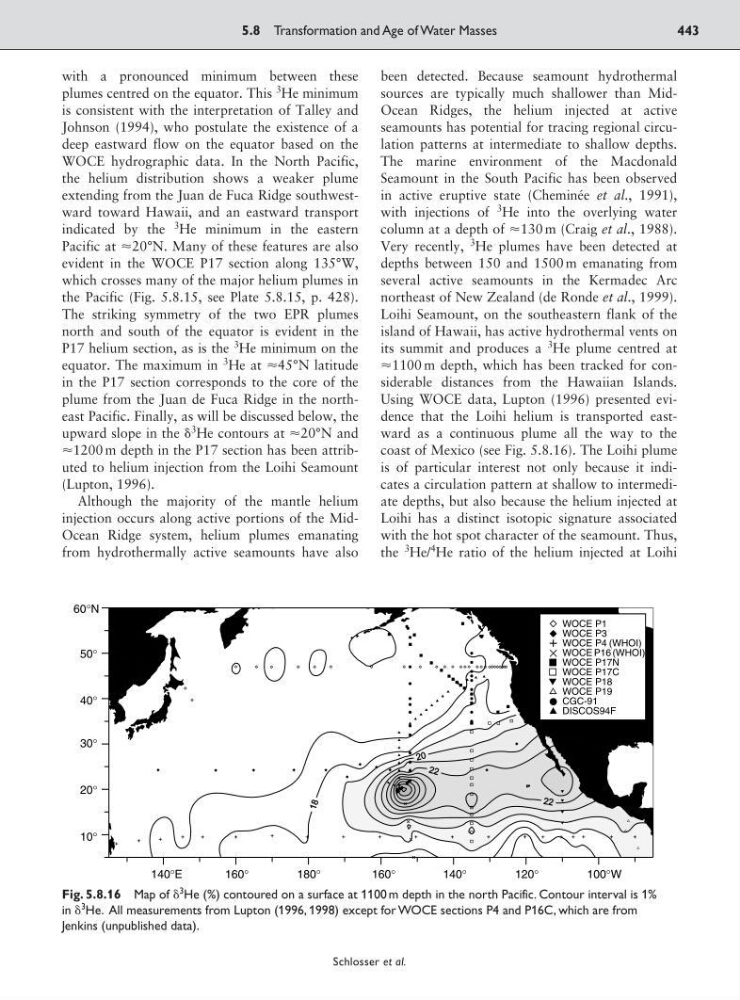
Loihi Seamount, on the southeastern flank of the
island of Hawaii, has active hydrothermal vents on
its summit and produces a
3 He plume centred at
Ϸ1100 m depth, which has been tracked for considerable distances from the Hawaiian Islands.
Using WOCE data, Lupton (1996) presented evidence that the Loihi helium is transported eastward as a continuous plume all the way to the
coast of Mexico (see Fig. 5.8.16). The Loihi plume
is of particular interest not only because it indicates a circulation pattern at shallow to intermediate depths, but also because the helium injected at
Loihi has a distinct isotopic signature associated
with the hot spot character of the seamount. Thus,
the
3 He/
4 He ratio of the helium injected at Loihi
5.8 Transformation and Age of Water Masses
443
Schlosser et al.
WOCE P1
WOCE P3
WOCE P4 (WHOI)
WOCE P16 (WHOI)
WOCE P17N
WOCE P17C
WOCE P18
WOCE P19
CGC-91
DISCO S94F
WOCE P1
WOCE P3
WOCE P4 (WHOI)
WOCE P16 (WHOI)
WOCE P17N
WOCE P17C
WOCE P18
WOCE P19
CGC-91
DISCOS94F
140°E
160°
60°N
50°
40°
30°
20°
10°
180°
160°
140°
120°
100°W
Fig. 5.8.16 Map of ␦
3
He (%) contoured on a surface at 1100 m depth in the north Pacific. Contour interval is 1%
in ␦
3 He. All measurements from Lupton (1996, 1998) except for WOCE sections P4 and P16C, which are from
Jenkins (unpublished data).
plumes centred on the equator. This
3 He minimum
is consistent with the interpretation of Talley and
Johnson (1994), who postulate the existence of a
deep eastward flow on the equator based on the
WOCE hydrographic data. In the North Pacific,
the helium distribution shows a weaker plume
extending from the Juan de Fuca Ridge southwestward toward Hawaii, and an eastward transport
indicated by the
3
He minimum in the eastern
Pacific at Ϸ20°N. Many of these features are also
evident in the WOCE P17 section along 135°W,
which crosses many of the major helium plumes in
the Pacific (Fig. 5.8.15, see Plate 5.8.15, p. 428).
The striking symmetry of the two EPR plumes
north and south of the equator is evident in the
P17 helium section, as is the
3
He minimum on the
equator. The maximum in
3
He at Ϸ45°N latitude
in the P17 section corresponds to the core of the
plume from the Juan de Fuca Ridge in the northeast Pacific. Finally, as will be discussed below, the
upward slope in the ␦
3 He contours at Ϸ20°N and
Ϸ1200 m depth in the P17 section has been attributed to helium injection from the Loihi Seamount
(Lupton, 1996).
Although the majority of the mantle helium
injection occurs along active portions of the MidOcean Ridge system, helium plumes emanating
from hydrothermally active seamounts have also
been detected. Because seamount hydrothermal
sources are typically much shallower than MidOcean Ridges, the helium injected at active
seamounts has potential for tracing regional circulation patterns at intermediate to shallow depths.
The marine environment of the Macdonald
Seamount in the South Pacific has been observed
in active eruptive state (Cheminée et al., 1991),
with injections of
3 He into the overlying water
column at a depth of Ϸ130 m (Craig et al., 1988).
Very recently,
3 He plumes have been detected at
depths between 150 and 1500 m emanating from
several active seamounts in the Kermadec Arc
northeast of New Zealand (de Ronde et al., 1999).
Loihi Seamount, on the southeastern flank of the
island of Hawaii, has active hydrothermal vents on
its summit and produces a
3 He plume centred at
Ϸ1100 m depth, which has been tracked for considerable distances from the Hawaiian Islands.
Using WOCE data, Lupton (1996) presented evidence that the Loihi helium is transported eastward as a continuous plume all the way to the
coast of Mexico (see Fig. 5.8.16). The Loihi plume
is of particular interest not only because it indicates a circulation pattern at shallow to intermediate depths, but also because the helium injected at
Loihi has a distinct isotopic signature associated
with the hot spot character of the seamount. Thus,
the
3 He/
4 He ratio of the helium injected at Loihi
5.8 Transformation and Age of Water Masses
443
Schlosser et al.
WOCE P1
WOCE P3
WOCE P4 (WHOI)
WOCE P16 (WHOI)
WOCE P17N
WOCE P17C
WOCE P18
WOCE P19
CGC-91
DISCO S94F
WOCE P1
WOCE P3
WOCE P4 (WHOI)
WOCE P16 (WHOI)
WOCE P17N
WOCE P17C
WOCE P18
WOCE P19
CGC-91
DISCOS94F
140°E
160°
60°N
50°
40°
30°
20°
10°
180°
160°
140°
120°
100°W
Fig. 5.8.16 Map of ␦
3
He (%) contoured on a surface at 1100 m depth in the north Pacific. Contour interval is 1%
in ␦
3 He. All measurements from Lupton (1996, 1998) except for WOCE sections P4 and P16C, which are from
Jenkins (unpublished data).