

36.1‰) into a dense Mediterranean Water, which
has a salinity of 38.4‰, a temperature of 13°C
and a density of 1029.7 kg m
93
, as it outflows at
depth through the Strait of Gibraltar. The
Mediterranean Sea is often regarded as a ‘laboratory basin’ for oceanographic circulation studies,
especially of the thermohaline circulation, which is
particularly active despite the relatively small size
of the sea. It is one of the few places in the world
where deep convection and water mass formation
take place. In the present climate, deep convection
occurs only in the Atlantic Ocean; the Labrador,
Greenland and Mediterranean Seas; and occasionally also in the Weddell Sea. Convection in these
regions feeds the thermohaline circulation, the
global meridional-overturning circulation of the
ocean responsible for roughly half of the poleward
heat transport demanded of the atmosphere–ocean
system (Marshall and Schott, 1999; see also
Bryden and Imawaki, Chapter 6.1). It is conjectured
that the resulting Mediterranean outflow plays an
important though indirect role in the North
Atlantic circulation (Reid, 1979) and, consequently,
in the thermohaline conveyor belt at global scales
and on time scales of global climate change (Wu
and Haines, 1996). According to Reid (1979) the
Mediterranean outflow helps maintain the high
salinity of the Norwegian Sea. Without this source
of high-salinity water the Norwegian–Greenland
Sea might not provide the denser waters that fill
the Arctic Basin and thus contribute a major component of the North Atlantic Deep Water. It is the
relatively saline North Atlantic Deep Water, transported by the deep western boundary current,
that penetrates into the low-salinity waters of the
Weddell Sea, where it is cooled further and
enriched with brine to provide the Antarctic Bottom Water – the densest water found in the oceans
of the world. To the extent that these suggested
linkages are correct, the exchange between the
Atlantic Ocean and the Mediterranean Sea is of
significant importance.
5.7.2 Formation of Mediterranean Water
There are several places within the Mediterranean
where preconditioning (i.e. a cyclonic circulation
with convex curvature of isopycnals that bring
dense, and usually weakly stratified, waters close to
the surface) and air–sea fluxes combine to induce
convective processes (for details on the convection
mechanisms, see Marshall and Schott, 1999). These
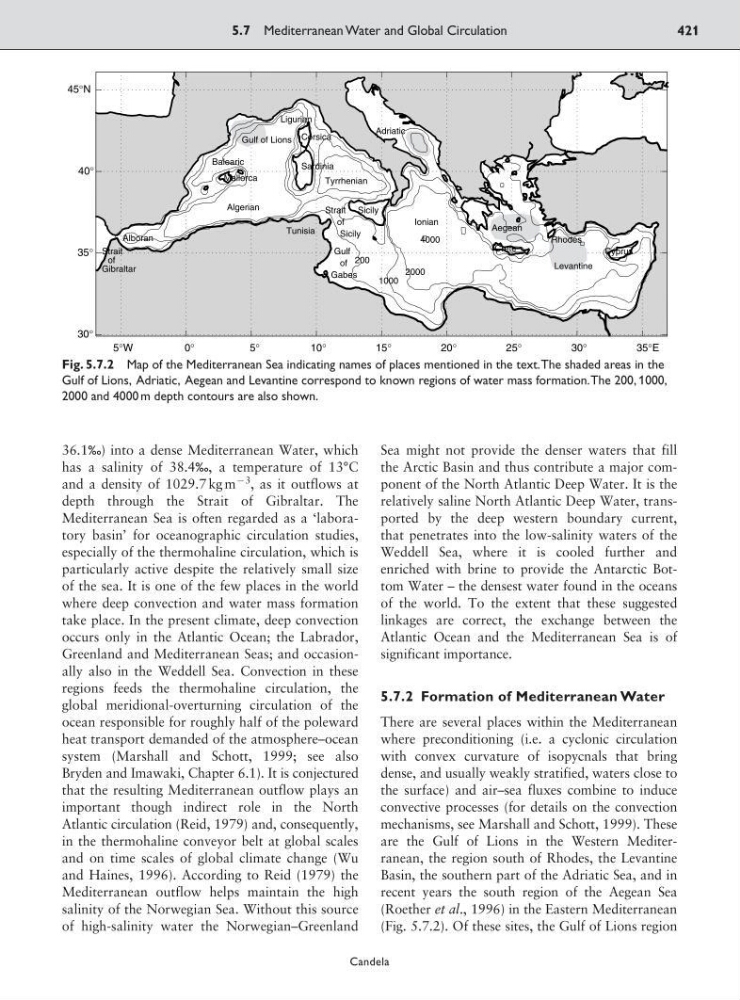
are the Gulf of Lions in the Western Mediterranean, the region south of Rhodes, the Levantine
Basin, the southern part of the Adriatic Sea, and in
recent years the south region of the Aegean Sea
(Roether et al., 1996) in the Eastern Mediterranean
(Fig. 5.7.2). Of these sites, the Gulf of Lions region
5.7 Mediterranean Water and Global Circulation
421
Candela
5°W
0°
5°
10°
15°
20°
25°
30°
35°E
30°
35°
45°N
Strait
Strait
of
of
Gibraltar
Sicily
Alboran
Algerian
Mallorca
Balearic
Ligurian
Gulf of Lions Corsica
Sardinia
Tyrrhenian
Sicily
Ionian
Gulf
of
Gabes
Tunisia
Adriatic
200
1000
2000
4000
Crete
Levantine
Rhodes
Aegean
Cyprus
40°
Fig. 5.7.2 Map of the Mediterranean Sea indicating names of places mentioned in the text.The shaded areas in the
Gulf of Lions, Adriatic, Aegean and Levantine correspond to known regions of water mass formation.The 200, 1000,
2000 and 4000 m depth contours are also shown.
has a salinity of 38.4‰, a temperature of 13°C
and a density of 1029.7 kg m
93
, as it outflows at
depth through the Strait of Gibraltar. The
Mediterranean Sea is often regarded as a ‘laboratory basin’ for oceanographic circulation studies,
especially of the thermohaline circulation, which is
particularly active despite the relatively small size
of the sea. It is one of the few places in the world
where deep convection and water mass formation
take place. In the present climate, deep convection
occurs only in the Atlantic Ocean; the Labrador,
Greenland and Mediterranean Seas; and occasionally also in the Weddell Sea. Convection in these
regions feeds the thermohaline circulation, the
global meridional-overturning circulation of the
ocean responsible for roughly half of the poleward
heat transport demanded of the atmosphere–ocean
system (Marshall and Schott, 1999; see also
Bryden and Imawaki, Chapter 6.1). It is conjectured
that the resulting Mediterranean outflow plays an
important though indirect role in the North
Atlantic circulation (Reid, 1979) and, consequently,
in the thermohaline conveyor belt at global scales
and on time scales of global climate change (Wu
and Haines, 1996). According to Reid (1979) the
Mediterranean outflow helps maintain the high
salinity of the Norwegian Sea. Without this source
of high-salinity water the Norwegian–Greenland
Sea might not provide the denser waters that fill
the Arctic Basin and thus contribute a major component of the North Atlantic Deep Water. It is the
relatively saline North Atlantic Deep Water, transported by the deep western boundary current,
that penetrates into the low-salinity waters of the
Weddell Sea, where it is cooled further and
enriched with brine to provide the Antarctic Bottom Water – the densest water found in the oceans
of the world. To the extent that these suggested
linkages are correct, the exchange between the
Atlantic Ocean and the Mediterranean Sea is of
significant importance.
5.7.2 Formation of Mediterranean Water
There are several places within the Mediterranean
where preconditioning (i.e. a cyclonic circulation
with convex curvature of isopycnals that bring
dense, and usually weakly stratified, waters close to
the surface) and air–sea fluxes combine to induce
convective processes (for details on the convection
mechanisms, see Marshall and Schott, 1999). These
are the Gulf of Lions in the Western Mediterranean, the region south of Rhodes, the Levantine
Basin, the southern part of the Adriatic Sea, and in
recent years the south region of the Aegean Sea
(Roether et al., 1996) in the Eastern Mediterranean
(Fig. 5.7.2). Of these sites, the Gulf of Lions region
5.7 Mediterranean Water and Global Circulation
421
Candela
5°W
0°
5°
10°
15°
20°
25°
30°
35°E
30°
35°
45°N
Strait
Strait
of
of
Gibraltar
Sicily
Alboran
Algerian
Mallorca
Balearic
Ligurian
Gulf of Lions Corsica
Sardinia
Tyrrhenian
Sicily
Ionian
Gulf
of
Gabes
Tunisia
Adriatic
200
1000
2000
4000
Crete
Levantine
Rhodes
Aegean
Cyprus
40°
Fig. 5.7.2 Map of the Mediterranean Sea indicating names of places mentioned in the text.The shaded areas in the
Gulf of Lions, Adriatic, Aegean and Levantine correspond to known regions of water mass formation.The 200, 1000,
2000 and 4000 m depth contours are also shown.