

frequent and long-lived reversals (Fig. 5.6.6). The
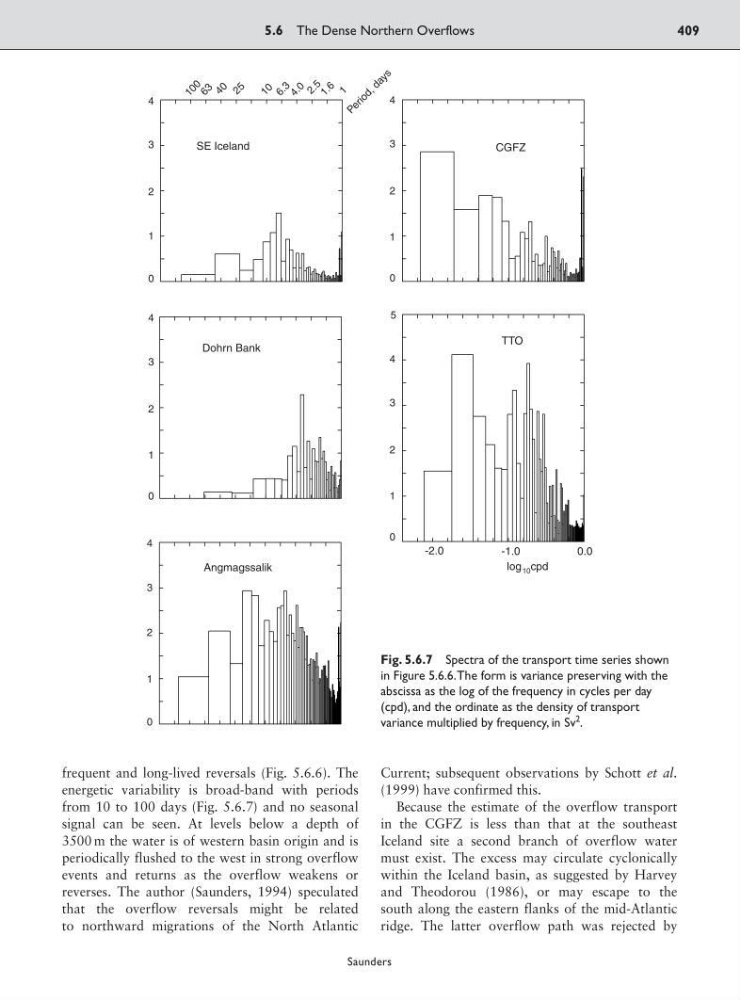
energetic variability is broad-band with periods
from 10 to 100 days (Fig. 5.6.7) and no seasonal
signal can be seen. At levels below a depth of
3500 m the water is of western basin origin and is
periodically flushed to the west in strong overflow
events and returns as the overflow weakens or
reverses. The author (Saunders, 1994) speculated
that the overflow reversals might be related
to northward migrations of the North Atlantic
Current; subsequent observations by Schott et al.
(1999) have confirmed this.
Because the estimate of the overflow transport
in the CGFZ is less than that at the southeast
Iceland site a second branch of overflow water
must exist. The excess may circulate cyclonically
within the Iceland basin, as suggested by Harvey
and Theodorou (1986), or may escape to the
south along the eastern flanks of the mid-Atlantic
ridge. The latter overflow path was rejected by
5.6 The Dense Northern Overflows
409
Saunders
SE Iceland
CGFZ
Dohrn Bank
TTO
Angmagssalik
0.0
-2.0
-1.0
log cpd
10
1
1 . 6
2 . 5
4 . 0
6 . 3
1 0
2 5
4 0
6 3
1 0 0
P e r i o d , d a y s
0
1
2
3
4
5
0
1
2
3
4
0
1
2
3
4
0
1
2
3
4
0
1
2
3
4
Fig. 5.6.7 Spectra of the transport time series shown
in Figure 5.6.6.The form is variance preserving with the
abscissa as the log of the frequency in cycles per day
(cpd), and the ordinate as the density of transport
variance multiplied by frequency, in Sv
2 .
energetic variability is broad-band with periods
from 10 to 100 days (Fig. 5.6.7) and no seasonal
signal can be seen. At levels below a depth of
3500 m the water is of western basin origin and is
periodically flushed to the west in strong overflow
events and returns as the overflow weakens or
reverses. The author (Saunders, 1994) speculated
that the overflow reversals might be related
to northward migrations of the North Atlantic
Current; subsequent observations by Schott et al.
(1999) have confirmed this.
Because the estimate of the overflow transport
in the CGFZ is less than that at the southeast
Iceland site a second branch of overflow water
must exist. The excess may circulate cyclonically
within the Iceland basin, as suggested by Harvey
and Theodorou (1986), or may escape to the
south along the eastern flanks of the mid-Atlantic
ridge. The latter overflow path was rejected by
5.6 The Dense Northern Overflows
409
Saunders
SE Iceland
CGFZ
Dohrn Bank
TTO
Angmagssalik
0.0
-2.0
-1.0
log cpd
10
1
1 . 6
2 . 5
4 . 0
6 . 3
1 0
2 5
4 0
6 3
1 0 0
P e r i o d , d a y s
0
1
2
3
4
5
0
1
2
3
4
0
1
2
3
4
0
1
2
3
4
0
1
2
3
4
Fig. 5.6.7 Spectra of the transport time series shown
in Figure 5.6.6.The form is variance preserving with the
abscissa as the log of the frequency in cycles per day
(cpd), and the ordinate as the density of transport
variance multiplied by frequency, in Sv
2 .