

virtue of their connection (or not) to the sea surface. In regions that are directly connected to the
surface, i.e. that are within a Montgomery streamtube, the flow can be said to be wind-forced and
the regions swept out by such a streamtube are
‘ventilated’, in the sense that the water along one
of these paths was at the sea surface a definite,
advective, time in the past. The LPS theory makes
detailed predictions for these ventilated portions of
the thermocline, and is often referred to as the
ventilated thermocline model. There are other
extensive regions of the thermocline that are not
within a Montgomery streamtube and that are not
connected to the sea surface by way of an advective path. These ‘unventilated’ regions may or may
not be at rest; along the eastern boundary of
a gyre there are extensive unventilated regions
that abut the eastern boundary and extend well
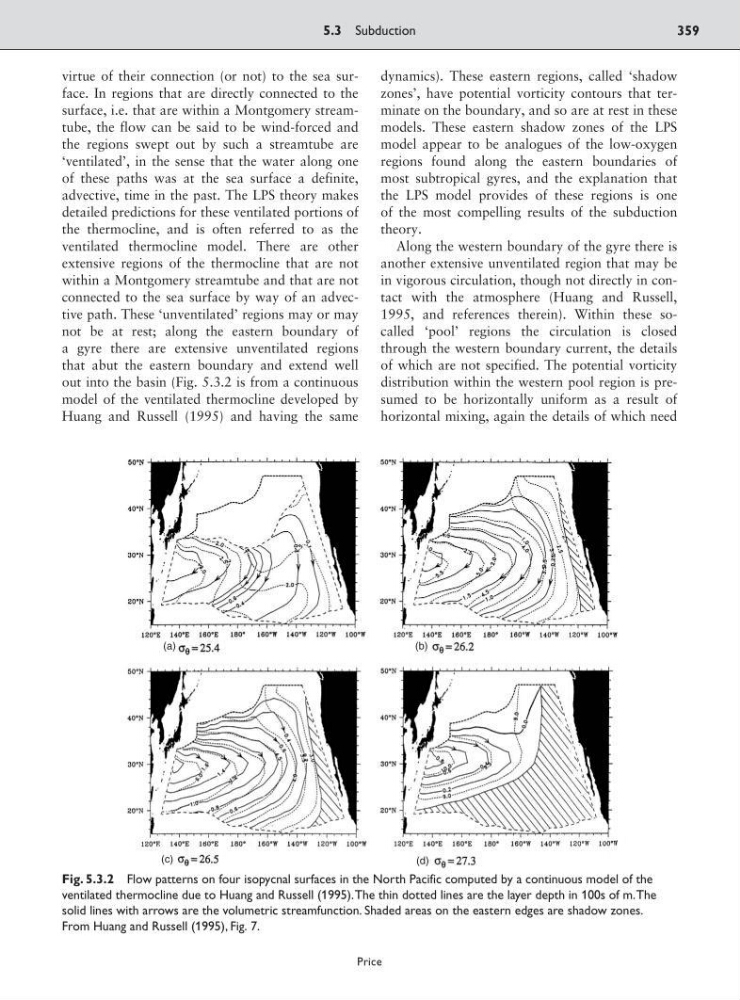
out into the basin (Fig. 5.3.2 is from a continuous
model of the ventilated thermocline developed by
Huang and Russell (1995) and having the same
dynamics). These eastern regions, called ‘shadow
zones’, have potential vorticity contours that terminate on the boundary, and so are at rest in these
models. These eastern shadow zones of the LPS
model appear to be analogues of the low-oxygen
regions found along the eastern boundaries of
most subtropical gyres, and the explanation that
the LPS model provides of these regions is one
of the most compelling results of the subduction
theory.
Along the western boundary of the gyre there is
another extensive unventilated region that may be
in vigorous circulation, though not directly in contact with the atmosphere (Huang and Russell,
1995, and references therein). Within these socalled ‘pool’ regions the circulation is closed
through the western boundary current, the details
of which are not specified. The potential vorticity
distribution within the western pool region is presumed to be horizontally uniform as a result of
horizontal mixing, again the details of which need
5.3 Subduction
359
Price
(a)
(b)
(d)
(c)
Fig. 5.3.2 Flow patterns on four isopycnal surfaces in the North Pacific computed by a continuous model of the
ventilated thermocline due to Huang and Russell (1995).The thin dotted lines are the layer depth in 100s of m.The
solid lines with arrows are the volumetric streamfunction. Shaded areas on the eastern edges are shadow zones.
From Huang and Russell (1995), Fig. 7.
surface, i.e. that are within a Montgomery streamtube, the flow can be said to be wind-forced and
the regions swept out by such a streamtube are
‘ventilated’, in the sense that the water along one
of these paths was at the sea surface a definite,
advective, time in the past. The LPS theory makes
detailed predictions for these ventilated portions of
the thermocline, and is often referred to as the
ventilated thermocline model. There are other
extensive regions of the thermocline that are not
within a Montgomery streamtube and that are not
connected to the sea surface by way of an advective path. These ‘unventilated’ regions may or may
not be at rest; along the eastern boundary of
a gyre there are extensive unventilated regions
that abut the eastern boundary and extend well
out into the basin (Fig. 5.3.2 is from a continuous
model of the ventilated thermocline developed by
Huang and Russell (1995) and having the same
dynamics). These eastern regions, called ‘shadow
zones’, have potential vorticity contours that terminate on the boundary, and so are at rest in these
models. These eastern shadow zones of the LPS
model appear to be analogues of the low-oxygen
regions found along the eastern boundaries of
most subtropical gyres, and the explanation that
the LPS model provides of these regions is one
of the most compelling results of the subduction
theory.
Along the western boundary of the gyre there is
another extensive unventilated region that may be
in vigorous circulation, though not directly in contact with the atmosphere (Huang and Russell,
1995, and references therein). Within these socalled ‘pool’ regions the circulation is closed
through the western boundary current, the details
of which are not specified. The potential vorticity
distribution within the western pool region is presumed to be horizontally uniform as a result of
horizontal mixing, again the details of which need
5.3 Subduction
359
Price
(a)
(b)
(d)
(c)
Fig. 5.3.2 Flow patterns on four isopycnal surfaces in the North Pacific computed by a continuous model of the
ventilated thermocline due to Huang and Russell (1995).The thin dotted lines are the layer depth in 100s of m.The
solid lines with arrows are the volumetric streamfunction. Shaded areas on the eastern edges are shadow zones.
From Huang and Russell (1995), Fig. 7.