

heat flux is consistent with observations in Drake
Passage that the fronts satisfy the linear criteria
for baroclinic instability (Bryden, 1979; Wright,
1981). Extrapolation of eddy heat flux measurements in Drake Passage and southeast of New
Zealand to the entire circumpolar belt suggested
the eddy fluxes were large enough to close the heat
balance (Bryden, 1979; Bryden and Heath, 1985),
but concern remained that these observations were
not representative of the ACC as a whole.
In terms of theory and modelling of the ACC,
the state of the art prior to the WOCE (World
Ocean Circulation Experiment) period can be
briefly summarized as follows. Early wind-driven
models of the ACC gave huge transport values
unless very large friction was included. Munk and
Palmén (1951) proposed that bottom form stress
balanced the wind stress. High-resolution quasigeostrophic models tended to confirm this balance
(e.g. McWilliams et al., 1978). At the same time,
Sverdrup theory appeared to do a reasonable job
of predicting the transport and path of the ACC
(Stommel, 1957; Baker, 1982). However, prior to
the WOCE era no high-resolution primitive equation models with realistic geometry, stratification,
and full thermodynamics had been run, and many
dynamical questions remained open.
Here we review what has been learnt about the
Antarctic Circumpolar Current system over the
last decade, largely as a result of the WOCE programme. By the ‘ACC system’ we mean not only
the zonal flow of the ACC itself, but also the
meridional overturning circulation and water
masses of the Southern Ocean. Nowlin and Klinck
(1986) provide a comprehensive review of ACC
physics as understood at that time, primarily on
the basis of measurements in Drake Passage and
earlier circumpolar hydrographic surveys. We
assume the reader has some familiarity with the
dynamics of ocean or atmosphere circulation.
Readers interested in more background on topics
such as Sverdrup balance, Ekman layers, and
potential vorticity are referred to textbooks such
as Gill (1982).
We first describe recent observations of the
structure and transport of the ACC (Section 4.6.2).
Numerical and analytical models have led to substantial advances with regard to the theory and
dynamics of the ACC, and its links to the meridional circulation (Section 4.6.3). New observations
4.6 The Antarctic Circumpolar Current System
273
Rintoul, Hughes and Olbers
70
60
50
40
30
Continental
Shelf
Mid-Ocean Ridge
AABW
NADW
UCDW
AAIW
SAMW
PF
SAF
STF
Antarctica
80°S
buoyancy
loss
buoyancy
gain
LCDW
Depth (m)
1000
2000
3000
4000
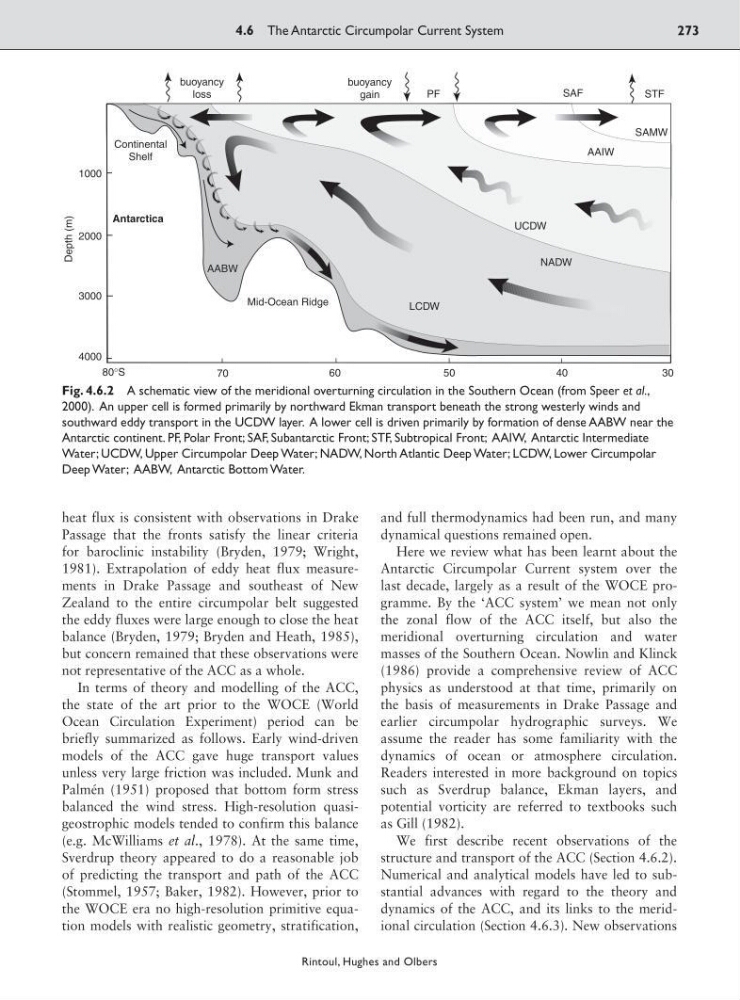
Fig. 4.6.2 A schematic view of the meridional overturning circulation in the Southern Ocean (from Speer et al.,
2000). An upper cell is formed primarily by northward Ekman transport beneath the strong westerly winds and
southward eddy transport in the UCDW layer. A lower cell is driven primarily by formation of dense AABW near the
Antarctic continent. PF, Polar Front; SAF, Subantarctic Front; STF, Subtropical Front; AAIW, Antarctic Intermediate
Water; UCDW, Upper Circumpolar Deep Water; NADW, North Atlantic Deep Water; LCDW, Lower Circumpolar
Deep Water; AABW, Antarctic Bottom Water.
Passage that the fronts satisfy the linear criteria
for baroclinic instability (Bryden, 1979; Wright,
1981). Extrapolation of eddy heat flux measurements in Drake Passage and southeast of New
Zealand to the entire circumpolar belt suggested
the eddy fluxes were large enough to close the heat
balance (Bryden, 1979; Bryden and Heath, 1985),
but concern remained that these observations were
not representative of the ACC as a whole.
In terms of theory and modelling of the ACC,
the state of the art prior to the WOCE (World
Ocean Circulation Experiment) period can be
briefly summarized as follows. Early wind-driven
models of the ACC gave huge transport values
unless very large friction was included. Munk and
Palmén (1951) proposed that bottom form stress
balanced the wind stress. High-resolution quasigeostrophic models tended to confirm this balance
(e.g. McWilliams et al., 1978). At the same time,
Sverdrup theory appeared to do a reasonable job
of predicting the transport and path of the ACC
(Stommel, 1957; Baker, 1982). However, prior to
the WOCE era no high-resolution primitive equation models with realistic geometry, stratification,
and full thermodynamics had been run, and many
dynamical questions remained open.
Here we review what has been learnt about the
Antarctic Circumpolar Current system over the
last decade, largely as a result of the WOCE programme. By the ‘ACC system’ we mean not only
the zonal flow of the ACC itself, but also the
meridional overturning circulation and water
masses of the Southern Ocean. Nowlin and Klinck
(1986) provide a comprehensive review of ACC
physics as understood at that time, primarily on
the basis of measurements in Drake Passage and
earlier circumpolar hydrographic surveys. We
assume the reader has some familiarity with the
dynamics of ocean or atmosphere circulation.
Readers interested in more background on topics
such as Sverdrup balance, Ekman layers, and
potential vorticity are referred to textbooks such
as Gill (1982).
We first describe recent observations of the
structure and transport of the ACC (Section 4.6.2).
Numerical and analytical models have led to substantial advances with regard to the theory and
dynamics of the ACC, and its links to the meridional circulation (Section 4.6.3). New observations
4.6 The Antarctic Circumpolar Current System
273
Rintoul, Hughes and Olbers
70
60
50
40
30
Continental
Shelf
Mid-Ocean Ridge
AABW
NADW
UCDW
AAIW
SAMW
PF
SAF
STF
Antarctica
80°S
buoyancy
loss
buoyancy
gain
LCDW
Depth (m)
1000
2000
3000
4000
Fig. 4.6.2 A schematic view of the meridional overturning circulation in the Southern Ocean (from Speer et al.,
2000). An upper cell is formed primarily by northward Ekman transport beneath the strong westerly winds and
southward eddy transport in the UCDW layer. A lower cell is driven primarily by formation of dense AABW near the
Antarctic continent. PF, Polar Front; SAF, Subantarctic Front; STF, Subtropical Front; AAIW, Antarctic Intermediate
Water; UCDW, Upper Circumpolar Deep Water; NADW, North Atlantic Deep Water; LCDW, Lower Circumpolar
Deep Water; AABW, Antarctic Bottom Water.