

flows in the meridional-vertical plane are also
significant. By following property extrema such as
an oxygen minimum or salinity maximum, early
investigators (e.g. Sverdrup, 1933) inferred the
overturning circulation shown schematically in Fig.
4.6.2. Deep water spreads poleward and upward
across the ACC and is balanced by equatorward
flow in lighter and denser layers. This pattern is driven at least in part by the wind stress acting on the
sea surface: south of the westerly wind stress maximum (which generally lies near the axis of the
ACC), the Ekman transport is divergent and deep
water upwells into the surface layer; north of the
westerly wind maximum, the Ekman transport is
convergent and surface waters are downwelled into
the ocean interior. The water masses exported from
the Southern Ocean to lower latitudes as part of
this overturning circulation are responsible for
renewing the intermediate and abyssal depths of the
southern hemisphere oceans. However, although
the general pattern and significance of the meridional circulation of the Southern Ocean has been
recognized for many decades, until recently no
attempt had been made to quantify the flow paths
and water mass conversions implied by Fig. 4.6.2.
The ACC is also unique in the extent to which
eddy fluxes contribute to the dynamical and
thermodynamical balances. For example, in the
absence of mean meridional geostrophic flow
across the Drake Passage gap, eddies must carry a
significant poleward heat flux to balance the heat
lost to the atmosphere at high latitudes and the
heat carried equatorward in the Ekman layer
(de Szoeke and Levine, 1981). A significant eddy
SECTION 4 THE GLOBAL FLOW FIELD
272
1
5
0
°
E
1
2
0
°
E
90°E
6
0
°
E
3
0
° E
0°
3 0 ° E
6 0 ° E
90°E
1 2 0 ° E
1 5 0 ° E
180°E
B e n g u el a C
A
g
u
lh
as
C.
A C C
S u b a n t a r c t ic F .
P o la r F .
Leeuw in C .
E
a s t
A u
s t .
C
.
W
e
d
d
e
ll
G
.
Ros s
G.
AC
C
Ma
lv
in
a
s
C
.
Bra zil C.
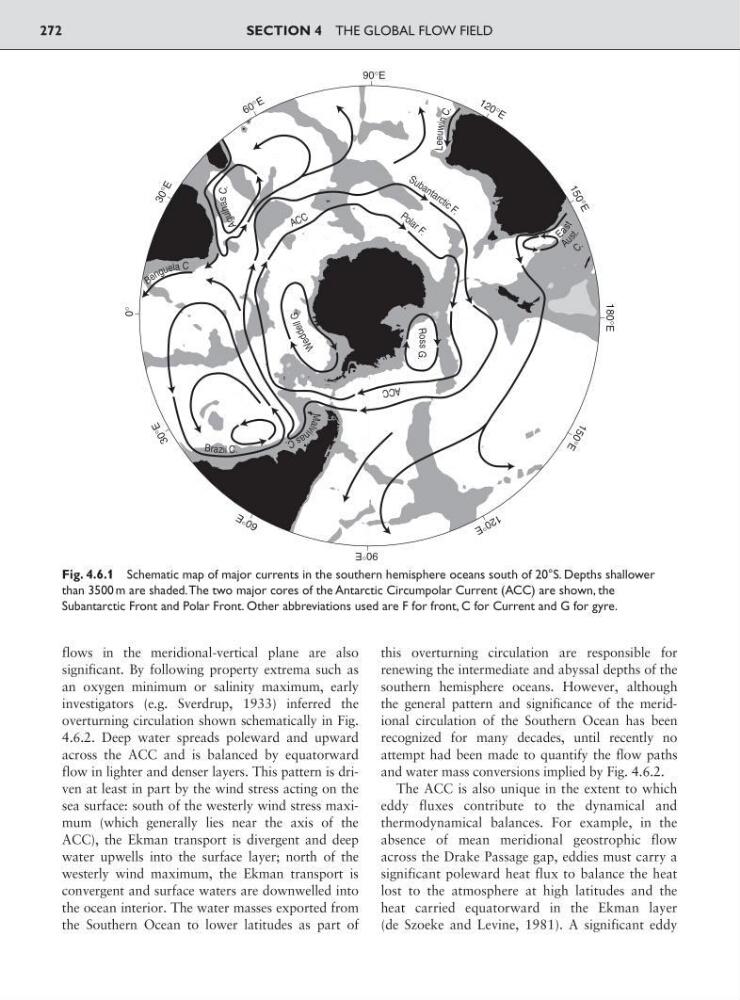
Fig. 4.6.1 Schematic map of major currents in the southern hemisphere oceans south of 20°S. Depths shallower
than 3500 m are shaded.The two major cores of the Antarctic Circumpolar Current (ACC) are shown, the
Subantarctic Front and Polar Front. Other abbreviations used are F for front, C for Current and G for gyre.
significant. By following property extrema such as
an oxygen minimum or salinity maximum, early
investigators (e.g. Sverdrup, 1933) inferred the
overturning circulation shown schematically in Fig.
4.6.2. Deep water spreads poleward and upward
across the ACC and is balanced by equatorward
flow in lighter and denser layers. This pattern is driven at least in part by the wind stress acting on the
sea surface: south of the westerly wind stress maximum (which generally lies near the axis of the
ACC), the Ekman transport is divergent and deep
water upwells into the surface layer; north of the
westerly wind maximum, the Ekman transport is
convergent and surface waters are downwelled into
the ocean interior. The water masses exported from
the Southern Ocean to lower latitudes as part of
this overturning circulation are responsible for
renewing the intermediate and abyssal depths of the
southern hemisphere oceans. However, although
the general pattern and significance of the meridional circulation of the Southern Ocean has been
recognized for many decades, until recently no
attempt had been made to quantify the flow paths
and water mass conversions implied by Fig. 4.6.2.
The ACC is also unique in the extent to which
eddy fluxes contribute to the dynamical and
thermodynamical balances. For example, in the
absence of mean meridional geostrophic flow
across the Drake Passage gap, eddies must carry a
significant poleward heat flux to balance the heat
lost to the atmosphere at high latitudes and the
heat carried equatorward in the Ekman layer
(de Szoeke and Levine, 1981). A significant eddy
SECTION 4 THE GLOBAL FLOW FIELD
272
1
5
0
°
E
1
2
0
°
E
90°E
6
0
°
E
3
0
° E
0°
3 0 ° E
6 0 ° E
90°E
1 2 0 ° E
1 5 0 ° E
180°E
B e n g u el a C
A
g
u
lh
as
C.
A C C
S u b a n t a r c t ic F .
P o la r F .
Leeuw in C .
E
a s t
A u
s t .
C
.
W
e
d
d
e
ll
G
.
Ros s
G.
AC
C
Ma
lv
in
a
s
C
.
Bra zil C.
Fig. 4.6.1 Schematic map of major currents in the southern hemisphere oceans south of 20°S. Depths shallower
than 3500 m are shaded.The two major cores of the Antarctic Circumpolar Current (ACC) are shown, the
Subantarctic Front and Polar Front. Other abbreviations used are F for front, C for Current and G for gyre.