

and smallest in boreal spring. (Notice, however,
the presence of eastward currents during the
March 1993 CITHER cruise at 7.5°N, but at a
latitude further north than usual for the NECC;
Arhan et al., 1998; Arnault et al., 1999; Bourles
et al., 1999b.)
Upper ocean circulation near South America
The strongest meridional transports in the tropical
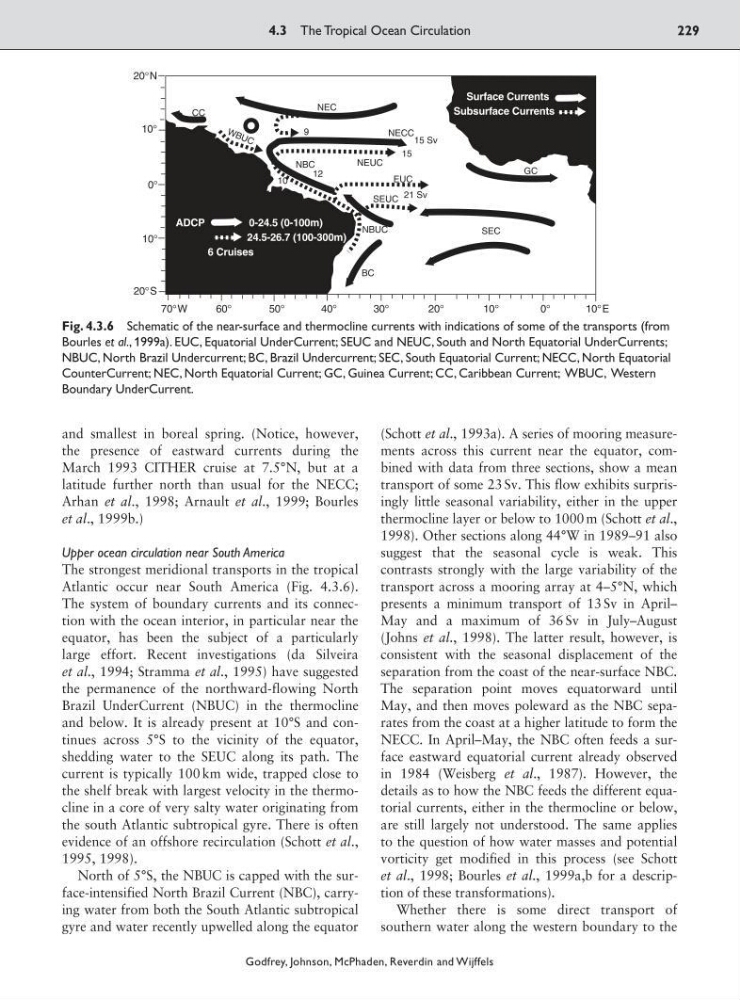
Atlantic occur near South America (Fig. 4.3.6).
The system of boundary currents and its connection with the ocean interior, in particular near the
equator, has been the subject of a particularly
large effort. Recent investigations (da Silveira
et al., 1994; Stramma et al., 1995) have suggested
the permanence of the northward-flowing North
Brazil UnderCurrent (NBUC) in the thermocline
and below. It is already present at 10°S and continues across 5°S to the vicinity of the equator,
shedding water to the SEUC along its path. The
current is typically 100 km wide, trapped close to
the shelf break with largest velocity in the thermocline in a core of very salty water originating from
the south Atlantic subtropical gyre. There is often
evidence of an offshore recirculation (Schott et al.,
1995, 1998).
North of 5°S, the NBUC is capped with the surface-intensified North Brazil Current (NBC), carrying water from both the South Atlantic subtropical
gyre and water recently upwelled along the equator
(Schott et al., 1993a). A series of mooring measurements across this current near the equator, combined with data from three sections, show a mean
transport of some 23 Sv. This flow exhibits surprisingly little seasonal variability, either in the upper
thermocline layer or below to 1000 m (Schott et al.,
1998). Other sections along 44°W in 1989–91 also
suggest that the seasonal cycle is weak. This
contrasts strongly with the large variability of the
transport across a mooring array at 4–5°N, which
presents a minimum transport of 13 Sv in April–
May and a maximum of 36 Sv in July–August
(Johns et al., 1998). The latter result, however, is
consistent with the seasonal displacement of the
separation from the coast of the near-surface NBC.
The separation point moves equatorward until
May, and then moves poleward as the NBC separates from the coast at a higher latitude to form the
NECC. In April–May, the NBC often feeds a surface eastward equatorial current already observed
in 1984 (Weisberg et al., 1987). However, the
details as to how the NBC feeds the different equatorial currents, either in the thermocline or below,
are still largely not understood. The same applies
to the question of how water masses and potential
vorticity get modified in this process (see Schott
et al., 1998; Bourles et al., 1999a,b for a description of these transformations).
Whether there is some direct transport of
southern water along the western boundary to the
4.3 The Tropical Ocean Circulation
229
Godfrey, Johnson, McPhaden, Reverdin and Wijffels
Surface Currents
Subsurface Currents
ADCP
0-24.5 (0-100m)
24.5-26.7 (100-300m)
6 Cruises
20°N
10°
0°
10°
20°S
70°W
6 0 °
50°
40°
30°
20°
10°
0°
10°E
Fig. 4.3.6 Schematic of the near-surface and thermocline currents with indications of some of the transports (from
Bourles et al., 1999a). EUC, Equatorial UnderCurrent; SEUC and NEUC, South and North Equatorial UnderCurrents;
NBUC, North Brazil Undercurrent; BC, Brazil Undercurrent; SEC, South Equatorial Current; NECC, North Equatorial
CounterCurrent; NEC, North Equatorial Current; GC, Guinea Current; CC, Caribbean Current; WBUC, Western
Boundary UnderCurrent.
the presence of eastward currents during the
March 1993 CITHER cruise at 7.5°N, but at a
latitude further north than usual for the NECC;
Arhan et al., 1998; Arnault et al., 1999; Bourles
et al., 1999b.)
Upper ocean circulation near South America
The strongest meridional transports in the tropical
Atlantic occur near South America (Fig. 4.3.6).
The system of boundary currents and its connection with the ocean interior, in particular near the
equator, has been the subject of a particularly
large effort. Recent investigations (da Silveira
et al., 1994; Stramma et al., 1995) have suggested
the permanence of the northward-flowing North
Brazil UnderCurrent (NBUC) in the thermocline
and below. It is already present at 10°S and continues across 5°S to the vicinity of the equator,
shedding water to the SEUC along its path. The
current is typically 100 km wide, trapped close to
the shelf break with largest velocity in the thermocline in a core of very salty water originating from
the south Atlantic subtropical gyre. There is often
evidence of an offshore recirculation (Schott et al.,
1995, 1998).
North of 5°S, the NBUC is capped with the surface-intensified North Brazil Current (NBC), carrying water from both the South Atlantic subtropical
gyre and water recently upwelled along the equator
(Schott et al., 1993a). A series of mooring measurements across this current near the equator, combined with data from three sections, show a mean
transport of some 23 Sv. This flow exhibits surprisingly little seasonal variability, either in the upper
thermocline layer or below to 1000 m (Schott et al.,
1998). Other sections along 44°W in 1989–91 also
suggest that the seasonal cycle is weak. This
contrasts strongly with the large variability of the
transport across a mooring array at 4–5°N, which
presents a minimum transport of 13 Sv in April–
May and a maximum of 36 Sv in July–August
(Johns et al., 1998). The latter result, however, is
consistent with the seasonal displacement of the
separation from the coast of the near-surface NBC.
The separation point moves equatorward until
May, and then moves poleward as the NBC separates from the coast at a higher latitude to form the
NECC. In April–May, the NBC often feeds a surface eastward equatorial current already observed
in 1984 (Weisberg et al., 1987). However, the
details as to how the NBC feeds the different equatorial currents, either in the thermocline or below,
are still largely not understood. The same applies
to the question of how water masses and potential
vorticity get modified in this process (see Schott
et al., 1998; Bourles et al., 1999a,b for a description of these transformations).
Whether there is some direct transport of
southern water along the western boundary to the
4.3 The Tropical Ocean Circulation
229
Godfrey, Johnson, McPhaden, Reverdin and Wijffels
Surface Currents
Subsurface Currents
ADCP
0-24.5 (0-100m)
24.5-26.7 (100-300m)
6 Cruises
20°N
10°
0°
10°
20°S
70°W
6 0 °
50°
40°
30°
20°
10°
0°
10°E
Fig. 4.3.6 Schematic of the near-surface and thermocline currents with indications of some of the transports (from
Bourles et al., 1999a). EUC, Equatorial UnderCurrent; SEUC and NEUC, South and North Equatorial UnderCurrents;
NBUC, North Brazil Undercurrent; BC, Brazil Undercurrent; SEC, South Equatorial Current; NECC, North Equatorial
CounterCurrent; NEC, North Equatorial Current; GC, Guinea Current; CC, Caribbean Current; WBUC, Western
Boundary UnderCurrent.