

near the isopycnal surface 26.8. The vertical
and lateral domain of the EIC is quite variable,
especially on seasonal time scales. The separation between the eastward NEUC or SEUC with
the NECC or EUC, respectively, is not always
distinguishable.
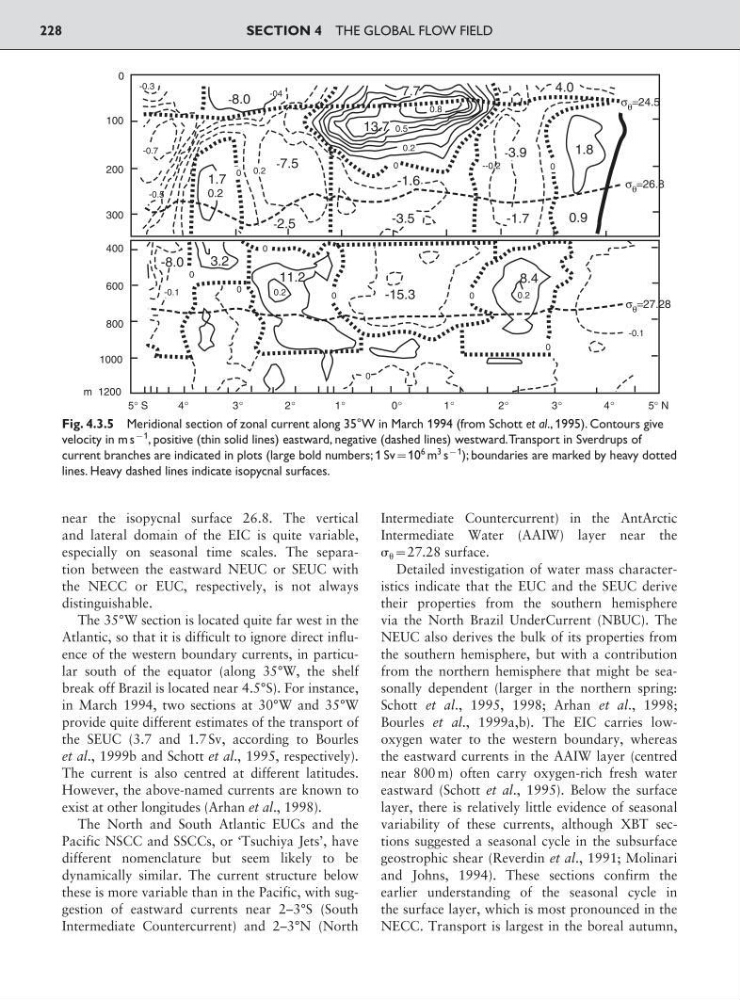
The 35°W section is located quite far west in the
Atlantic, so that it is difficult to ignore direct influence of the western boundary currents, in particular south of the equator (along 35°W, the shelf
break off Brazil is located near 4.5°S). For instance,
in March 1994, two sections at 30°W and 35°W
provide quite different estimates of the transport of
the SEUC (3.7 and 1.7 Sv, according to Bourles
et al., 1999b and Schott et al., 1995, respectively).
The current is also centred at different latitudes.
However, the above-named currents are known to
exist at other longitudes (Arhan et al., 1998).
The North and South Atlantic EUCs and the
Pacific NSCC and SSCCs, or ‘Tsuchiya Jets’, have
different nomenclature but seem likely to be
dynamically similar. The current structure below
these is more variable than in the Pacific, with suggestion of eastward currents near 2–3°S (South
Intermediate Countercurrent) and 2–3°N (North
Intermediate Countercurrent) in the AntArctic
Intermediate Water (AAIW) layer near the
:27.28 surface.
Detailed investigation of water mass characteristics indicate that the EUC and the SEUC derive
their properties from the southern hemisphere
via the North Brazil UnderCurrent (NBUC). The
NEUC also derives the bulk of its properties from
the southern hemisphere, but with a contribution
from the northern hemisphere that might be seasonally dependent (larger in the northern spring:
Schott et al., 1995, 1998; Arhan et al., 1998;
Bourles et al., 1999a,b). The EIC carries lowoxygen water to the western boundary, whereas
the eastward currents in the AAIW layer (centred
near 800 m) often carry oxygen-rich fresh water
eastward (Schott et al., 1995). Below the surface
layer, there is relatively little evidence of seasonal
variability of these currents, although XBT sections suggested a seasonal cycle in the subsurface
geostrophic shear (Reverdin et al., 1991; Molinari
and Johns, 1994). These sections confirm the
earlier understanding of the seasonal cycle in
the surface layer, which is most pronounced in the
NECC. Transport is largest in the boreal autumn,
SECTION 4 THE GLOBAL FLOW FIELD
228
0
100
200
300
400
600
800
1000
m 1200
5° S
5° N
4°
4°
3°
3 °
2°
2 °
1°
0 °
1 °
Fig. 4.3.5 Meridional section of zonal current along 35°W in March 1994 (from Schott et al., 1995). Contours give
velocity in m s
91
, positive (thin solid lines) eastward, negative (dashed lines) westward.Transport in Sverdrups of
current branches are indicated in plots (large bold numbers; 1 Sv:10
6 m
3 s
91 ); boundaries are marked by heavy dotted
lines. Heavy dashed lines indicate isopycnal surfaces.
and lateral domain of the EIC is quite variable,
especially on seasonal time scales. The separation between the eastward NEUC or SEUC with
the NECC or EUC, respectively, is not always
distinguishable.
The 35°W section is located quite far west in the
Atlantic, so that it is difficult to ignore direct influence of the western boundary currents, in particular south of the equator (along 35°W, the shelf
break off Brazil is located near 4.5°S). For instance,
in March 1994, two sections at 30°W and 35°W
provide quite different estimates of the transport of
the SEUC (3.7 and 1.7 Sv, according to Bourles
et al., 1999b and Schott et al., 1995, respectively).
The current is also centred at different latitudes.
However, the above-named currents are known to
exist at other longitudes (Arhan et al., 1998).
The North and South Atlantic EUCs and the
Pacific NSCC and SSCCs, or ‘Tsuchiya Jets’, have
different nomenclature but seem likely to be
dynamically similar. The current structure below
these is more variable than in the Pacific, with suggestion of eastward currents near 2–3°S (South
Intermediate Countercurrent) and 2–3°N (North
Intermediate Countercurrent) in the AntArctic
Intermediate Water (AAIW) layer near the
:27.28 surface.
Detailed investigation of water mass characteristics indicate that the EUC and the SEUC derive
their properties from the southern hemisphere
via the North Brazil UnderCurrent (NBUC). The
NEUC also derives the bulk of its properties from
the southern hemisphere, but with a contribution
from the northern hemisphere that might be seasonally dependent (larger in the northern spring:
Schott et al., 1995, 1998; Arhan et al., 1998;
Bourles et al., 1999a,b). The EIC carries lowoxygen water to the western boundary, whereas
the eastward currents in the AAIW layer (centred
near 800 m) often carry oxygen-rich fresh water
eastward (Schott et al., 1995). Below the surface
layer, there is relatively little evidence of seasonal
variability of these currents, although XBT sections suggested a seasonal cycle in the subsurface
geostrophic shear (Reverdin et al., 1991; Molinari
and Johns, 1994). These sections confirm the
earlier understanding of the seasonal cycle in
the surface layer, which is most pronounced in the
NECC. Transport is largest in the boreal autumn,
SECTION 4 THE GLOBAL FLOW FIELD
228
0
100
200
300
400
600
800
1000
m 1200
5° S
5° N
4°
4°
3°
3 °
2°
2 °
1°
0 °
1 °
Fig. 4.3.5 Meridional section of zonal current along 35°W in March 1994 (from Schott et al., 1995). Contours give
velocity in m s
91
, positive (thin solid lines) eastward, negative (dashed lines) westward.Transport in Sverdrups of
current branches are indicated in plots (large bold numbers; 1 Sv:10
6 m
3 s
91 ); boundaries are marked by heavy dotted
lines. Heavy dashed lines indicate isopycnal surfaces.