

to the base of the thermocline), below which some
poleward flow is found. The equatorward flow is
well defined in magnitude in the South Pacific,
being 15<1 Sv between 17°S and 7°S, nearly all in
the east and central Pacific. Nearly all this inflow
has neutral density greater than 23, and thus can
directly feed the EUC. In the North Pacific, JMcP
also investigate earlier suggestions (Fine et al.,
1987; McPhaden and Fine, 1988; Liu, 1994;
McCreary and Lu, 1994) that further water enters
the EUC via a circuitous interior pathway. This
passes west of the strong vorticity barrier of large
fN
2 values at 10°N, to reach the EUC in the
central Pacific. JMcP find the magnitude of this
interior flow to be 5<1 Sv. However, half of this
has neutral density less than 23, placing it above
the EUC. Thus the northern interior pathway may
not be a significant fractional contributor to the
EUC. The net of an EUC at 165°E of 16 Sv plus
these flows is about 37 Sv – rather more than the
observed magnitude of the EUC near 155°W,
namely about 32 Sv (see TOGAObs for a review).
Wijffels (1993) also found a net convergence of
about 6 Sv in the EUC density range. The maximum transport of the EUC is believed to occur
near 140°W.
This picture of rather close mass balance of flow
in the EUC density range is puzzlingly different
from the net thermocline picture in the western
Pacific. Net Ekman and geostrophic flows out of
SECTION 4 THE GLOBAL FLOW FIELD
218
0
100
200
300
400
Depth (m)
0
100
200
300
400
Depth (m)
0
100
200
300
400
Depth (m)
(a)
U (cm s
–1 )
(b)
T (°C)
(c)
S
17°S
1 0 °
10°
0°
20°N
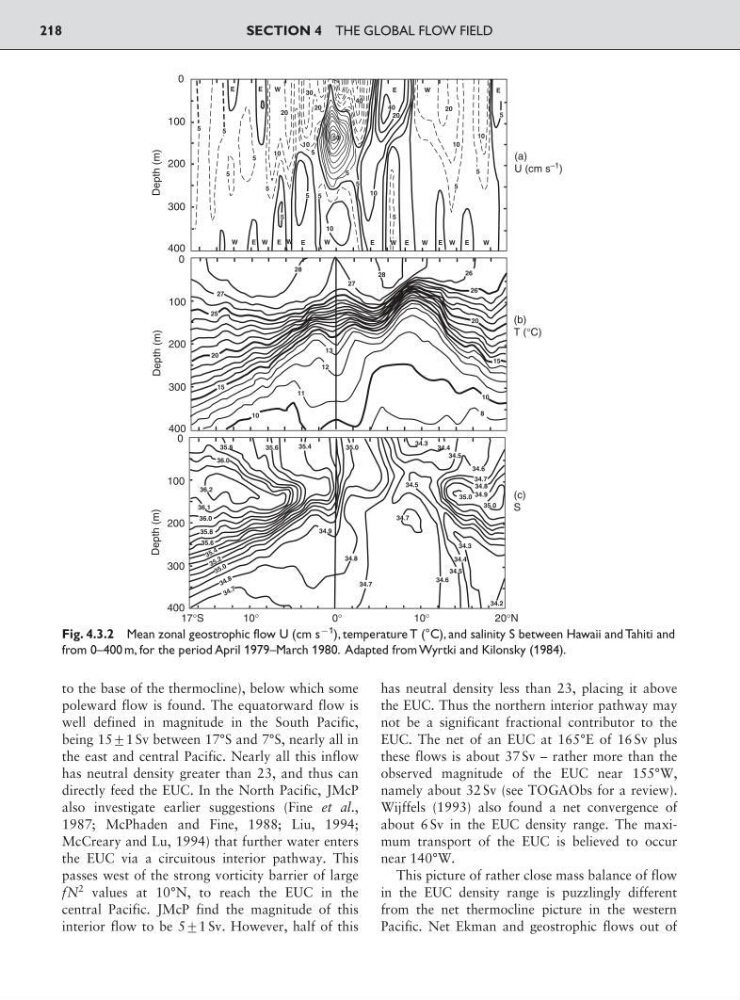
Fig. 4.3.2 Mean zonal geostrophic flow U (cm s
91 ), temperature T (°C), and salinity S between Hawaii and Tahiti and
from 0–400 m, for the period April 1979–March 1980. Adapted from Wyrtki and Kilonsky (1984).
poleward flow is found. The equatorward flow is
well defined in magnitude in the South Pacific,
being 15<1 Sv between 17°S and 7°S, nearly all in
the east and central Pacific. Nearly all this inflow
has neutral density greater than 23, and thus can
directly feed the EUC. In the North Pacific, JMcP
also investigate earlier suggestions (Fine et al.,
1987; McPhaden and Fine, 1988; Liu, 1994;
McCreary and Lu, 1994) that further water enters
the EUC via a circuitous interior pathway. This
passes west of the strong vorticity barrier of large
fN
2 values at 10°N, to reach the EUC in the
central Pacific. JMcP find the magnitude of this
interior flow to be 5<1 Sv. However, half of this
has neutral density less than 23, placing it above
the EUC. Thus the northern interior pathway may
not be a significant fractional contributor to the
EUC. The net of an EUC at 165°E of 16 Sv plus
these flows is about 37 Sv – rather more than the
observed magnitude of the EUC near 155°W,
namely about 32 Sv (see TOGAObs for a review).
Wijffels (1993) also found a net convergence of
about 6 Sv in the EUC density range. The maximum transport of the EUC is believed to occur
near 140°W.
This picture of rather close mass balance of flow
in the EUC density range is puzzlingly different
from the net thermocline picture in the western
Pacific. Net Ekman and geostrophic flows out of
SECTION 4 THE GLOBAL FLOW FIELD
218
0
100
200
300
400
Depth (m)
0
100
200
300
400
Depth (m)
0
100
200
300
400
Depth (m)
(a)
U (cm s
–1 )
(b)
T (°C)
(c)
S
17°S
1 0 °
10°
0°
20°N
Fig. 4.3.2 Mean zonal geostrophic flow U (cm s
91 ), temperature T (°C), and salinity S between Hawaii and Tahiti and
from 0–400 m, for the period April 1979–March 1980. Adapted from Wyrtki and Kilonsky (1984).