

These flows combine to carry the mean heat and
fresh water transports, whose elucidation is a primary objective of WOCE, out of the equatorial
Pacific.
To address the complex topic of how this is
achieved, this section on thermocline flows in the
equatorial Pacific has six subsections. They deal in
turn with flow pathways; budget studies; thermohaline phenomena; eddy diffusion; the width and
depth of the EUC; and longer-term variability,
from Tropical Instability Waves to ENSO.
Upper ocean flow pathways in the equatorial Pacific
Given the nearly conservative nature of subsurface
ocean flow, it is useful to delineate the pathways by
which waters of various sources flow into and out
of the upper equatorial Pacific, from their subduction point until they return to the surface mixed
layer (Liu and Philander, Chapter 4.4). Any water
mass changes due to subsurface processes along
these pathways (e.g. mixing in the low Richardson
number region above and below the EUC core;
Toole et al., 1987) also need to be accounted for.
Several hypotheses for decadal variability of El
Niño are predicated on assumptions regarding
pathways to the EUC (e.g. Gu and Philander,
1997; Zhang et al., 1998a; Schneider et al., 1999b).
The clarification of flow pathways is being pursued by modellers as well as observationalists,
with some success, e.g. McCreary and Lu (1994),
Liu et al. (1994), Lu and McCreary (1995) and Lu
et al. (1998). However, in the following we do not
attempt to review the results of these models in
detail, concentrating on recent observational studies.
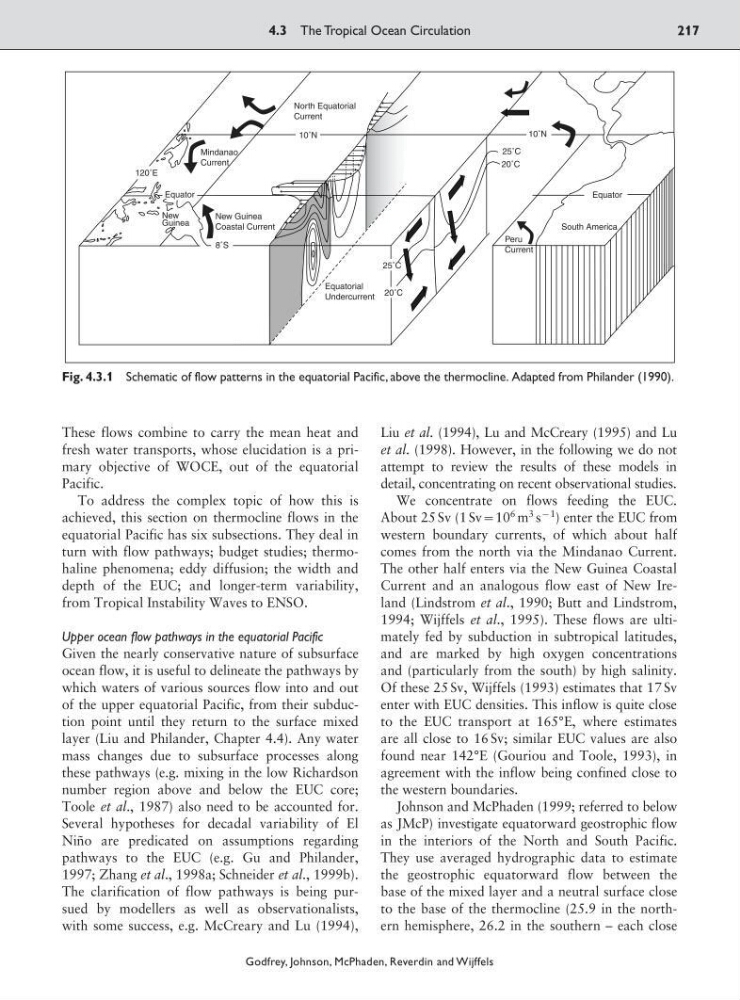
We concentrate on flows feeding the EUC.
About 25 Sv (1 Sv:10
6 m
3 s
91
) enter the EUC from
western boundary currents, of which about half
comes from the north via the Mindanao Current.
The other half enters via the New Guinea Coastal
Current and an analogous flow east of New Ireland (Lindstrom et al., 1990; Butt and Lindstrom,
1994; Wijffels et al., 1995). These flows are ultimately fed by subduction in subtropical latitudes,
and are marked by high oxygen concentrations
and (particularly from the south) by high salinity.
Of these 25 Sv, Wijffels (1993) estimates that 17 Sv
enter with EUC densities. This inflow is quite close
to the EUC transport at 165°E, where estimates
are all close to 16 Sv; similar EUC values are also
found near 142°E (Gouriou and Toole, 1993), in
agreement with the inflow being confined close to
the western boundaries.
Johnson and McPhaden (1999; referred to below
as JMcP) investigate equatorward geostrophic flow
in the interiors of the North and South Pacific.
They use averaged hydrographic data to estimate
the geostrophic equatorward flow between the
base of the mixed layer and a neutral surface close
to the base of the thermocline (25.9 in the northern hemisphere, 26.2 in the southern – each close
4.3 The Tropical Ocean Circulation
217
Godfrey, Johnson, McPhaden, Reverdin and Wijffels
Fig. 4.3.1 Schematic of flow patterns in the equatorial Pacific, above the thermocline. Adapted from Philander (1990).
fresh water transports, whose elucidation is a primary objective of WOCE, out of the equatorial
Pacific.
To address the complex topic of how this is
achieved, this section on thermocline flows in the
equatorial Pacific has six subsections. They deal in
turn with flow pathways; budget studies; thermohaline phenomena; eddy diffusion; the width and
depth of the EUC; and longer-term variability,
from Tropical Instability Waves to ENSO.
Upper ocean flow pathways in the equatorial Pacific
Given the nearly conservative nature of subsurface
ocean flow, it is useful to delineate the pathways by
which waters of various sources flow into and out
of the upper equatorial Pacific, from their subduction point until they return to the surface mixed
layer (Liu and Philander, Chapter 4.4). Any water
mass changes due to subsurface processes along
these pathways (e.g. mixing in the low Richardson
number region above and below the EUC core;
Toole et al., 1987) also need to be accounted for.
Several hypotheses for decadal variability of El
Niño are predicated on assumptions regarding
pathways to the EUC (e.g. Gu and Philander,
1997; Zhang et al., 1998a; Schneider et al., 1999b).
The clarification of flow pathways is being pursued by modellers as well as observationalists,
with some success, e.g. McCreary and Lu (1994),
Liu et al. (1994), Lu and McCreary (1995) and Lu
et al. (1998). However, in the following we do not
attempt to review the results of these models in
detail, concentrating on recent observational studies.
We concentrate on flows feeding the EUC.
About 25 Sv (1 Sv:10
6 m
3 s
91
) enter the EUC from
western boundary currents, of which about half
comes from the north via the Mindanao Current.
The other half enters via the New Guinea Coastal
Current and an analogous flow east of New Ireland (Lindstrom et al., 1990; Butt and Lindstrom,
1994; Wijffels et al., 1995). These flows are ultimately fed by subduction in subtropical latitudes,
and are marked by high oxygen concentrations
and (particularly from the south) by high salinity.
Of these 25 Sv, Wijffels (1993) estimates that 17 Sv
enter with EUC densities. This inflow is quite close
to the EUC transport at 165°E, where estimates
are all close to 16 Sv; similar EUC values are also
found near 142°E (Gouriou and Toole, 1993), in
agreement with the inflow being confined close to
the western boundaries.
Johnson and McPhaden (1999; referred to below
as JMcP) investigate equatorward geostrophic flow
in the interiors of the North and South Pacific.
They use averaged hydrographic data to estimate
the geostrophic equatorward flow between the
base of the mixed layer and a neutral surface close
to the base of the thermocline (25.9 in the northern hemisphere, 26.2 in the southern – each close
4.3 The Tropical Ocean Circulation
217
Godfrey, Johnson, McPhaden, Reverdin and Wijffels
Fig. 4.3.1 Schematic of flow patterns in the equatorial Pacific, above the thermocline. Adapted from Philander (1990).