

many studies as a benchmark for comparison with
observations (Rapp et al., 1996; Stammer et al.,
1996).
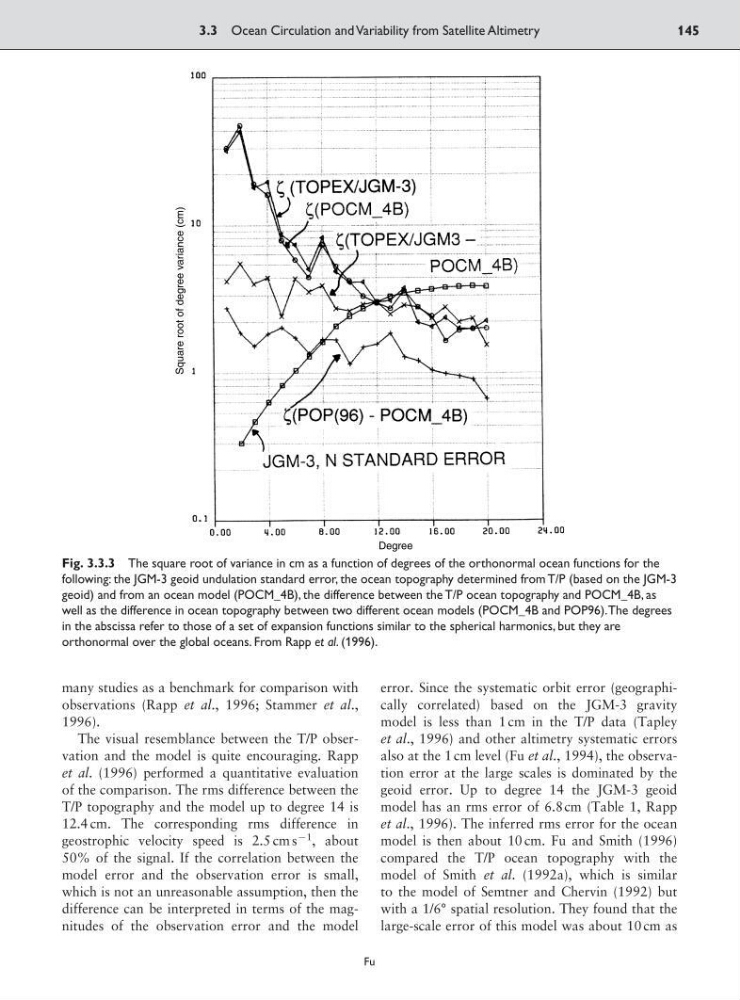
The visual resemblance between the T/P observation and the model is quite encouraging. Rapp
et al. (1996) performed a quantitative evaluation
of the comparison. The rms difference between the
T/P topography and the model up to degree 14 is
12.4 cm. The corresponding rms difference in
geostrophic velocity speed is 2.5 cm s
91
, about
50% of the signal. If the correlation between the
model error and the observation error is small,
which is not an unreasonable assumption, then the
difference can be interpreted in terms of the magnitudes of the observation error and the model
error. Since the systematic orbit error (geographically correlated) based on the JGM-3 gravity
model is less than 1 cm in the T/P data (Tapley
et al., 1996) and other altimetry systematic errors
also at the 1 cm level (Fu et al., 1994), the observation error at the large scales is dominated by the
geoid error. Up to degree 14 the JGM-3 geoid
model has an rms error of 6.8cm (Table 1, Rapp
et al., 1996). The inferred rms error for the ocean
model is then about 10 cm. Fu and Smith (1996)
compared the T/P ocean topography with the
model of Smith et al. (1992a), which is similar
to the model of Semtner and Chervin (1992) but
with a 1/6° spatial resolution. They found that the
large-scale error of this model was about 10 cm as
3.3 Ocean Circulation and Variability from Satellite Altimetry
145
Fu
Degree
Square root of degree variance (cm)
Fig. 3.3.3 The square root of variance in cm as a function of degrees of the orthonormal ocean functions for the
following: the JGM-3 geoid undulation standard error, the ocean topography determined from T/P (based on the JGM-3
geoid) and from an ocean model (POCM_4B), the difference between the T/P ocean topography and POCM_4B, as
well as the difference in ocean topography between two different ocean models (POCM_4B and POP96).The degrees
in the abscissa refer to those of a set of expansion functions similar to the spherical harmonics, but they are
orthonormal over the global oceans. From Rapp et al. (1996).
observations (Rapp et al., 1996; Stammer et al.,
1996).
The visual resemblance between the T/P observation and the model is quite encouraging. Rapp
et al. (1996) performed a quantitative evaluation
of the comparison. The rms difference between the
T/P topography and the model up to degree 14 is
12.4 cm. The corresponding rms difference in
geostrophic velocity speed is 2.5 cm s
91
, about
50% of the signal. If the correlation between the
model error and the observation error is small,
which is not an unreasonable assumption, then the
difference can be interpreted in terms of the magnitudes of the observation error and the model
error. Since the systematic orbit error (geographically correlated) based on the JGM-3 gravity
model is less than 1 cm in the T/P data (Tapley
et al., 1996) and other altimetry systematic errors
also at the 1 cm level (Fu et al., 1994), the observation error at the large scales is dominated by the
geoid error. Up to degree 14 the JGM-3 geoid
model has an rms error of 6.8cm (Table 1, Rapp
et al., 1996). The inferred rms error for the ocean
model is then about 10 cm. Fu and Smith (1996)
compared the T/P ocean topography with the
model of Smith et al. (1992a), which is similar
to the model of Semtner and Chervin (1992) but
with a 1/6° spatial resolution. They found that the
large-scale error of this model was about 10 cm as
3.3 Ocean Circulation and Variability from Satellite Altimetry
145
Fu
Degree
Square root of degree variance (cm)
Fig. 3.3.3 The square root of variance in cm as a function of degrees of the orthonormal ocean functions for the
following: the JGM-3 geoid undulation standard error, the ocean topography determined from T/P (based on the JGM-3
geoid) and from an ocean model (POCM_4B), the difference between the T/P ocean topography and POCM_4B, as
well as the difference in ocean topography between two different ocean models (POCM_4B and POP96).The degrees
in the abscissa refer to those of a set of expansion functions similar to the spherical harmonics, but they are
orthonormal over the global oceans. From Rapp et al. (1996).