

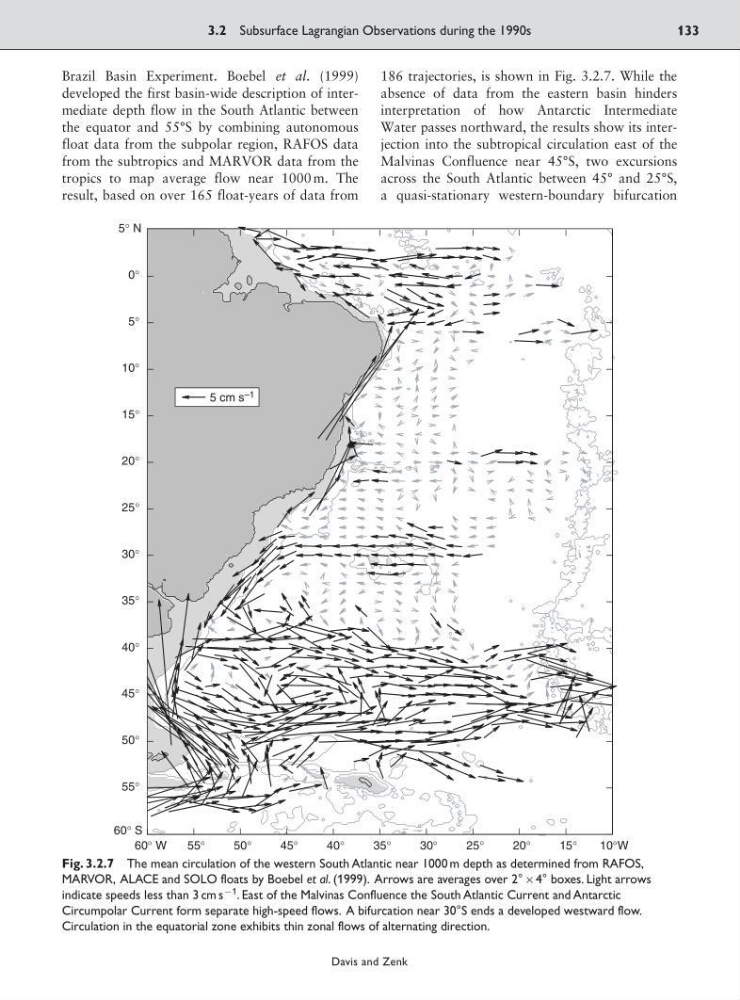
Brazil Basin Experiment. Boebel et al. (1999)
developed the first basin-wide description of intermediate depth flow in the South Atlantic between
the equator and 55°S by combining autonomous
float data from the subpolar region, RAFOS data
from the subtropics and MARVOR data from the
tropics to map average flow near 1000 m. The
result, based on over 165 float-years of data from
186 trajectories, is shown in Fig. 3.2.7. While the
absence of data from the eastern basin hinders
interpretation of how Antarctic Intermediate
Water passes northward, the results show its interjection into the subtropical circulation east of the
Malvinas Confluence near 45°S, two excursions
across the South Atlantic between 45° and 25°S,
a quasi-stationary western-boundary bifurcation
3.2 Subsurface Lagrangian Observations during the 1990s
133
Davis and Zenk
5 cm s –1
60° W
55°
50°
45°
40°
35°
30°
25°
20°
15°
10°W
60° S
55°
50°
45°
40°
35°
30°
25°
20°
15°
10°
5°
0°
5° N
Fig. 3.2.7 The mean circulation of the western South Atlantic near 1000 m depth as determined from RAFOS,
MARVOR, ALACE and SOLO floats by Boebel et al. (1999). Arrows are averages over 2°4° boxes. Light arrows
indicate speeds less than 3 cm s
91 . East of the Malvinas Confluence the South Atlantic Current and Antarctic
Circumpolar Current form separate high-speed flows. A bifurcation near 30°S ends a developed westward flow.
Circulation in the equatorial zone exhibits thin zonal flows of alternating direction.
developed the first basin-wide description of intermediate depth flow in the South Atlantic between
the equator and 55°S by combining autonomous
float data from the subpolar region, RAFOS data
from the subtropics and MARVOR data from the
tropics to map average flow near 1000 m. The
result, based on over 165 float-years of data from
186 trajectories, is shown in Fig. 3.2.7. While the
absence of data from the eastern basin hinders
interpretation of how Antarctic Intermediate
Water passes northward, the results show its interjection into the subtropical circulation east of the
Malvinas Confluence near 45°S, two excursions
across the South Atlantic between 45° and 25°S,
a quasi-stationary western-boundary bifurcation
3.2 Subsurface Lagrangian Observations during the 1990s
133
Davis and Zenk
5 cm s –1
60° W
55°
50°
45°
40°
35°
30°
25°
20°
15°
10°W
60° S
55°
50°
45°
40°
35°
30°
25°
20°
15°
10°
5°
0°
5° N
Fig. 3.2.7 The mean circulation of the western South Atlantic near 1000 m depth as determined from RAFOS,
MARVOR, ALACE and SOLO floats by Boebel et al. (1999). Arrows are averages over 2°4° boxes. Light arrows
indicate speeds less than 3 cm s
91 . East of the Malvinas Confluence the South Atlantic Current and Antarctic
Circumpolar Current form separate high-speed flows. A bifurcation near 30°S ends a developed westward flow.
Circulation in the equatorial zone exhibits thin zonal flows of alternating direction.