

deep-towed survey vehicles may also find visual evidence for communities of vent-specific organisms,
sulfide structures (both active and extinct), and
murky water. These surface ship surveys may then
lead to the use of an ROV (remotely operated vehicle) or submersible, in what has been called a
‘nested survey strategy.’ Sites have also been found
by the fortuitous dredging up of both pieces of
hydrothermal chimneys and vent-specific animals.
Controls on Fluid Compositions
Hydrothermal vent fluids are primarily, if not entirely, sea water that has been altered due to reaction
within the oceanic crust at high temperatures (at
least 3501C, and more likely 44001C) and elevated
pressures (at least 80 bar, and more typically at least
250 bar). The two primary controls on vent fluid
compositions are phase separation and water–rock
reaction (Figure 3). Unlike pure water, sea water is a
two-component system, containing both water and
salt (primarily NaCl, especially for hydrothermal
fluids from which the magnesium and sulfate have
been essentially quantitatively removed). The critical
point for sea water is higher than that for distilled
water – 4071C and 298 bar rather than 3741C and
220 bar – and most importantly the two-phase curve
therefore continues beyond the critical point
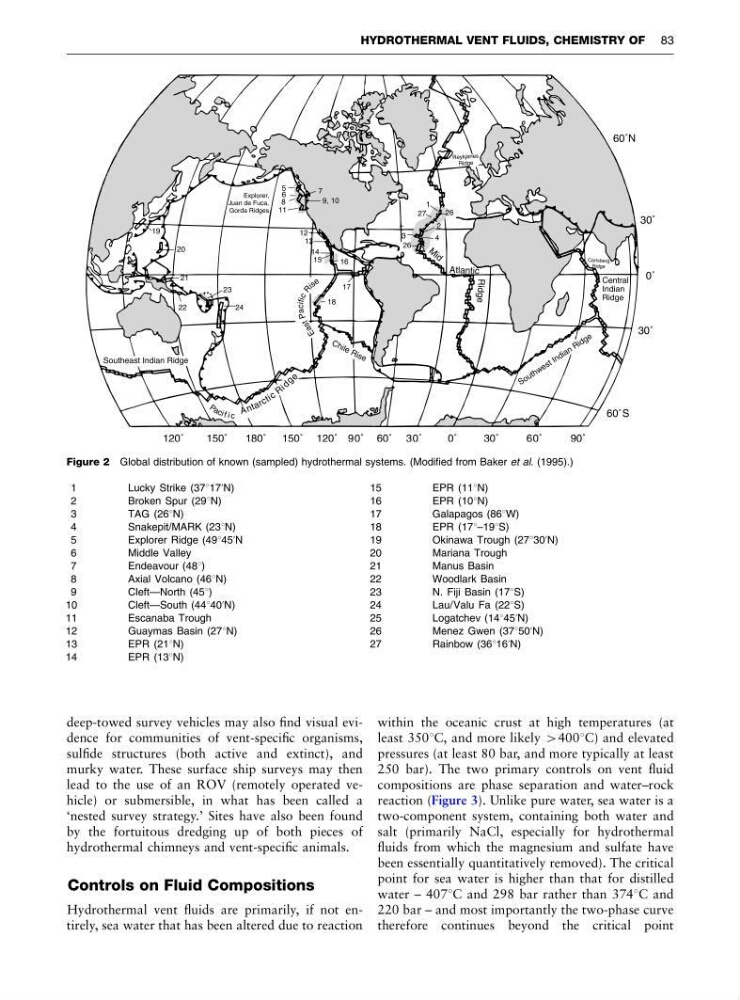
Figure 2 Global distribution of known (sampled) hydrothermal systems. (Modified from Baker et al. (1995).)
HYDROTHERMAL VENT FLUIDS, CHEMISTRY OF 83
sulfide structures (both active and extinct), and
murky water. These surface ship surveys may then
lead to the use of an ROV (remotely operated vehicle) or submersible, in what has been called a
‘nested survey strategy.’ Sites have also been found
by the fortuitous dredging up of both pieces of
hydrothermal chimneys and vent-specific animals.
Controls on Fluid Compositions
Hydrothermal vent fluids are primarily, if not entirely, sea water that has been altered due to reaction
within the oceanic crust at high temperatures (at
least 3501C, and more likely 44001C) and elevated
pressures (at least 80 bar, and more typically at least
250 bar). The two primary controls on vent fluid
compositions are phase separation and water–rock
reaction (Figure 3). Unlike pure water, sea water is a
two-component system, containing both water and
salt (primarily NaCl, especially for hydrothermal
fluids from which the magnesium and sulfate have
been essentially quantitatively removed). The critical
point for sea water is higher than that for distilled
water – 4071C and 298 bar rather than 3741C and
220 bar – and most importantly the two-phase curve
therefore continues beyond the critical point
Figure 2 Global distribution of known (sampled) hydrothermal systems. (Modified from Baker et al. (1995).)
HYDROTHERMAL VENT FLUIDS, CHEMISTRY OF 83