

Organic complexation of dissolved cobalt and
nickel in the open ocean has not been reported;
however, organically complexed cobalt and nickel in
estuarine and coastal samples have been found. The
fraction of organic complexation is highly variable
from estuary to coastal ocean. About 50% of the
dissolved cobalt in coastal sea water was found to be
organically complexed. In UK coastal waters and
south San Francisco Bay, 30–50% of the nickel was
bound in extremely strong organic complexes.
The information presented in this section demonstrates the importance of organic complexation of
several transition metals and heavy metals. These
organic ligands exist at low concentrations and form
very strong complexes (i.e., they have high conditional stability constants). Although the actual
chemical structures of these complexing organic ligands are still unknown, new analytical techniques
may soon uncover their structure.
How Speciation Relates to Biology
Early researchers suggested that some organic compounds present in sea water in trace quantities may
influence the primary production of marine communities by reducing toxic free metal concentrations
(especially Cu
2þ ) to nontoxic levels. Data show that
maximum levels of organically complexed copper
occur in the surface euphotic zone at depths near the
productivity maximum, and decrease dramatically
below the vernal mixed layer in the North Pacific.
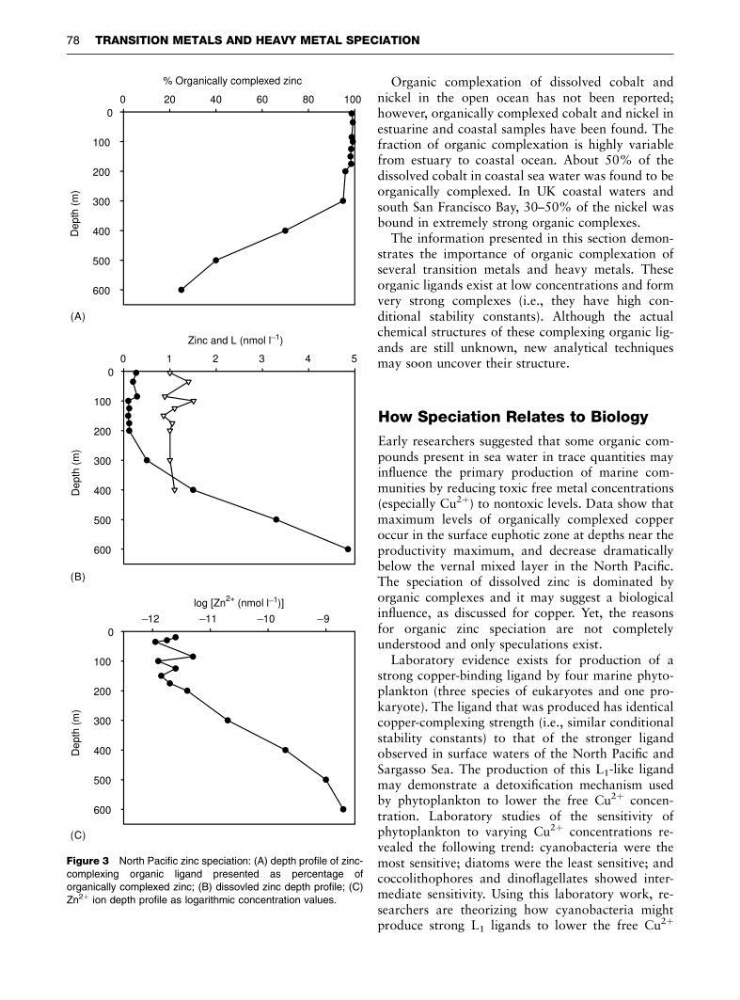
The speciation of dissolved zinc is dominated by
organic complexes and it may suggest a biological
influence, as discussed for copper. Yet, the reasons
for organic zinc speciation are not completely
understood and only speculations exist.
Laboratory evidence exists for production of a
strong copper-binding ligand by four marine phytoplankton (three species of eukaryotes and one prokaryote). The ligand that was produced has identical
copper-complexing strength (i.e., similar conditional
stability constants) to that of the stronger ligand
observed in surface waters of the North Pacific and
Sargasso Sea. The production of this L 1 -like ligand
may demonstrate a detoxification mechanism used
by phytoplankton to lower the free Cu
2þ concentration. Laboratory studies of the sensitivity of
phytoplankton to varying Cu
2þ concentrations revealed the following trend: cyanobacteria were the
most sensitive; diatoms were the least sensitive; and
coccolithophores and dinoflagellates showed intermediate sensitivity. Using this laboratory work, researchers are theorizing how cyanobacteria might
produce strong L 1 ligands to lower the free Cu
2þ
% Organically complexed zinc
0
20
40
60
80
100
Depth
(m)
0
100
200
300
400
500
600
Zinc and L (nmol l
_ 1 )
0
1
2
3
4
5
Depth
(m)
0
100
200
300
400
500
600
log [Zn
2+ (nmol l
_ 1
)]
_ 12
_ 11
_ 10
_ 9
Depth
(m)
0
100
200
300
400
500
600
(C)
(B)
(A)
Figure 3 North Pacific zinc speciation: (A) depth profile of zinccomplexing organic ligand presented as percentage of
organically complexed zinc; (B) dissovled zinc depth profile; (C)
Zn
2þ ion depth profile as logarithmic concentration values.
78 TRANSITION METALS AND HEAVY METAL SPECIATION
nickel in the open ocean has not been reported;
however, organically complexed cobalt and nickel in
estuarine and coastal samples have been found. The
fraction of organic complexation is highly variable
from estuary to coastal ocean. About 50% of the
dissolved cobalt in coastal sea water was found to be
organically complexed. In UK coastal waters and
south San Francisco Bay, 30–50% of the nickel was
bound in extremely strong organic complexes.
The information presented in this section demonstrates the importance of organic complexation of
several transition metals and heavy metals. These
organic ligands exist at low concentrations and form
very strong complexes (i.e., they have high conditional stability constants). Although the actual
chemical structures of these complexing organic ligands are still unknown, new analytical techniques
may soon uncover their structure.
How Speciation Relates to Biology
Early researchers suggested that some organic compounds present in sea water in trace quantities may
influence the primary production of marine communities by reducing toxic free metal concentrations
(especially Cu
2þ ) to nontoxic levels. Data show that
maximum levels of organically complexed copper
occur in the surface euphotic zone at depths near the
productivity maximum, and decrease dramatically
below the vernal mixed layer in the North Pacific.
The speciation of dissolved zinc is dominated by
organic complexes and it may suggest a biological
influence, as discussed for copper. Yet, the reasons
for organic zinc speciation are not completely
understood and only speculations exist.
Laboratory evidence exists for production of a
strong copper-binding ligand by four marine phytoplankton (three species of eukaryotes and one prokaryote). The ligand that was produced has identical
copper-complexing strength (i.e., similar conditional
stability constants) to that of the stronger ligand
observed in surface waters of the North Pacific and
Sargasso Sea. The production of this L 1 -like ligand
may demonstrate a detoxification mechanism used
by phytoplankton to lower the free Cu
2þ concentration. Laboratory studies of the sensitivity of
phytoplankton to varying Cu
2þ concentrations revealed the following trend: cyanobacteria were the
most sensitive; diatoms were the least sensitive; and
coccolithophores and dinoflagellates showed intermediate sensitivity. Using this laboratory work, researchers are theorizing how cyanobacteria might
produce strong L 1 ligands to lower the free Cu
2þ
% Organically complexed zinc
0
20
40
60
80
100
Depth
(m)
0
100
200
300
400
500
600
Zinc and L (nmol l
_ 1 )
0
1
2
3
4
5
Depth
(m)
0
100
200
300
400
500
600
log [Zn
2+ (nmol l
_ 1
)]
_ 12
_ 11
_ 10
_ 9
Depth
(m)
0
100
200
300
400
500
600
(C)
(B)
(A)
Figure 3 North Pacific zinc speciation: (A) depth profile of zinccomplexing organic ligand presented as percentage of
organically complexed zinc; (B) dissovled zinc depth profile; (C)
Zn
2þ ion depth profile as logarithmic concentration values.
78 TRANSITION METALS AND HEAVY METAL SPECIATION