

Thermodynamic calculations show that chromate
is the expected form in oxygenated sea water, while
the insoluble Cr(III) species would predominate in
very low-oxygen (so called ‘suboxic’) or anoxic
waters. However, it is important to note that thermodynamic calculations only predict elemental speciation at equilibrium (when the rates of formation
and destruction are balanced), but they do not consider the rates of conversion themselves. For example,
Cr(III) should not exist in oxygenated sea water, but
its rate of oxidation to Cr(VI) is slow (days to
months), meaning that Cr(III) can persist in oxic
water (‘kinetic stabilization’). In the eastern North
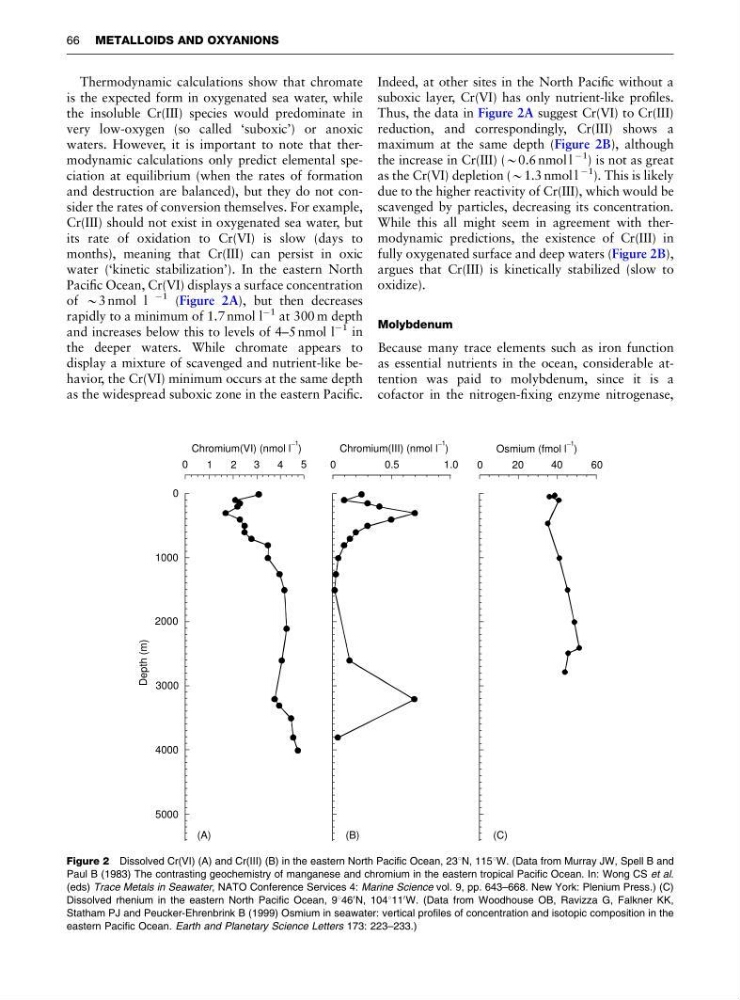
Pacific Ocean, Cr(VI) displays a surface concentration
of B3 nmol l
À1 (Figure 2A), but then decreases
rapidly to a minimum of 1.7 nmol l
À1 at 300 m depth
and increases below this to levels of 4–5 nmol l
À1 in
the deeper waters. While chromate appears to
display a mixture of scavenged and nutrient-like behavior, the Cr(VI) minimum occurs at the same depth
as the widespread suboxic zone in the eastern Pacific.
Indeed, at other sites in the North Pacific without a
suboxic layer, Cr(VI) has only nutrient-like profiles.
Thus, the data in Figure 2A suggest Cr(VI) to Cr(III)
reduction, and correspondingly, Cr(III) shows a
maximum at the same depth (Figure 2B), although
the increase in Cr(III) (B0.6 nmol l
À1
) is not as great
as the Cr(VI) depletion (B1.3 nmol l
À1
). This is likely
due to the higher reactivity of Cr(III), which would be
scavenged by particles, decreasing its concentration.
While this all might seem in agreement with thermodynamic predictions, the existence of Cr(III) in
fully oxygenated surface and deep waters (Figure 2B),
argues that Cr(III) is kinetically stabilized (slow to
oxidize).
Molybdenum
Because many trace elements such as iron function
as essential nutrients in the ocean, considerable attention was paid to molybdenum, since it is a
cofactor in the nitrogen-fixing enzyme nitrogenase,
0
1
2
3
4
5
0
1000
2000
3000
4000
5000
(A)
Chromium(VI) (nmol l )
_ 1
Depth (m)
0
0 . 5
1 . 0
0
20
40
60
Chromium(III) (nmol l )
_ 1
Osmium (fmol l )
_ 1
(B)
(C)
Figure 2 Dissolved Cr(VI) (A) and Cr(III) (B) in the eastern North Pacific Ocean, 231N, 1151W. (Data from Murray JW, Spell B and
Paul B (1983) The contrasting geochemistry of manganese and chromium in the eastern tropical Pacific Ocean. In: Wong CS et al.
(eds) Trace Metals in Seawater, NATO Conference Services 4: Marine Science vol. 9, pp. 643–668. New York: Plenium Press.) (C)
Dissolved rhenium in the eastern North Pacific Ocean, 9146
0 N, 104111
0 W. (Data from Woodhouse OB, Ravizza G, Falkner KK,
Statham PJ and Peucker-Ehrenbrink B (1999) Osmium in seawater: vertical profiles of concentration and isotopic composition in the
eastern Pacific Ocean. Earth and Planetary Science Letters 173: 223–233.)
66 METALLOIDS AND OXYANIONS
is the expected form in oxygenated sea water, while
the insoluble Cr(III) species would predominate in
very low-oxygen (so called ‘suboxic’) or anoxic
waters. However, it is important to note that thermodynamic calculations only predict elemental speciation at equilibrium (when the rates of formation
and destruction are balanced), but they do not consider the rates of conversion themselves. For example,
Cr(III) should not exist in oxygenated sea water, but
its rate of oxidation to Cr(VI) is slow (days to
months), meaning that Cr(III) can persist in oxic
water (‘kinetic stabilization’). In the eastern North
Pacific Ocean, Cr(VI) displays a surface concentration
of B3 nmol l
À1 (Figure 2A), but then decreases
rapidly to a minimum of 1.7 nmol l
À1 at 300 m depth
and increases below this to levels of 4–5 nmol l
À1 in
the deeper waters. While chromate appears to
display a mixture of scavenged and nutrient-like behavior, the Cr(VI) minimum occurs at the same depth
as the widespread suboxic zone in the eastern Pacific.
Indeed, at other sites in the North Pacific without a
suboxic layer, Cr(VI) has only nutrient-like profiles.
Thus, the data in Figure 2A suggest Cr(VI) to Cr(III)
reduction, and correspondingly, Cr(III) shows a
maximum at the same depth (Figure 2B), although
the increase in Cr(III) (B0.6 nmol l
À1
) is not as great
as the Cr(VI) depletion (B1.3 nmol l
À1
). This is likely
due to the higher reactivity of Cr(III), which would be
scavenged by particles, decreasing its concentration.
While this all might seem in agreement with thermodynamic predictions, the existence of Cr(III) in
fully oxygenated surface and deep waters (Figure 2B),
argues that Cr(III) is kinetically stabilized (slow to
oxidize).
Molybdenum
Because many trace elements such as iron function
as essential nutrients in the ocean, considerable attention was paid to molybdenum, since it is a
cofactor in the nitrogen-fixing enzyme nitrogenase,
0
1
2
3
4
5
0
1000
2000
3000
4000
5000
(A)
Chromium(VI) (nmol l )
_ 1
Depth (m)
0
0 . 5
1 . 0
0
20
40
60
Chromium(III) (nmol l )
_ 1
Osmium (fmol l )
_ 1
(B)
(C)
Figure 2 Dissolved Cr(VI) (A) and Cr(III) (B) in the eastern North Pacific Ocean, 231N, 1151W. (Data from Murray JW, Spell B and
Paul B (1983) The contrasting geochemistry of manganese and chromium in the eastern tropical Pacific Ocean. In: Wong CS et al.
(eds) Trace Metals in Seawater, NATO Conference Services 4: Marine Science vol. 9, pp. 643–668. New York: Plenium Press.) (C)
Dissolved rhenium in the eastern North Pacific Ocean, 9146
0 N, 104111
0 W. (Data from Woodhouse OB, Ravizza G, Falkner KK,
Statham PJ and Peucker-Ehrenbrink B (1999) Osmium in seawater: vertical profiles of concentration and isotopic composition in the
eastern Pacific Ocean. Earth and Planetary Science Letters 173: 223–233.)
66 METALLOIDS AND OXYANIONS