

(fmol l
À1
; 10
À15 mol l
À1
). Nevertheless, low concentrations do not mean that the oxyanions are unimportant as either essential or toxic compounds, or
as useful ocean tracers; these points will be highlighted below. To provide a logical order to this presentation, the periodic table will be followed from left
to right.
The Elements
Vanadium
In oxygenated sea water with an average pH of 8,
vanadium should be found in the þ 5 oxidation
state, which undergoes hydrolysis to form vanadate,
HVO 4
2À . In sea water with no oxygen (‘anoxic’)
such as found in the Black Sea, V(V) can be reduced
to V(IV) which is more reactive than V(V), and as a
consequence, anoxic sediments have elevated concentrations of vanadium relative to sediments underlying oxic waters. Thus, sedimentary vanadium may
act as a historical tracer of anoxic conditions. Vanadium has also been studied in sea water because it is
enriched in fossil fuels and may be a potential pollutant. In this respect, vanadium does not have any
established biological function, although the chemistries of phosphate and vanadate are similar, and
therefore vanadate might be taken up into soft tissues
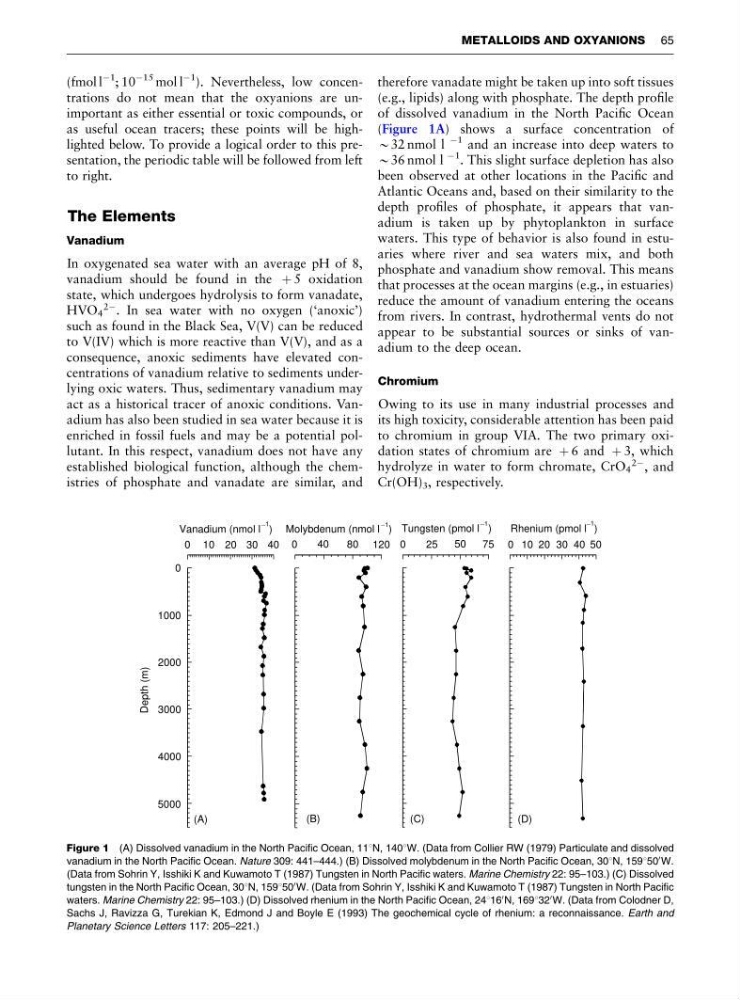
(e.g., lipids) along with phosphate. The depth profile
of dissolved vanadium in the North Pacific Ocean
(Figure 1A) shows a surface concentration of
B32 nmol l
À1 and an increase into deep waters to
B36 nmol l
À1
. This slight surface depletion has also
been observed at other locations in the Pacific and
Atlantic Oceans and, based on their similarity to the
depth profiles of phosphate, it appears that vanadium is taken up by phytoplankton in surface
waters. This type of behavior is also found in estuaries where river and sea waters mix, and both
phosphate and vanadium show removal. This means
that processes at the ocean margins (e.g., in estuaries)
reduce the amount of vanadium entering the oceans
from rivers. In contrast, hydrothermal vents do not
appear to be substantial sources or sinks of vanadium to the deep ocean.
Chromium
Owing to its use in many industrial processes and
its high toxicity, considerable attention has been paid
to chromium in group VIA. The two primary oxidation states of chromium are þ 6 and þ 3, which
hydrolyze in water to form chromate, CrO 4
2À , and
Cr(OH) 3 , respectively.
0 10 20 30 40
5000
4000
3000
2000
1000
0
(A)
Vanadium (nmol l )
_ 1
Depth (m)
0 10 20 30 40 50
0
25
50
75
0
40
80 120
Molybdenum (nmol l )
_ 1
Tungsten (pmol l )
_ 1
Rhenium (pmol l )
_ 1
(B)
(C)
(D)
Figure 1 (A) Dissolved vanadium in the North Pacific Ocean, 111N, 1401W. (Data from Collier RW (1979) Particulate and dissolved
vanadium in the North Pacific Ocean. Nature 309: 441–444.) (B) Dissolved molybdenum in the North Pacific Ocean, 301N, 159150
0 W.
(Data from Sohrin Y, Isshiki K and Kuwamoto T (1987) Tungsten in North Pacific waters. Marine Chemistry 22: 95–103.) (C) Dissolved
tungsten in the North Pacific Ocean, 301N, 159150
0 W. (Data from Sohrin Y, Isshiki K and Kuwamoto T (1987) Tungsten in North Pacific
waters. Marine Chemistry 22: 95–103.) (D) Dissolved rhenium in the North Pacific Ocean, 24116
0 N, 169132
0 W. (Data from Colodner D,
Sachs J, Ravizza G, Turekian K, Edmond J and Boyle E (1993) The geochemical cycle of rhenium: a reconnaissance. Earth and
Planetary Science Letters 117: 205–221.)
METALLOIDS AND OXYANIONS 65
À1
; 10
À15 mol l
À1
). Nevertheless, low concentrations do not mean that the oxyanions are unimportant as either essential or toxic compounds, or
as useful ocean tracers; these points will be highlighted below. To provide a logical order to this presentation, the periodic table will be followed from left
to right.
The Elements
Vanadium
In oxygenated sea water with an average pH of 8,
vanadium should be found in the þ 5 oxidation
state, which undergoes hydrolysis to form vanadate,
HVO 4
2À . In sea water with no oxygen (‘anoxic’)
such as found in the Black Sea, V(V) can be reduced
to V(IV) which is more reactive than V(V), and as a
consequence, anoxic sediments have elevated concentrations of vanadium relative to sediments underlying oxic waters. Thus, sedimentary vanadium may
act as a historical tracer of anoxic conditions. Vanadium has also been studied in sea water because it is
enriched in fossil fuels and may be a potential pollutant. In this respect, vanadium does not have any
established biological function, although the chemistries of phosphate and vanadate are similar, and
therefore vanadate might be taken up into soft tissues
(e.g., lipids) along with phosphate. The depth profile
of dissolved vanadium in the North Pacific Ocean
(Figure 1A) shows a surface concentration of
B32 nmol l
À1 and an increase into deep waters to
B36 nmol l
À1
. This slight surface depletion has also
been observed at other locations in the Pacific and
Atlantic Oceans and, based on their similarity to the
depth profiles of phosphate, it appears that vanadium is taken up by phytoplankton in surface
waters. This type of behavior is also found in estuaries where river and sea waters mix, and both
phosphate and vanadium show removal. This means
that processes at the ocean margins (e.g., in estuaries)
reduce the amount of vanadium entering the oceans
from rivers. In contrast, hydrothermal vents do not
appear to be substantial sources or sinks of vanadium to the deep ocean.
Chromium
Owing to its use in many industrial processes and
its high toxicity, considerable attention has been paid
to chromium in group VIA. The two primary oxidation states of chromium are þ 6 and þ 3, which
hydrolyze in water to form chromate, CrO 4
2À , and
Cr(OH) 3 , respectively.
0 10 20 30 40
5000
4000
3000
2000
1000
0
(A)
Vanadium (nmol l )
_ 1
Depth (m)
0 10 20 30 40 50
0
25
50
75
0
40
80 120
Molybdenum (nmol l )
_ 1
Tungsten (pmol l )
_ 1
Rhenium (pmol l )
_ 1
(B)
(C)
(D)
Figure 1 (A) Dissolved vanadium in the North Pacific Ocean, 111N, 1401W. (Data from Collier RW (1979) Particulate and dissolved
vanadium in the North Pacific Ocean. Nature 309: 441–444.) (B) Dissolved molybdenum in the North Pacific Ocean, 301N, 159150
0 W.
(Data from Sohrin Y, Isshiki K and Kuwamoto T (1987) Tungsten in North Pacific waters. Marine Chemistry 22: 95–103.) (C) Dissolved
tungsten in the North Pacific Ocean, 301N, 159150
0 W. (Data from Sohrin Y, Isshiki K and Kuwamoto T (1987) Tungsten in North Pacific
waters. Marine Chemistry 22: 95–103.) (D) Dissolved rhenium in the North Pacific Ocean, 24116
0 N, 169132
0 W. (Data from Colodner D,
Sachs J, Ravizza G, Turekian K, Edmond J and Boyle E (1993) The geochemical cycle of rhenium: a reconnaissance. Earth and
Planetary Science Letters 117: 205–221.)
METALLOIDS AND OXYANIONS 65