

(1974); higher concentrations have been found in
coastal waters. More than a decade later CS 2 concentrations in the North Atlantic were found to be
comparable to the earlier observations. However, in
coastal waters CS 2 concentrations were found to be a
factor 10 lower, respectively 33 and 300 pmol l
À1
.
The global CS 2 flux has been estimated on
6.7 Gmol S y
À1
, and it has been concluded that the
marine emission of CS 2 provides a significant indirect
source of COS, but it forms an insignificant source of
tropospheric SO 2 .
Nonmethane Hydrocarbons
Nonmethane hydrocarbons (NMHCs) are important
reactive gases in the atmosphere since they provide a
sink for hydroxyl radicals and play key roles in the
production and destruction of ozone in the troposphere. NMHCs generally refer to the C 2 –C 4 series,
notably ethane, ethene, acetylene, propane, propene,
and n-butane, but also the five-carbon compound
isoprene. Of these, ethene is generally the most
abundant contributing 40% to the total NMHC pool
in sea water. Published data of concentrations of
NMHCs in sea water vary widely sometimes exceeding a factor 100. For example, in one extensive
study, ethene and propane were found to be the most
abundant species in the intertropical South Pacific,
with mixing ratios of 2.7 to 58 and 6 to 75 pptv,
respectively; whereas in the equatorial Atlantic these
species showed mixing ratios of 20 pptv and 10 pptv,
respectively.
The water-column dynamics of NMHCs are
poorly understood. NMHCs have been detected in
the surface sea and with maxima in the euphotic
zone and tend to be present at concentrations in sea
water at around 10
À10 mol l
À1
. Evidence suggests
that photochemical oxidation of dissolved organic
matter results in the formation of NMHCs. There
can be very little doubt that the physiology of
planktonic organisms is also involved in NMHC
formation. Ethene and isoprene are freely produced
by terrestrial plants where the former is a powerful
plant hormone but the function of the latter less well
understood. It is likely that similar processes occur in
planktonic algae. NMHC production tends to correlate with light intensity, dissolved organic carbon
and biological production. A simplified scheme of
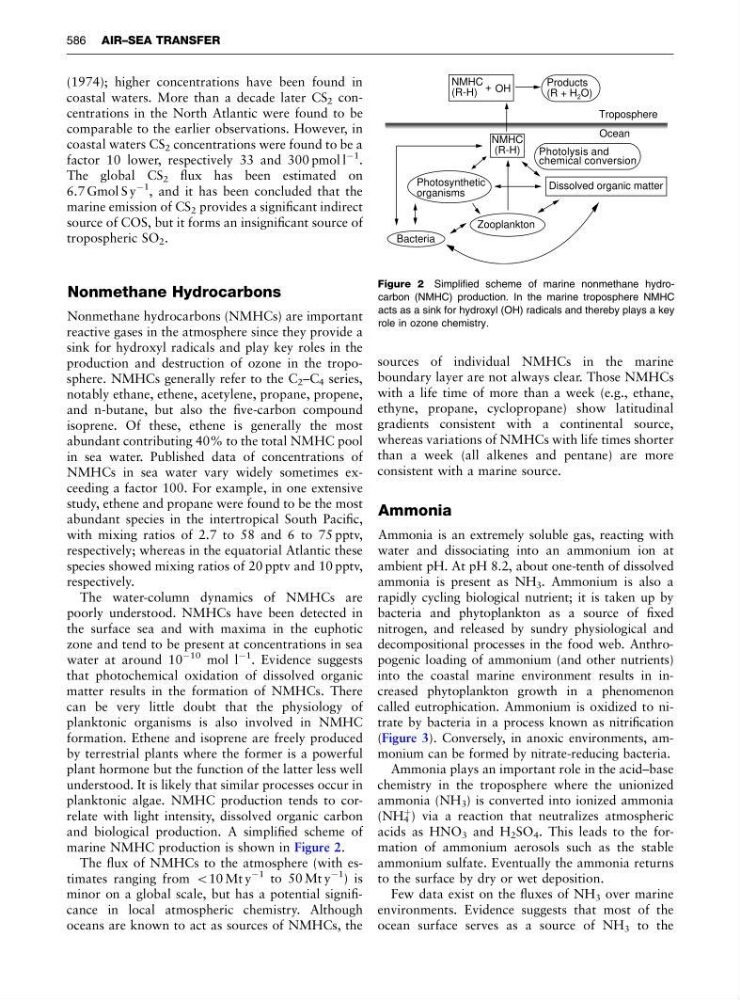
marine NMHC production is shown in Figure 2.
The flux of NMHCs to the atmosphere (with estimates ranging from o10 Mt y
À1 to 50 Mt y
À1
) is
minor on a global scale, but has a potential significance in local atmospheric chemistry. Although
oceans are known to act as sources of NMHCs, the
sources of individual NMHCs in the marine
boundary layer are not always clear. Those NMHCs
with a life time of more than a week (e.g., ethane,
ethyne, propane, cyclopropane) show latitudinal
gradients consistent with a continental source,
whereas variations of NMHCs with life times shorter
than a week (all alkenes and pentane) are more
consistent with a marine source.
Ammonia
Ammonia is an extremely soluble gas, reacting with
water and dissociating into an ammonium ion at
ambient pH. At pH 8.2, about one-tenth of dissolved
ammonia is present as NH 3 . Ammonium is also a
rapidly cycling biological nutrient; it is taken up by
bacteria and phytoplankton as a source of fixed
nitrogen, and released by sundry physiological and
decompositional processes in the food web. Anthropogenic loading of ammonium (and other nutrients)
into the coastal marine environment results in increased phytoplankton growth in a phenomenon
called eutrophication. Ammonium is oxidized to nitrate by bacteria in a process known as nitrification
(Figure 3). Conversely, in anoxic environments, ammonium can be formed by nitrate-reducing bacteria.
Ammonia plays an important role in the acid–base
chemistry in the troposphere where the unionized
ammonia (NH 3 ) is converted into ionized ammonia
(NH 4
þ ) via a reaction that neutralizes atmospheric
acids as HNO 3 and H 2 SO 4 . This leads to the formation of ammonium aerosols such as the stable
ammonium sulfate. Eventually the ammonia returns
to the surface by dry or wet deposition.
Few data exist on the fluxes of NH 3 over marine
environments. Evidence suggests that most of the
ocean surface serves as a source of NH 3 to the
Troposphere
Ocean
NMHC
(R-H) + OH
Products
(R + H 2 O)
NMHC
(R-H)
Bacteria
Zooplankton
Photosynthetic
organisms
Dissolved organic matter
Photolysis and
chemical conversion
Figure 2 Simplified scheme of marine nonmethane hydrocarbon (NMHC) production. In the marine troposphere NMHC
acts as a sink for hydroxyl (OH) radicals and thereby plays a key
role in ozone chemistry.
586 AIR–SEA TRANSFER