

necessarily related to anthropogenic effects. Other
oceanic sites where phosphorus limitation of primary
productivity has been documented include the
Mediterranean Sea and Florida Bay (USA).
One key question that studies of nitrogen and
phosphorus limitation must address before meaningful conclusions may be drawn about phosphorus
versus nitrogen limitation of marine primary productivity is the extent to which the dissolved organic
nutrient pools are accessible to phytoplankton. In
brief, this is the question of bioavailability. Many
studies of nutrient cycling and nutrient limitation do
not include measurement of these quantitatively important nutrient pools, even though there is indisputable evidence that at least some portion of the
dissolved organic nitrogen (DON) and dissolved organic phosphorus (DOP) pools is bioavailable. An
important direction for future research is to characterize the DON and DOP pools at the molecular
level, and to evaluate what fraction of these are
bioavailable. The analytical challenge of identifying
the molecular composition of the DOP pool is significant. Recent advances in
31 P-nuclear magnetic
resonance (NMR) spectroscopy have permitted a
look at the high molecular weight (41 nm) fraction
of the DOP pool. However, this fraction represents
only one-third of the total DOP pool; the other twothirds of this pool, made up of smaller-molecularweight DOP compounds, remains outside our
current window of analytical accessibility.
Debate continues among oceanographers about
the most probable limiting nutrient on recent and on
long, geological timescales. While there is an abundant reservoir of nitrogen (gaseous N 2 ) in the atmosphere that can be rendered bioavailable by
nitrogen-fixing photosynthetic organisms, phosphorus supply to the ocean is limited to that
weathered off the continents and delivered by rivers,
with some minor atmospheric input. As a consequence of continental weathering control on
phosphorus supply to the oceans, phosphorus limitation has been considered more likely than nitrogen
limitation on geological timescales. As the recent
studies reviewed in this section suggest, phosphorus
limitation may be an important phenomenon in the
modern ocean as well. Overall, current literature
indicates that there is a growing appreciation of the
complexities of nutrient limitation in general, and
the role of phosphorus limitation in particular, in
both fresh water and marine systems.
Cosmogenic
32
P and
33 P as Tracers of Phosphorus
Cycling in Surface Waters
There are two radioactive isotopes of phosphorus,
32
P
(half-life ¼ 14.3 days) and
33
P (half-life ¼ 25.3 days).
Both have been widely used in the study of biologically mediated phosphorus cycling in aquatic systems.
Until very recently, these experiments have been
conducted by artificially introducing radiophosphorus
into laboratory incubations or, far more rarely, by
direct introduction into natural waters under controlled circumstances. Such experiments necessarily
involve significant perturbation of the system, which
can complicate interpretation of results. Recent advances in phosphorus sampling and radioisotope
measurement have made it possible to use naturally
produced
32
P and
33
P as in situ tracers of phosphorus
recycling in surface waters. This advance has permitted studies of net phosphorus recycling in the absence
of experimental perturbation caused by addition of
artificially introduced radiophosphorus.
32 P and
33 P are produced naturally in the atmosphere by interaction of cosmic rays with atmospheric
argon nuclei. They are then quickly scavenged onto
aerosol particles and delivered to the ocean surface
predominantly in rain. The ratio of
33
P/
32
P introduced to the oceans by rainfall remains relatively
constant, despite the fact that absolute concentrations
can vary from one precipitation event to another.
Once the dissolved phosphorus is incorporated into a
given surface water phosphorus pool (e.g., by uptake
by phytoplankton or bacteria, grazing of phytoplankton or bacteria by zooplankton, or abiotic
sorption), the
33
P/
32
P ratio will increase in a systematic way as a given pool ages. This increase in the
33
P/
32
P ratio with time results from the different halflives of the two phosphorus radioisotopes. By measuring the
33
P/
32
P ratio in rain and in different marine
phosphorus pools – e.g., DIP, DOP (sometimes called
soluble nonreactive phosphorus, or SNP), and particulate phosphorus of various size classes
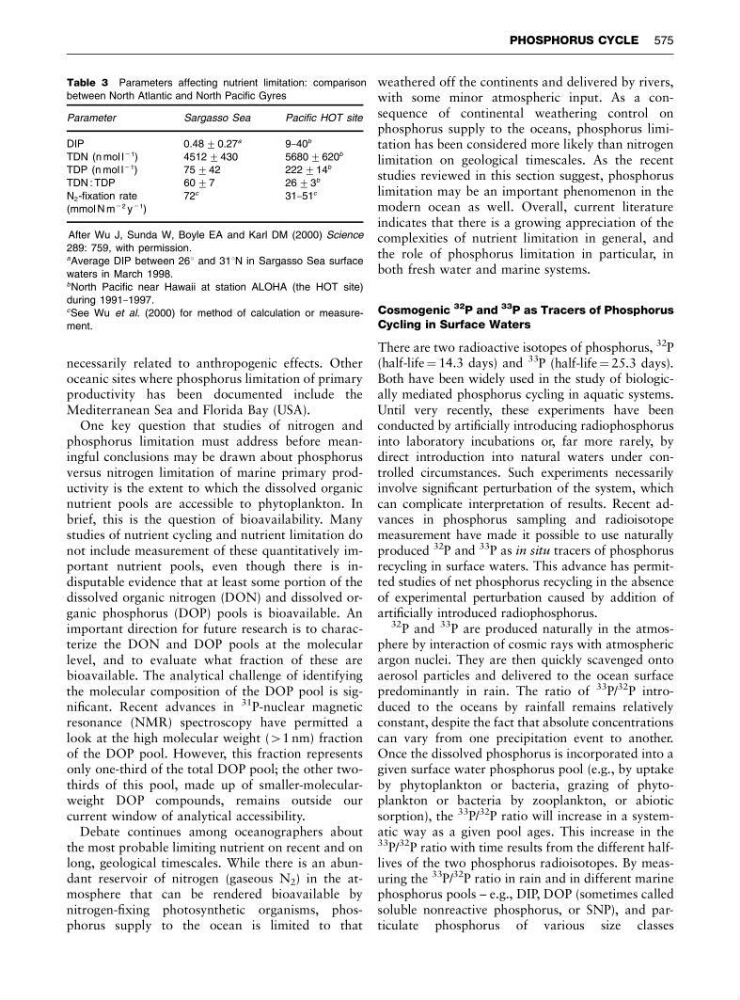
Table 3 Parameters affecting nutrient limitation: comparison
between North Atlantic and North Pacific Gyres
PHOSPHORUS CYCLE 575