

orthophosphate is typically low. When bioavailable
phosphorus is exhausted prior to more abundant
nutrients, it limits the amount of sustainable biological productivity. Phosphorus limitation in lakes is
widely accepted, and terrestrial soils are often
phosphorus-limited. In the oceans, however, phosphorus limitation is the subject of controversy and
debate.
The prevailing wisdom has favored nitrogen as the
limiting macronutrient in the oceans. However, a
growing body of literature convincingly demonstrates that phosphate limitation of marine primary
productivity can and does occur in some marine
systems. In the oligotrophic gyres of both the western
North Atlantic and subtropical North Pacific, evidence in the form of dissolved nitrogen : phosphorous (N:P) ratios has been used to argue convincingly
that these systems are currently phosphate-limited.
The N(:)P ratio of phytoplankton during nutrientsufficient conditions is 16N:1P (the Redfield ratio)
(see ). A positive deviation from this ratio indicates
probable phosphate limitation, while a negative deviation indicates probable nitrogen limitation. In the
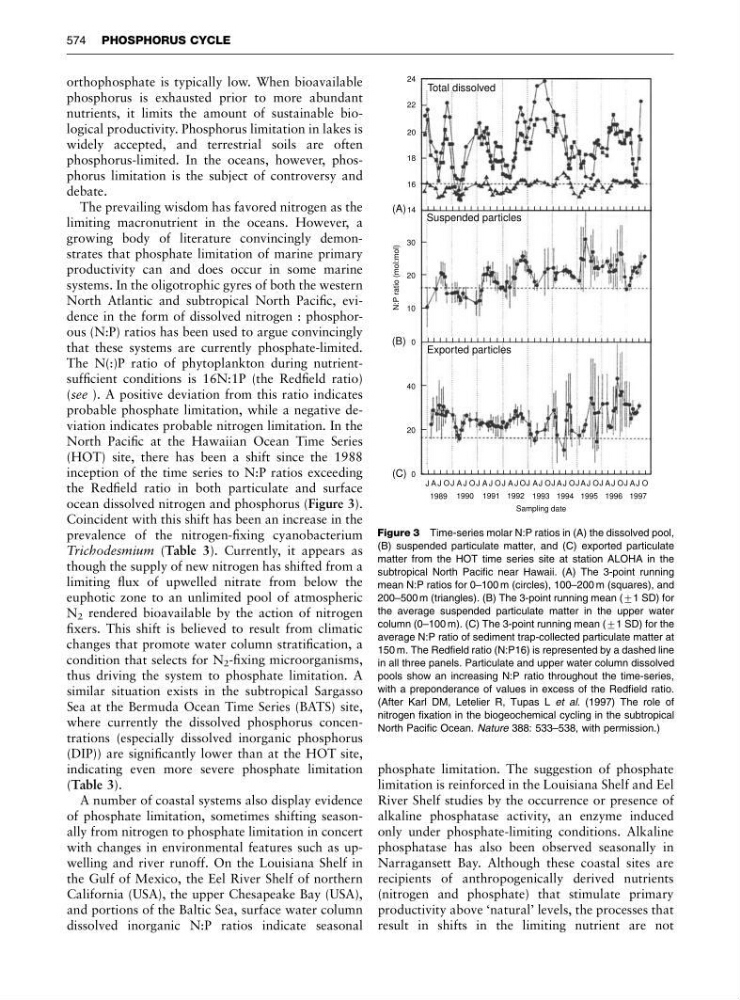
North Pacific at the Hawaiian Ocean Time Series
(HOT) site, there has been a shift since the 1988
inception of the time series to N:P ratios exceeding
the Redfield ratio in both particulate and surface
ocean dissolved nitrogen and phosphorus (Figure 3).
Coincident with this shift has been an increase in the
prevalence of the nitrogen-fixing cyanobacterium
Trichodesmium (Table 3). Currently, it appears as
though the supply of new nitrogen has shifted from a
limiting flux of upwelled nitrate from below the
euphotic zone to an unlimited pool of atmospheric
N 2 rendered bioavailable by the action of nitrogen
fixers. This shift is believed to result from climatic
changes that promote water column stratification, a
condition that selects for N 2 -fixing microorganisms,
thus driving the system to phosphate limitation. A
similar situation exists in the subtropical Sargasso
Sea at the Bermuda Ocean Time Series (BATS) site,
where currently the dissolved phosphorus concentrations (especially dissolved inorganic phosphorus
(DIP)) are significantly lower than at the HOT site,
indicating even more severe phosphate limitation
(Table 3).
A number of coastal systems also display evidence
of phosphate limitation, sometimes shifting seasonally from nitrogen to phosphate limitation in concert
with changes in environmental features such as upwelling and river runoff. On the Louisiana Shelf in
the Gulf of Mexico, the Eel River Shelf of northern
California (USA), the upper Chesapeake Bay (USA),
and portions of the Baltic Sea, surface water column
dissolved inorganic N:P ratios indicate seasonal
phosphate limitation. The suggestion of phosphate
limitation is reinforced in the Louisiana Shelf and Eel
River Shelf studies by the occurrence or presence of
alkaline phosphatase activity, an enzyme induced
only under phosphate-limiting conditions. Alkaline
phosphatase has also been observed seasonally in
Narragansett Bay. Although these coastal sites are
recipients of anthropogenically derived nutrients
(nitrogen and phosphate) that stimulate primary
productivity above ‘natural’ levels, the processes that
result in shifts in the limiting nutrient are not
Total dissolved
Suspended particles
Exported particles
J A
A
A
A
A
A
A
A
A
J
J
J
J
J
J
J
J
J
O
O
O
O
O
O
O
O
O
J
J
J
J
J
J
J
J
24
22
20
18
16
14
30
20
10
0
40
20
0
N:P ratio (mol:mol)
1989 1990 1991 1992 1993 1994 1995 1996 1997
Sampling date
(A)
(B)
(C)
Figure 3 Time-series molar N:P ratios in (A) the dissolved pool,
(B) suspended particulate matter, and (C) exported particulate
matter from the HOT time series site at station ALOHA in the
subtropical North Pacific near Hawaii. (A) The 3-point running
mean N:P ratios for 0–100 m (circles), 100–200 m (squares), and
200–500 m (triangles). (B) The 3-point running mean (71 SD) for
the average suspended particulate matter in the upper water
column (0–100 m). (C) The 3-point running mean (71 SD) for the
average N:P ratio of sediment trap-collected particulate matter at
150 m. The Redfield ratio (N:P16) is represented by a dashed line
in all three panels. Particulate and upper water column dissolved
pools show an increasing N:P ratio throughout the time-series,
with a preponderance of values in excess of the Redfield ratio.
(After Karl DM, Letelier R, Tupas L et al. (1997) The role of
nitrogen fixation in the biogeochemical cycling in the subtropical
North Pacific Ocean. Nature 388: 533–538, with permission.)
574 PHOSPHORUS CYCLE